Insights & Resources

Expert guides on SIP trunking, cloud phone systems, contact centers, and business communication trends.

Callback Queue Jamaica: Let Customers Hang Up and Keep Their Place in Line Contact Center

Callback Queue Jamaica: Let Customers Hang Up and Keep Their Place in Line

Putting callers on hold until they give up is one of the most common ways Jamaican businesses lose enquiries they worked hard to generate. A callback queue lets callers hang up and receive a return call when your team is free — without losing their position. Here is how virtual queuing works and which businesses benefit most.

Read article →
Time-Based Call Routing Jamaica: Route Calls Differently on Public Holidays and Weekends Cloud PBX

Time-Based Call Routing Jamaica: Route Calls Differently on Public Holidays and Weekends

Your business schedule and your phone system's schedule are two different things — and that gap is costing you callers. Time-based call routing automatically handles calls differently during business hours, weekends, and Jamaica's 14 public holidays, without anyone touching the system. Here's how it works and what to configure first.

Read article →
How Does Voice over Internet Protocol Work? A Complete, Plain-English Explanation Cloud PBX

How Does Voice over Internet Protocol Work? A Complete, Plain-English Explanation

VoIP turns your voice into thousands of small labelled packets, sends them across an ordinary internet connection alongside your email and card payments, and reassembles them at the other end in a fraction of a second. This guide explains every step — sampling, codecs, RTP, SIP signalling, jitter buffers and NAT — and why understanding it makes every call-quality problem obvious.

Read article →
Managing a Hybrid Workforce: Routing Calls Between Office Desk Phones and Remote Laptops Cloud PBX

Managing a Hybrid Workforce: Routing Calls Between Office Desk Phones and Remote Laptops

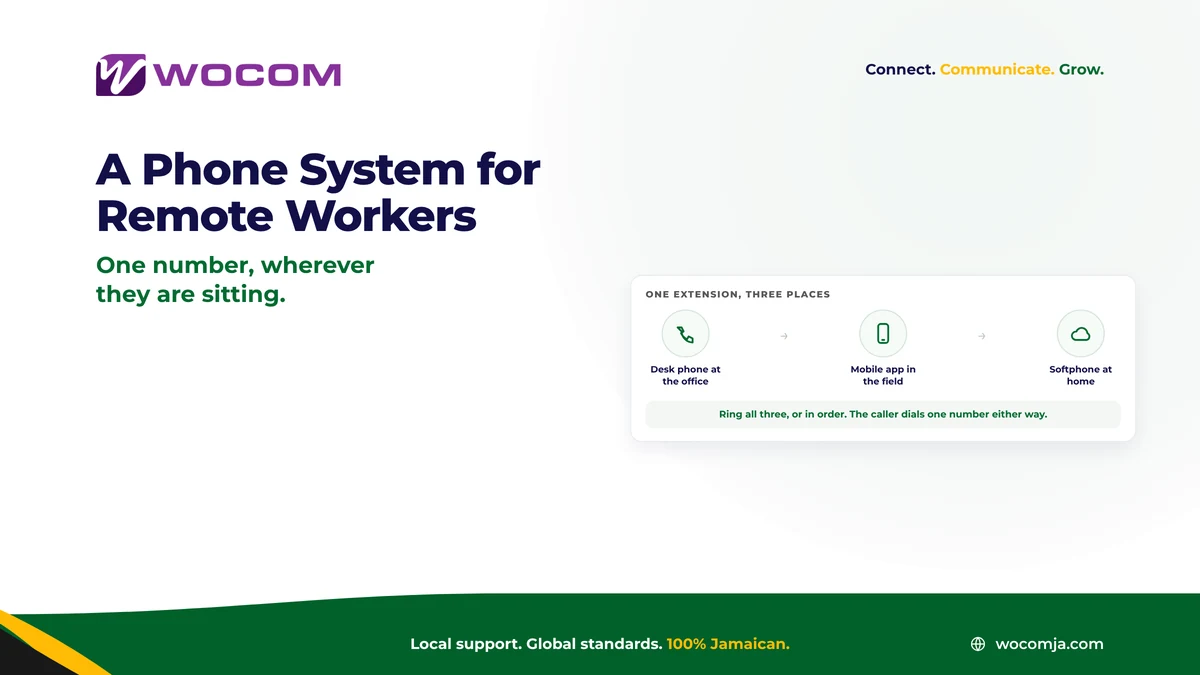
Half your team is in the office and half is at home or on the road — but your customers still dial one number and expect somebody to answer. This is how to build call routing that follows the person instead of the desk, why staff handing out personal mobile numbers is a business risk, and the settings that make a hybrid team sound like one office.

Read article →
The 30-Day VoIP Migration Checklist: A Week-by-Week Plan for Switching Without Downtime Migration Guide

The 30-Day VoIP Migration Checklist: A Week-by-Week Plan for Switching Without Downtime

Moving a business phone system fails for boring reasons: a number nobody knew was published, an alarm line on a circuit that got cancelled, a port submitted with the wrong account name. This is the week-by-week plan we run with clients — four weeks, named owners, a cut-over runbook, and a rollback trigger agreed before anyone touches anything.

Read article →
VoIP Codecs Explained: G.711 vs G.729 and When Each One Is the Right Choice SIP Trunking

VoIP Codecs Explained: G.711 vs G.729 and When Each One Is the Right Choice

G.711 sends your voice uncompressed at about 87 kbps a call and sounds like a landline. G.729 compresses it to roughly 31 kbps and fits three times as many calls down the same link, at a measurable cost in quality. Here is what each codec actually does, what it breaks, and how to choose between them for a Jamaican business.

Read article →
Configuring QoS for Voice: Step-by-Step Router Guides for Cisco, Ubiquiti and SonicWall SIP Trunking

Configuring QoS for Voice: Step-by-Step Router Guides for Cisco, Ubiquiti and SonicWall

Choppy calls on a connection that tests fine are almost always a queueing problem, not a bandwidth problem. This is the practical guide to fixing it: what to measure first, the two settings that matter more than everything else combined, and working configurations for Cisco IOS, Ubiquiti UniFi and EdgeRouter, and SonicWall — with the verification commands to prove it worked.

Read article →
How to Write a Telecom RFP: A Free Template and Scoring Framework for Enterprise Buyers Business Growth

How to Write a Telecom RFP: A Free Template and Scoring Framework for Enterprise Buyers

A telecom RFP is not paperwork — it is the only mechanism that makes three vendor proposals genuinely comparable. This guide walks through every section a buyer needs, the questions that separate a licensed network operator from a reseller, and a weighted scoring framework that stops the cheapest bid from winning by default. Includes a free, vendor-neutral RFP template in Word and PDF.

Read article →
CapEx vs OpEx: Should Your Business Buy a Phone System or Subscribe to One? Business Growth

CapEx vs OpEx: Should Your Business Buy a Phone System or Subscribe to One?

Buying a phone system is a capital purchase — a large cheque, an asset on the books, and a depreciation schedule. Subscribing is an operating cost — a flat monthly figure and nothing to own. Here is the honest financial comparison for a Jamaican business, including the point where ownership genuinely becomes cheaper, and what the subscription premium actually buys you.

Read article →
The Hidden Costs of Legacy Landlines: What Copper Really Charges a Jamaican Business Business Growth

The Hidden Costs of Legacy Landlines: What Copper Really Charges a Jamaican Business

Ask a Jamaican business owner what their phone lines cost and you will get one number — the monthly rental. That number is usually less than half of what the lines actually take out of the business each year. Here is the full accounting: maintenance contracts and technician call-outs, the 25% telephone rate of GCT, and the hardware replacement cycle nobody budgets for until the day the system dies.

Read article →
Virtual Fax Jamaica: Receive and Send Faxes Without a Physical Fax Machine Migration Guide

Virtual Fax Jamaica: Receive and Send Faxes Without a Physical Fax Machine

Thousands of Jamaican businesses — law firms, medical clinics, accountants, and government suppliers — still depend on fax for official documents but struggle with ageing machines that jam, break down, and require dedicated analogue lines. Virtual fax replaces the hardware entirely: incoming faxes arrive as PDF attachments in your email inbox, and you send from a browser with no machine required. Here is how it works, what it costs, and how to migrate without a day of downtime.

Read article →

Page 7 of 17 · 401 articles

⭐ Enjoying the WOCOM blog?
Make WOCOM your preferred source on Google — one tap and you'll see more of our insights right in your Search results.
Google Add WOCOM →

👋 Thank you for visiting! I'm here to assist you with your voice and AI questions.

WOCOM Sales

Online

Start a conversation

Please share your details so our team can assist you better.

Please enter your name and a valid email.

Connecting you with an agent...

Please wait while we find the best available representative