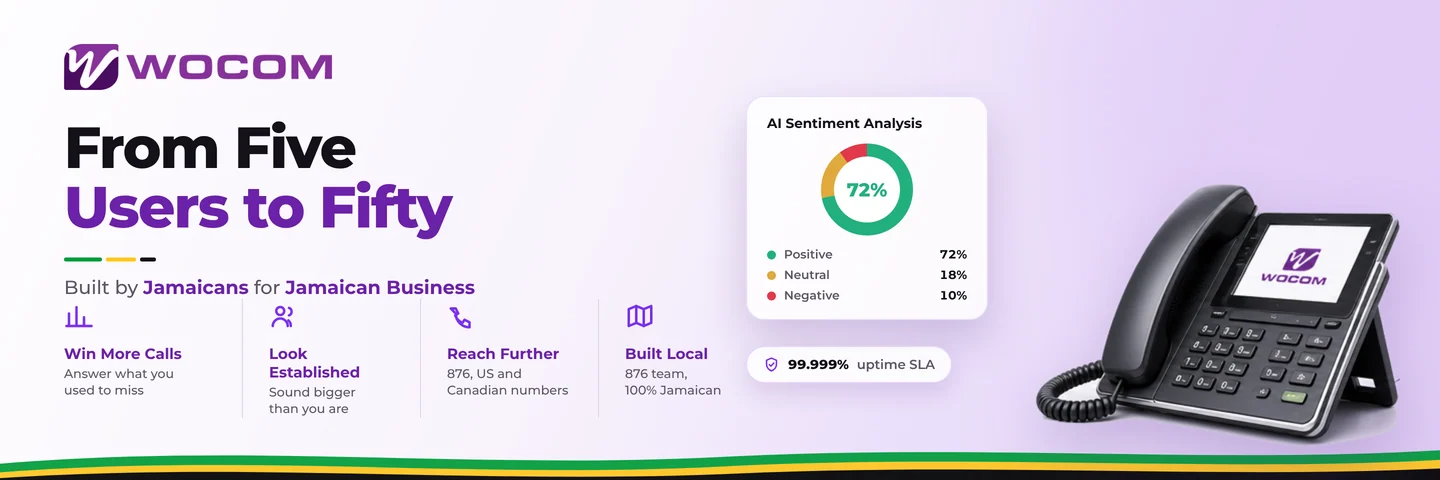
From Five Users to Fifty: What Breaks in a Phone System as You Grow
Growing businesses rarely rebuild their phone setup. They add to it, one person at a time, until the arrangement that was perfect for five people is quietly failing for thirty. The failures are predictable enough to plan for.
Five to ten: everyone answers everything
At this size a single ring group works. A call comes in, several phones ring, whoever is free picks up. It is simple and it is genuinely the right answer.
What to get right now, because it is much harder later: put the main number on the business rather than on a person, and give everyone an extension from day one. Businesses that skip this end up with customers who ring one individual's mobile, and unpicking that at thirty people is painful. The small business guide covers the starting setup.
Ten to twenty: the everybody-rings model breaks
The first real failure point. When eight phones ring for every call, people stop answering — each assumes somebody else will. Answer times get worse even though headcount went up.
The fix is departments: sales, accounts, support, each with its own group, fed by a short menu. Two rules make it work — no more than four options, and a way to reach a person without choosing any of them.
This is also where reporting starts to matter. Below ten people somebody notices a missed call. Above ten, nobody does, and you need the numbers to know.
Twenty to thirty-five: queues, and the first hire decided by data
Menus alone stop being enough when calls arrive faster than they can be handled. Callers reaching a busy department get engaged tone or voicemail, and both lose business.
A queue holds the caller in order with a position announcement. It is a substantially better experience than being cut off, and it produces the first genuinely useful piece of management information: how long people wait and when they give up. That number, and not a hunch, tells you whether the next hire should answer phones.
Thirty-five to fifty: supervision and specialisation
Two things change. Call handling becomes a role rather than something everyone does between other work, which means the people doing it need coaching — and coaching needs recordings and quality review rather than impressions.
The second is capacity planning. At this size simultaneous calls are high enough that channel capacity is a real constraint, and worth sizing from data rather than guesswork — see capacity planning. This is also the point where a business phone system starts turning into a contact centre, whether or not anybody calls it that.
What should not change on the way up
Three things should survive the whole journey. The main number stays the same. Extensions stay portable, so people keep their number as they change desks and roles. And the routing stays something a non-technical person can change — a system only a consultant can adjust stops being adjusted, and slowly drifts away from how the business actually works.
The cost shape
Per-user pricing means cost tracks headcount rather than stepping up in lumps when a hardware limit is hit. That is the main structural advantage of cloud at this stage: there is no version of “we need a bigger box” at user thirty-three. The cost guide works through the figures.
Frequently Asked Questions
At what size does a business need a menu rather than a ring group?
Usually somewhere between ten and fifteen users, when everybody-rings starts producing slower answers rather than faster ones.
When do we need call queues?
When callers regularly arrive faster than they can be answered — typically past twenty users, or earlier in a business with concentrated call peaks.
Do we have to change our number as we grow?
No. The main number should stay fixed throughout; what changes is the routing behind it.
How far can this scale before it becomes a contact centre?
It is less about headcount than about whether answering calls is a job in itself. Once it is, queue management, recording and supervision are what you actually need.
Getting started
The useful exercise is to look one stage ahead rather than at today. If you are at twelve people on a single ring group, the department split is the next change worth making. The Cloud PBX page covers what is included at every size.
Continue exploring
Ready to upgrade your communications?
Talk to our team about the right solution for your business.
Book a Demo Contact SalesMichelle Goss is a data and AI analyst at WOCOM, where she studies how Jamaican businesses use voice, messaging and AI to win and keep customers. With a BSc in Data Science & Analytics, she turns call data, customer trends and AI receptionist performance into practical guidance owners can act on. Michelle writes WOCOM's coverage of AI call handling, call analytics, customer growth and industry trends.