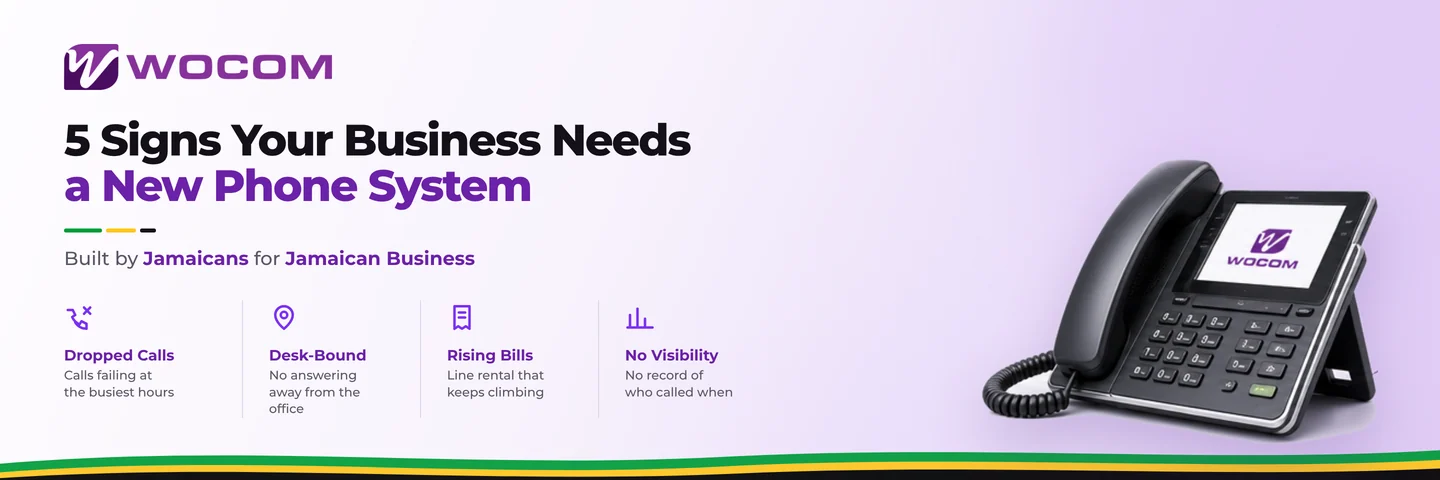
Five Signs Your Business Needs a New Phone System (Not Just a Repair)
Phone systems rarely fail outright. They degrade, and the business adapts around them — a workaround here, a personal mobile there — until the workarounds are the system. By then the cost is being paid daily in missed calls rather than annually in an invoice.
These are the five symptoms that mean the system itself is the problem. If you recognise three, it is worth pricing a replacement. If you recognise all five, the system has already been replaced by improvisation.
1. Calls fail at exactly the wrong hour
The complaint is always the same shape: it is fine most of the day, and unusable between eleven and one. That is not a fault, it is a capacity limit. The system has a fixed number of lines and your busiest hour exceeds them, so callers get engaged tone or silence at the moment they most want to buy something.
The tell is that the problem is predictable. Genuine faults are erratic; capacity limits arrive on schedule. On a modern system capacity is a number that gets changed, not a physical limit that requires an engineer.
2. Nobody can answer away from their desk
If a member of staff has to be sitting at a particular desk to receive their calls, the system was designed for a way of working that no longer exists. What follows is predictable: people hand out personal mobile numbers, the business loses sight of those conversations, and the customer relationship transfers to the individual rather than the company.
The fix is an extension that belongs to the person and rings wherever they are — covered in the work from home phone system guide.
3. Every change needs somebody to come out
Adding a person, changing an opening hour, redirecting a number for a public holiday — if any of these require a call-out, a job number and a wait, the system is charging you for its own inflexibility.
The real cost is not the fee. It is the changes you stop making because they are too much trouble, which is why so many businesses run all year on the routing somebody configured once.
4. The bill goes up and the service does not
Line rental rises, call rates stay where they are, and nothing new appears in return. Meanwhile the maintenance contract covers a system whose spare parts are getting harder to find.
Two costs are worth adding up before renewing anything: the annual line rental for lines that are rarely all in use at once, and the maintenance contract on hardware that is past its supported life. Legacy PBX end-of-life covers when keeping costs more than replacing.
5. You cannot answer “how many calls did we miss?”
This is the one that decides it. If nobody in the business can say how many calls came in yesterday, how many went unanswered, and at what time — then every decision about staffing and opening hours is being made on impression.
Businesses that get this data are usually surprised twice: by how many calls arrive before opening, and by how many are abandoned in a specific twenty-minute window. Both are fixable, but only once they are visible.
What replacing it actually involves
Less disruption than most expect, because the disruptive parts — numbers and handsets — usually stay. Numbers port across and keep working. Many existing handsets can be reused. The switch itself is generally an evening, and the old system can stay live in parallel until the new one is proven.
If your concern is growth rather than failure, the companion piece to this one is 5 signs your business has outgrown its phone system, which looks at the same decision from the other direction.
Frequently Asked Questions
How long should a business phone system last?
Traditional hardware typically runs seven to ten years before support and spare parts become the limiting factor. A cloud system does not age the same way, because the switching is maintained by the provider.
Can I keep my numbers if I replace the system?
Yes. Numbers port between licensed providers and keep working throughout. Porting is usually the longest step, and it runs in the background.
Will I have to buy all new handsets?
Often not. Many SIP handsets can be reconfigured for a new system. Older analogue handsets can be kept through a gateway where a business wants to preserve them.
How much downtime is involved?
Typically none during business hours. The cutover is scheduled outside working time, and the old lines stay available until the new service is confirmed working.
What if only part of the system is the problem?
That happens, and it is worth diagnosing before replacing. A capacity limit or a poor internet connection can look exactly like a failing phone system.
Getting started
The cheapest first step costs nothing: count last month's missed calls and note the hour they cluster in. If the system cannot tell you, that is the fifth sign. The Cloud PBX page covers what a replacement includes, and pricing has the figures.
Continue exploring
Ready to upgrade your communications?
Talk to our team about the right solution for your business.
Book a Demo Contact SalesEverett Kildare is WOCOM's voice and infrastructure specialist, with more than 25 years of experience designing and running carrier-grade voice, SIP and virtualization infrastructure. Holding a BSc in Information Technology, he has built, secured and migrated phone systems for businesses of every size. Everett writes WOCOM's technical coverage of SIP trunking, cloud PBX, contact centres, business continuity and migration.