PABX Maintenance Contracts Jamaica: What You're Really Paying For
The Contract You Sign and Then Stop Reading
When a Jamaican business installs a PABX — a Panasonic, NEC, Avaya, or similar — the sale almost always comes with a maintenance agreement. The first year it feels reassuring: someone is responsible if something breaks. By the fourth or fifth renewal, most business owners sign without reviewing it. The system is running, the price has crept up modestly each year, and changing anything feels risky.
That is exactly when the contract deserves a hard look. The maintenance fee is just one line in a total cost picture that includes analogue line rental, ad hoc parts, proprietary handsets, and the invisible cost of features you simply cannot have on ageing hardware. This guide walks through each layer so you can make a clear-eyed decision at your next renewal date.
What a Typical PABX Maintenance Contract Covers in Jamaica
Standard PABX maintenance agreements offered by Jamaican telecoms and hardware resellers generally include:
- One or two preventive maintenance visits per year
- Emergency fault response, usually with a 24- to 72-hour SLA depending on the contract tier
- Minor parts replacement up to a defined threshold
- Extension and line troubleshooting
- Software support for the currently installed version
That list sounds complete until you read what is excluded. Most agreements do not cover replacement of major cards or boards, damage from lightning or power surge (a real exposure in Jamaica's wet season), cabling faults, IP handset failures, or any upgrade to a newer software version. Those items generate separate invoices.
The Hidden Costs Your Maintenance Invoice Does Not Show
Businesses that track their telecom spend carefully often find the annual maintenance fee is the smallest part of their true PABX cost. The larger number comes from these recurring and unpredictable items:
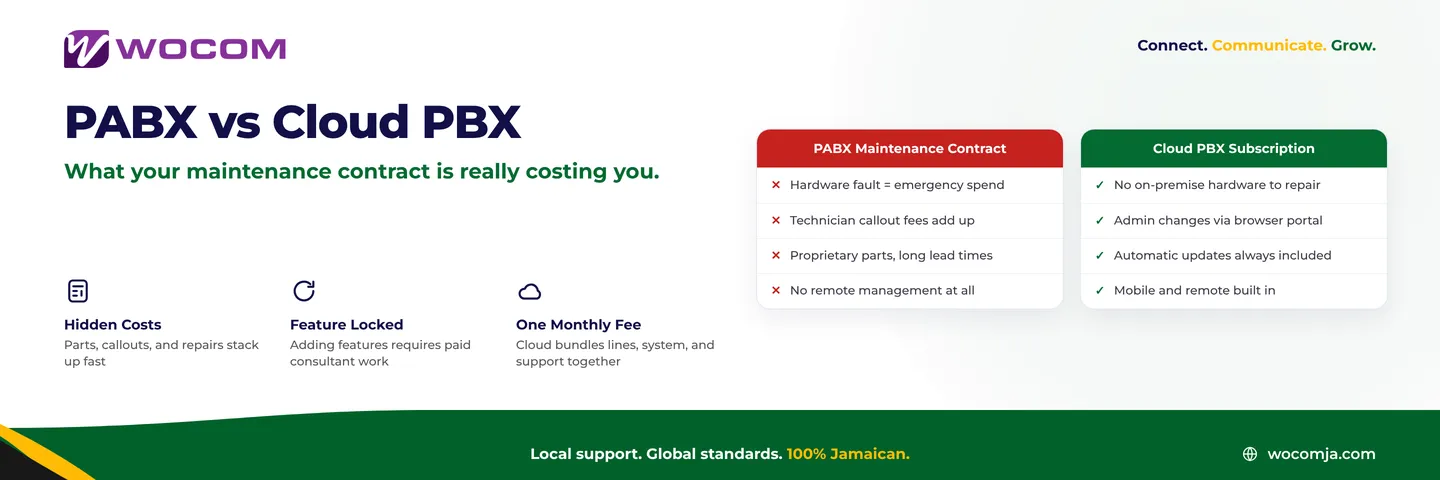
Analogue line rental. A PABX connects to the public network through analogue PSTN lines or a PRI circuit. These are separate contracts entirely and carry a monthly rental charge regardless of how many calls you make. A business with four to eight analogue lines is paying line rental every month on top of call charges and the maintenance agreement.
Hardware parts. Station cards, trunk modules, and power supply units for systems manufactured before 2020 are increasingly difficult to source locally. When a part must come from a regional distributor in Miami or Panama, the wait can stretch to several business days — during which trunks are reduced and callers get busy signals or incorrect routing.
Callout fees above contract allowance. Many contracts include two emergency callouts per year. A fault that falls outside that allowance, or outside business hours, typically attracts an additional charge. A business that has two covered callouts and then experiences a third fault in the same contract year pays the full emergency rate.
Proprietary handsets. Adding a desk phone to a PABX means buying a handset from the same manufacturer family. Sourcing new Panasonic KX or NEC DT series phones in Kingston or Montego Bay has become harder as supply chains shift. When replacements are available, unit prices reflect the scarcity.
Software upgrades. Moving a PABX to a newer software major version — the kind that adds voicemail-to-email, basic call recording, or queue handling — is not a setting change. It requires either a paid engagement with the original installer or a manufacturer-certified partner. For many systems reaching end-of-life, that upgrade is no longer available at any price.
What Changes When You Move to Cloud PBX
Cloud PBX removes the hardware layer from your premises entirely. The phone system runs on managed infrastructure maintained by the provider. For a Jamaican business, the practical changes are immediate:
No maintenance contract. There is no physical box on site requiring service visits. Platform faults are handled by the provider's engineering team, typically resolved before most businesses are even aware of an issue.
Lines and system in one invoice. A cloud PBX paired with SIP trunking consolidates your calling channels and your phone system into a single monthly charge. The analogue line rental disappears.
Updates included. New features — call recording, IVR changes, ring group adjustments, call analytics, AI receptionist capability — roll out as part of the subscription. There is no separate upgrade project and no consultant fee.
Any handset, any device. Cloud PBX is SIP-based. Staff can use a brand-name IP desk phone, a laptop softphone, or a mobile app. You are not tied to one manufacturer's handset range.
Administrator self-service. Adding a user, changing a routing rule, updating a voicemail greeting, or creating a new IVR branch takes minutes in a browser. No technician needs to visit your office in New Kingston, Spanish Town, or Half Way Tree.
Running the Comparison Honestly
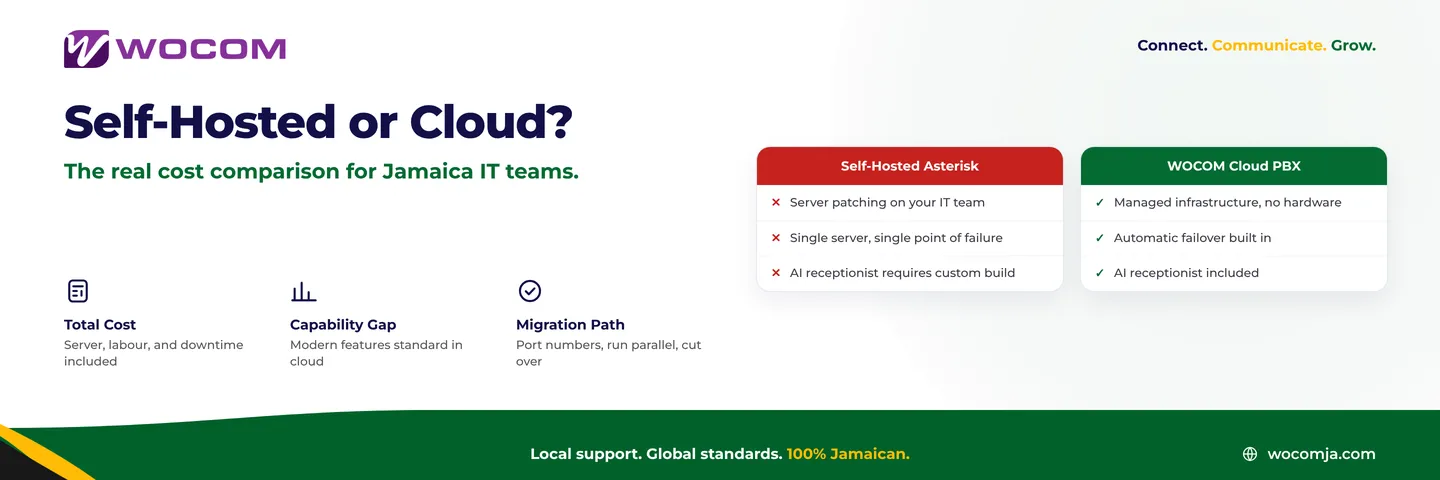
When businesses in Jamaica total their PABX cost — maintenance contract, analogue line rental, ad hoc callouts, and parts averaged over three years — the figure is often substantially higher than the equivalent cloud PBX and SIP trunk subscription for the same number of users and channels.
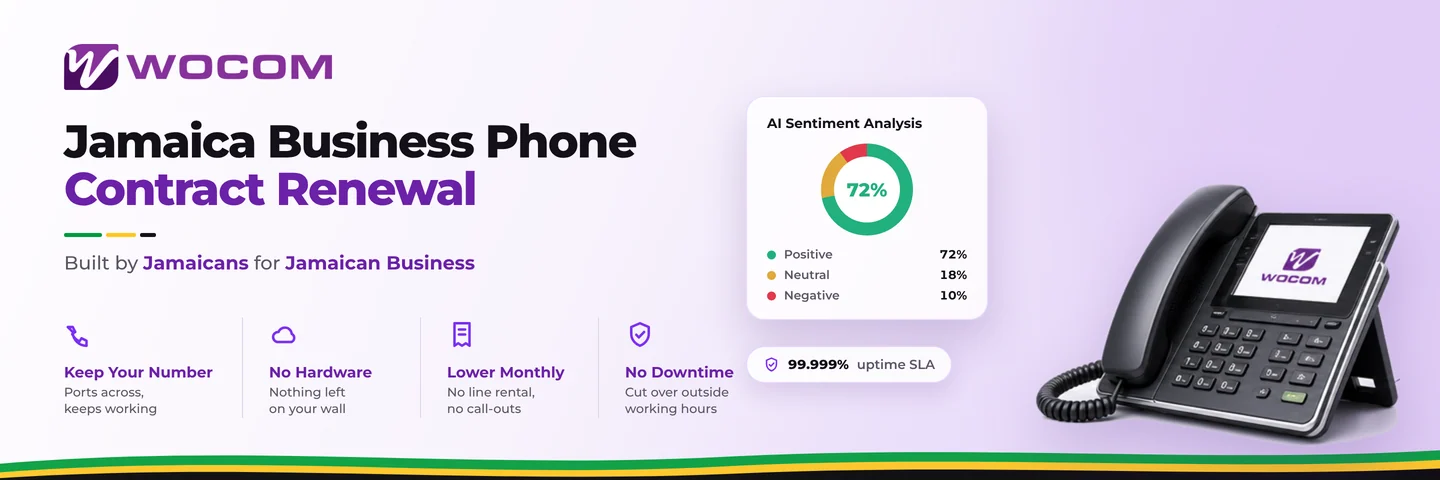
The gap widens further when you account for what cloud adds that legacy hardware simply cannot deliver: AI-powered call handling, call recording with searchable transcripts, real-time call analytics, mobile extensions for field staff, and automatic failover to a mobile or alternate route if your internet connection degrades.
A useful exercise before your next renewal is to gather three numbers: the total paid to your maintenance provider over the last 24 months (contract fees, callouts, parts, handsets), the total monthly analogue line rental, and the number of extensions you actually use. Those inputs are usually enough to model whether a migration makes financial sense.
When to Move Early vs Running to Contract End
If your current maintenance contract expires within six months, the practical advice is to run to term. Migration logistics and any early-exit clause in the existing agreement rarely justify moving ahead of natural renewal.
If you have twelve months or more remaining and your PABX is showing signs of age — intermittent trunk drops, board faults, difficulty sourcing parts — the calculation shifts. An honest look at downtime cost per hour versus the remaining contract value often changes the maths considerably.
Useful questions to put to your current provider at renewal time: Is this software version still supported by the manufacturer? Can I add cloud extensions or mobile access without a hardware upgrade? What is the parts replacement threshold in the contract, and what happens when a major board fails outside that limit?
If the answers reveal gaps, those are legitimate grounds to begin a migration conversation rather than auto-renewing.
Get a Phone System Cost Review from WOCOM
WOCOM provides cloud PBX and SIP trunking to businesses across Jamaica — from single-location offices in Kingston to multi-site operations in Montego Bay, Mandeville, and beyond. We can audit your current phone system costs at no charge: your maintenance contract, line rental, and call spend against a cloud subscription sized to your actual team.
If cloud makes sense for your business, we handle the migration. If the timing is not right, you leave the conversation knowing exactly what your current setup costs. Contact WOCOM today to book your free phone system review.
Continue exploring
Ready to upgrade your communications?
Talk to our team about the right solution for your business.
Book a Demo Contact SalesEverett Kildare is WOCOM's voice and infrastructure specialist, with more than 25 years of experience designing and running carrier-grade voice, SIP and virtualization infrastructure. Holding a BSc in Information Technology, he has built, secured and migrated phone systems for businesses of every size. Everett writes WOCOM's technical coverage of SIP trunking, cloud PBX, contact centres, business continuity and migration.