Call Centre Quality Monitoring Jamaica: Coach Better Agents and Improve Every Customer Call
Why Quality Monitoring Is Non-Negotiable for Jamaica Contact Centres
Your agents handle dozens — sometimes hundreds — of customer interactions every day. Without a system to evaluate those conversations, you are flying blind. One agent might close inquiries smoothly while another frustrates callers without realising it, and your overall customer satisfaction numbers suffer without you ever knowing why.
Quality monitoring bridges that gap. It gives supervisors the data and tools to hear what is actually happening on the floor, spot gaps in agent performance, and correct them before they become expensive problems. For Jamaica businesses competing on service — whether you run a five-seat team in Kingston or a fifty-seat BPO in Montego Bay — it is the difference between a contact centre that retains customers and one that quietly drives them away.
The Core Supervision Tools: Listen-In, Barge-In, and Whisper Coaching
Modern cloud contact centre platforms, including the one WOCOM provides, offer three live call supervision tools that every Jamaican call centre supervisor should know how to use:
- Listen-In (Silent Monitoring): The supervisor joins a live call without either party knowing. You hear the full conversation in real time. Ideal for spot-checks, monitoring newly onboarded agents, or reviewing how a difficult escalation is being handled before it spirals.
- Barge-In: The supervisor joins the call and can speak to both the agent and the customer simultaneously. Used when a call is going seriously off-course — an angry escalation, a compliance risk, or a situation where the agent needs immediate backup.
- Whisper Coaching: The supervisor speaks only to the agent during a live call, without the customer hearing a word. The agent receives real-time guidance — a suggested answer, a pricing reminder, a de-escalation cue — while the conversation continues naturally for the caller.
These three tools alone can dramatically compress a new agent's learning curve. Instead of discovering mistakes in a post-shift debrief, agents get coached in the moment, while the context is still fresh and the behaviour is still correctable.
Call Recording: Your Most Valuable Training Asset
Every call your contact centre handles is a potential training case study. A cloud contact centre with built-in call recording captures these interactions automatically, stores them securely, and makes them searchable and reviewable at any time.
Here is how Jamaica contact centres use recorded calls effectively:
- New hire onboarding: Play examples of your best-performing agents handling common scenarios — not scripts from a printed manual, but real calls that demonstrate tone, pacing, and how to handle objections in practice.
- Complaint resolution: When a customer calls back to escalate, supervisors can pull the original call immediately rather than relying on the agent's recollection of what was or was not said.
- Compliance documentation: Jamaica financial services firms, insurance providers, and healthcare contact centres increasingly need documented evidence of what was communicated to customers. Recorded calls serve as that record, and cloud storage means they are retrievable for months or years.
- Targeted coaching sessions: Rather than vague feedback like "you need to sound more confident," a supervisor can reference a specific call, a specific exchange, and explain exactly what a stronger response would have looked like.
A well-run Jamaica contact centre does not just store call recordings — it mines them to build institutional knowledge that makes every new hire better, faster.
Building a QA Scorecard That Works for Your Team
Listening to calls without a structured scoring framework produces inconsistent, subjective evaluations. One supervisor might rate a call a 7 out of 10 while another gives that same call a 4. A QA scorecard standardises the process so that agent performance is measured fairly and consistently across your entire team.
A practical scorecard for a Jamaican contact centre typically covers these categories:
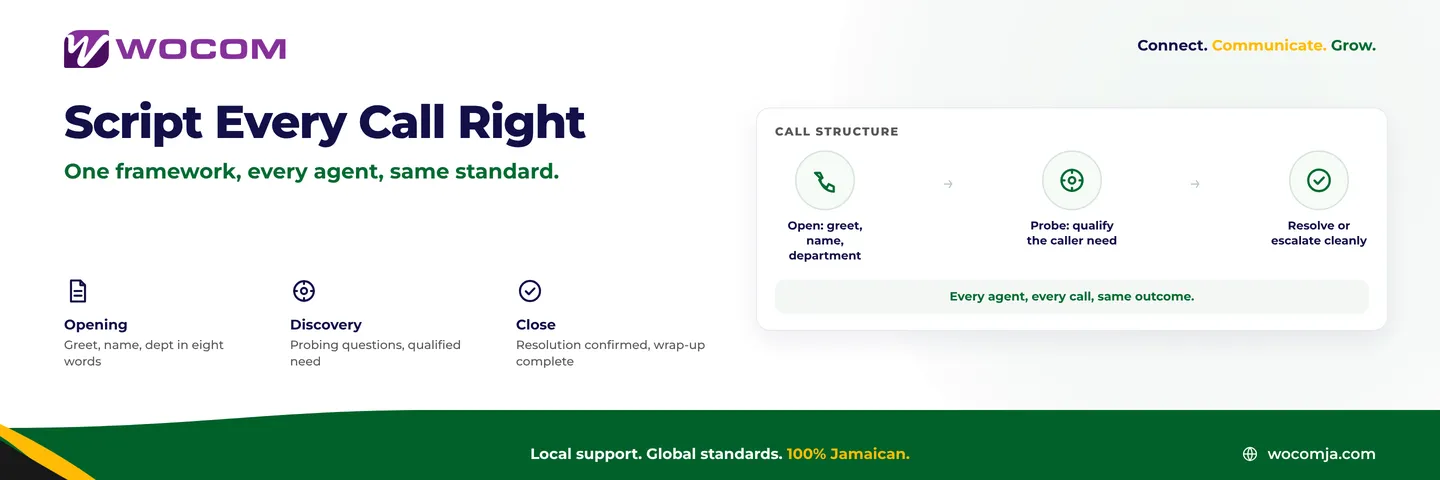
- Greeting and identification — Did the agent answer professionally, state the company name, and identify themselves clearly?
- Problem comprehension — Did the agent correctly understand what the customer needed without making them repeat themselves?
- Accuracy of information — Were the details provided correct — pricing, account details, product features, policy terms?
- Hold procedure — Was the customer informed before being placed on hold, and was hold time reasonable?
- First-call resolution — Was the issue resolved during this interaction, or did the customer need to call back?
- Close and follow-up — Did the agent confirm the customer's satisfaction and summarise any next steps before ending the call?
Weight each category based on what matters most to your specific operation. A debt collection contact centre will prioritise compliance and accuracy. A sales team will weight objection handling and conversion rate more heavily. Customise the scorecard to reflect what good looks like for your business, not some generic template.
Wallboards and Live Performance Dashboards
Real-time visibility is one of the most underutilised advantages of cloud-based contact centre software. A wallboard — a live display showing queue depth, current wait times, calls handled per agent, and abandonment rate — gives supervisors and agents alike an at-a-glance picture of how the floor is performing right now, not how it performed yesterday.
When a queue starts building, a supervisor can immediately open an additional channel, pull an agent from lower-priority work, or trigger an overflow routing rule — decisions based on live data rather than gut instinct. For Jamaica contact centres managing peak periods such as end-of-month billing queries, holiday season sales spikes, or post-hurricane insurance claim surges, this real-time awareness is invaluable.
Cloud platforms deliver these dashboards through a standard web browser. A supervisor based in Montego Bay can monitor a Kingston team's live performance without being in the same building — or the same parish.
How Cloud Contact Centre Makes This Affordable for Jamaica Businesses
The supervision tools described above used to require significant on-premise hardware investment and dedicated IT support. A Jamaica contact centre would need a substantial capital outlay before implementing structured QA at any meaningful scale.
Cloud-based contact centre changes that equation completely. WOCOM's platform delivers listen-in, barge-in, whisper coaching, call recording, and live performance dashboards as part of a fully hosted service — no servers to buy, no complex infrastructure to manage. You add seats as your team grows and pay for what you actually use.
For smaller Jamaican call centres running five to fifteen agents, this means access to enterprise-grade supervision tools that were previously only available to large BPOs with deep IT budgets. For established contact centres looking to migrate from legacy on-premise systems, WOCOM's team handles number porting, hardware provisioning, and staff training so your floor keeps running through the transition.
Ready to Build a Higher-Standard Contact Centre?
WOCOM works with contact centres and customer service teams across Jamaica — from Kingston financial services operations to Montego Bay hospitality and BPO teams. Our cloud contact centre platform includes the quality monitoring, call recording, live supervision, and real-time dashboard tools your supervisors need to consistently deliver excellent customer experiences and develop agents who are genuinely good at their jobs.
Visit wocomja.com/contact or speak with a contact centre specialist today. We will assess your current setup and show you exactly what a structured quality monitoring programme would look like for your team — at a price point that makes sense for your operation.
Continue exploring
Ready to upgrade your communications?
Talk to our team about the right solution for your business.
Book a Demo Contact SalesEverett Kildare is WOCOM's voice and infrastructure specialist, with more than 25 years of experience designing and running carrier-grade voice, SIP and virtualization infrastructure. Holding a BSc in Information Technology, he has built, secured and migrated phone systems for businesses of every size. Everett writes WOCOM's technical coverage of SIP trunking, cloud PBX, contact centres, business continuity and migration.