The Complete Guide to SIP Trunking for Jamaican Business
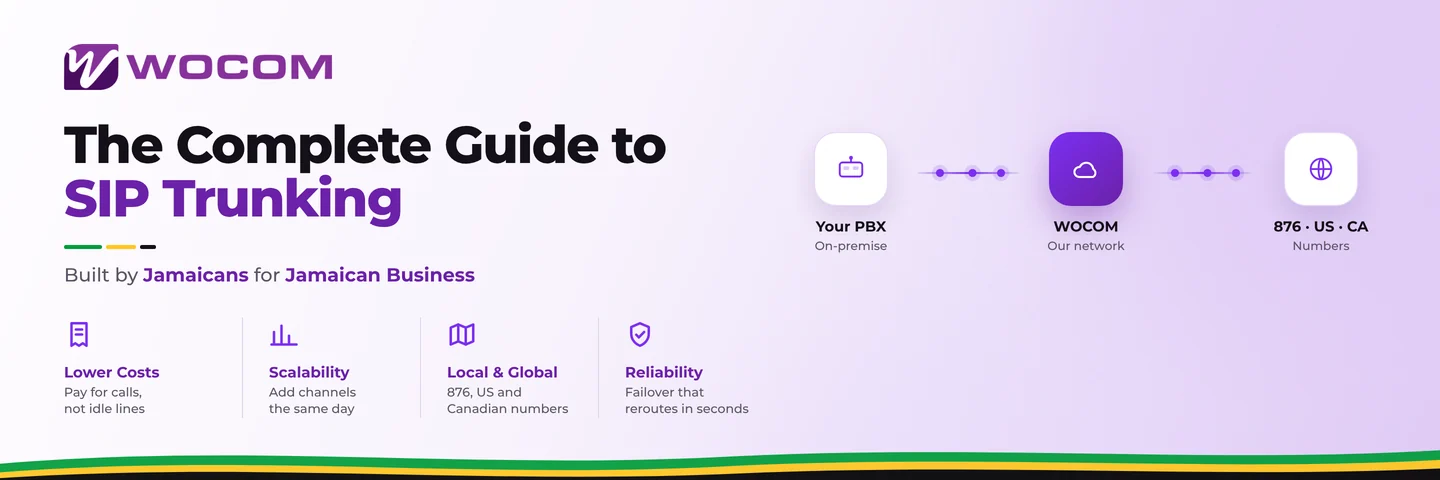
SIP trunking is a way of delivering phone calls over your internet connection instead of over old copper lines, using a protocol called SIP (Session Initiation Protocol) to set up, manage and end each call. In plain terms, a SIP trunk is a virtual "pipe" that connects your phone system to the public telephone network through a provider like WOCOM, carrying many simultaneous calls at once. For a Jamaican business, that means you can keep your 876 numbers, slash your call costs and scale your phone lines up or down with a few clicks rather than waiting weeks for an engineer to run new cabling.
This is the definitive guide to SIP trunking for Jamaican business. Whether you run a small office in New Kingston, a hotel in Montego Bay, a call centre in Portmore or a multi-branch operation across the island, this guide explains exactly what SIP trunking is, how it works, what it costs in Jamaican dollars, and how to choose a provider that will not let you down. If you want the wider context first, start with our ultimate guide to business phone systems in Jamaica and then come back here for the deep dive.
What is SIP trunking and how does it work?
Let us answer the most common question directly: what is SIP trunking? SIP trunking is the delivery of voice calls (and increasingly video and messaging) over an internet or private data connection using the Session Initiation Protocol. Instead of renting physical phone lines from a carrier, you rent virtual channels on a "trunk" that links your phone system to the global telephone network. The word "trunk" is borrowed from the old telephone world, where a trunk was the bundle of lines connecting one exchange to another. A SIP trunk does the same job, only it is software-defined and runs over the same internet connection your business already pays for.
The role of SIP, the protocol
SIP is the signalling protocol that does the "handshaking" for a call. When someone rings your business, SIP messages are exchanged to set up the call: who is calling whom, which codec to use, and where to send the audio. Once the call is connected, the actual voice audio travels as separate packets using a companion protocol called RTP (Real-time Transport Protocol). SIP also handles holding, transferring and ending the call. It is the same protocol family that underpins most modern unified-communications platforms, which is why SIP trunking integrates so cleanly with cloud phone systems.
Channels and concurrent calls
The single most important concept in SIP trunking is the channel, sometimes called a session or a concurrent call path. One channel equals one simultaneous call. If you buy a SIP trunk with ten channels, your business can have ten conversations happening at the same moment. The eleventh caller would get a busy tone or be diverted, unless you have overflow handling in place. This is the opposite of the old "one line, one number" thinking. With SIP, your phone numbers (DIDs) and your channels are decoupled: you might have fifty 876 numbers pointed at a trunk that only needs eight channels, because not everyone calls at once. Sizing channels correctly is part art, part maths, and a good provider will help you model it against your busy-hour traffic.
Codecs: how voice is compressed
A codec (coder-decoder) determines how your voice is digitised and compressed for transit. The two you will hear about most are G.711, which offers excellent, near-landline quality but uses more bandwidth (around 87 kbps per call), and G.729, which compresses harder (around 31 kbps per call) at a small cost to fidelity. For most Jamaican offices on a solid fibre or fixed-wireless link, G.711 is the comfortable default. Where bandwidth is tight, or for branches connecting back over a constrained link, G.729 stretches your capacity further. WOCOM supports both and can negotiate the best codec automatically per call.
DIDs: your phone numbers
A DID (Direct Inward Dial) is simply a phone number that routes a call directly to a destination on your trunk. Your existing 876 numbers are DIDs. You can buy new local Kingston or Montego Bay numbers, vanity numbers, or numbers in other markets, and point any of them at extensions, departments, ring groups or your Cloud PBX. DIDs and channels are billed separately, which is what makes SIP so flexible: add a hundred numbers for a marketing campaign without adding a single channel if those numbers feed an automated line.
SIP trunk vs PRI vs analogue lines
To understand why SIP trunking has taken over, it helps to know what came before. There are three broad ways a business connects to the telephone network, and most Jamaican firms are still running on the older two.
Analogue lines (POTS)
The plain old telephone line is the technology in most homes and small shops. Each line carries exactly one call and ties to one number. To handle five simultaneous calls you need five physical lines, five sets of copper, and a hunt group configured by the carrier. Analogue is simple and resilient during a power cut, but it is expensive to scale, slow to provision, and offers none of the features modern businesses expect. Adding a line can take days or weeks.
PRI (Primary Rate Interface)
PRI was the business standard for decades. It is a digital circuit, usually an E1 in our part of the world, delivering 30 voice channels over a single connection. PRI is reliable and high quality, but it is rigid: you buy channels in fixed blocks of 30, you pay for them whether you use them or not, the circuit is tied to one physical location, and if that building loses power or its line is cut, every number on it goes dark. Provisioning a PRI can take weeks and requires specialist hardware. We cover this head-to-head in detail in our dedicated SIP trunk vs PRI comparison.
SIP trunking
SIP trunking replaces both. It rides over your existing internet connection, scales one channel at a time, is not tied to a single building, and unlocks the full suite of modern features. Because it is software-defined, changes that took weeks on a PRI happen in minutes. The table later in this guide lays the three options side by side. The short version: analogue is for the corner shop, PRI is legacy, and SIP trunking is where serious Jamaican businesses are heading.
Benefits of SIP trunking for Jamaican business
The advantages are not abstract. Here is what SIP trunking actually delivers for a business operating in Jamaica.
Lower costs
- No line rental on copper. You stop paying for physical lines you barely use. You pay for channels and minutes instead, which maps far more closely to real usage.
- Cheaper calling, especially international. Calls between your own sites become free internal traffic. International termination to the US, UK and Cayman, the routes Jamaican businesses use most, is dramatically cheaper over SIP than over traditional metered lines.
- One bill, one network. Because WOCOM owns and operates its own network rather than reselling someone else's, there is no middle-man margin stacked on top of your minutes.
Scalability on demand
Need ten extra channels for the Christmas rush, or for a Reggae Sumfest ticket line in Montego Bay? Add them in minutes and remove them afterwards. You are never stuck buying a fixed block of 30 PRI channels to get the two you need. This elasticity is impossible with copper or PRI and is one of the strongest reasons growing businesses switch.
Keep your 876 numbers
Your phone number is part of your brand. Customers, suppliers and Google all know it. SIP trunking lets you port your existing 876 numbers across so they keep working exactly as before, just delivered over a smarter network. You lose nothing and gain everything. Number porting is covered in detail below.
Work from anywhere
Because a SIP trunk is not chained to one building, your team can take office calls from home in Portmore, from a hotel in Ocho Rios, or from a branch in Mandeville, using a softphone or desk phone that registers to the same system. During a hurricane, a flood, or a simple power cut at head office, your numbers keep ringing because they live in the network, not in your wiring cupboard.
A platform, not just a line
A SIP trunk is the foundation for everything else WOCOM offers: a full Cloud PBX with auto-attendants and call queues, our AI Receptionist Alex who answers around the clock and never puts a caller on hold, and a complete Contact Center for sales and support teams. For developers, our programmable SIP service lets you build call flows, notifications and integrations directly into your own applications.
What you need to get started
SIP trunking has a refreshingly short shopping list. Three things, and WOCOM helps with all of them.
1. An IP-PBX or cloud PBX
You need something to terminate the trunk and route calls to your people. This can be an on-premises IP-PBX (a physical or virtual box in your server room running software such as a SIP-capable PBX) or, far more commonly today, a hosted cloud-based system. If you already own an IP-PBX, a SIP trunk slots straight in. If you do not want to run any hardware at all, WOCOM's Cloud PBX gives you the phone system and the trunk together as one managed service.
2. Internet and bandwidth
SIP runs over your data connection, so a stable internet link matters. The rule of thumb is roughly 100 kbps in each direction per concurrent call on G.711, so a ten-channel trunk wants about 1 Mbps reserved for voice, with headroom on top. More important than raw speed is quality: low latency, low jitter and low packet loss. We strongly recommend prioritising voice traffic with QoS on your router, and where possible giving voice its own VLAN. A modern fibre or quality fixed-wireless connection in Kingston or Montego Bay handles this comfortably. WOCOM will help you assess whether your link is ready.
3. A licensed provider
This is where it matters most. WOCOM is a licensed Jamaican carrier that owns and operates its own network, supplies the SIP trunk, the DIDs, the channels and the 876 support behind it. Because we run the network end to end, we control the quality, the routing and the security rather than handing your traffic to a third party. You get local support from people who understand Jamaican business, not an overseas call queue.
SIP trunking pricing in Jamaica
One of the reasons SIP trunking is so attractive is that the pricing model is transparent and matches how you actually use the phone. There are three components, all framed in Jamaican dollars.
Per-channel charges
You pay a monthly fee for each concurrent channel (call path) you provision. This is your capacity. A small office might need four to eight channels; a busy contact centre in New Kingston might need fifty or more. Because you can add and remove channels easily, you size to your real busy-hour demand rather than over-buying "just in case".
Per-minute charges
Outbound calls are typically billed per minute, with rates that vary by destination. Calls to Jamaican mobiles and landlines are inexpensive; international routes to the US, UK and Cayman are billed at competitive per-minute rates that undercut traditional metered lines. Many businesses also choose bundled minute packages for predictability. Calls between your own WOCOM extensions and sites are free.
DID (number) charges
Each phone number carries a small monthly fee, separate from channels. Inbound minutes to your DIDs may be included or billed depending on your plan. Because numbers and channels are decoupled, you can hold dozens of 876 numbers cheaply without buying matching capacity.
What this means for your budget
- Predictable. Monthly channel and DID fees are fixed, so the bulk of your bill is known in advance.
- Usage-based. You only pay per-minute for the calls you actually make.
- No wasted capacity. Unlike a 30-channel PRI block, you pay only for the channels you provision.
For exact JMD figures tailored to your call volumes, our team will put together a quote based on your busy-hour traffic and international mix. Get in touch via our SIP trunk page for a costed proposal.
What a SIP trunking service includes in Jamaica
Pricing tells you what a SIP trunk costs. It does not tell you what you are actually being handed on day one — and that is where SIP trunking services in Jamaica differ most from one provider to the next. Two quotes at the same per-channel rate can describe very different amounts of work.
A complete service should cover all of the following without a separate line on the invoice:
- Provisioning and configuration — the trunk built and registered against your PBX, not a set of credentials emailed to you to figure out.
- Number porting — moving your existing 876 numbers across, including the paperwork and the coordination with the losing carrier.
- Channel capacity you can change — adding or removing concurrent calls as your season changes, without a new installation.
- Fraud monitoring and call limits — destination restrictions and spend caps applied by default rather than after an incident.
- Failover routing — an agreed destination for calls when your primary connection drops, configured before you need it.
- Local support with a named escalation path — someone in Jamaica who can look at your trunk rather than a ticket queue in another time zone.
When you compare providers, ask which of those six are included and which are chargeable. That list, more than the headline per-channel rate, is what separates a managed SIP trunking service from a set of login details.
Security: protecting your trunk from fraud
Because SIP trunks run over the internet, security is not optional, it is essential. Toll fraud, where criminals hijack a poorly secured trunk to dial premium-rate international numbers, can run up enormous bills overnight. The good news is that a properly configured trunk on a network like WOCOM's is well defended. Here is how.
Encryption: TLS and SRTP
Signalling can be encrypted with TLS (Transport Layer Security), the same technology that secures banking websites, so the SIP messages setting up your calls cannot be read or tampered with in transit. The audio itself is protected with SRTP (Secure Real-time Transport Protocol), which encrypts the voice packets. Together, TLS and SRTP mean your calls are private end to end.
IP whitelisting and authentication
WOCOM locks your trunk to known, authorised IP addresses and credentials, so only your phone system can register and place calls. Anything attempting to connect from an unknown source is rejected. Strong, unique SIP passwords and registration-based authentication add further layers.
Fraud detection and limits
- Real-time monitoring. Our network watches for the tell-tale signatures of fraud, such as a sudden burst of calls to unusual international destinations, and can block them automatically.
- Spend and destination caps. You can set ceilings on daily spend and bar high-risk destinations you never legitimately call.
- Rate limiting. Limits on calls per second and concurrent calls stop a compromised endpoint from doing serious damage.
Because WOCOM owns the network, these protections operate at the carrier level, not just on your PBX, which is a meaningful advantage over buying a trunk from a reseller who has no visibility into the underlying traffic.
Reliability, uptime and failover
A phone system that goes down takes your business with it. SIP trunking, done right, is actually more resilient than the copper it replaces, precisely because it is not tied to a single physical line into one building.
99.999% uptime SLA
WOCOM backs its SIP trunking with a 99.999% uptime service-level agreement, the "five nines" standard that translates to only a few minutes of permitted downtime across an entire year. We can offer this because we own and operate the network end to end, with redundant routing and carrier-grade infrastructure rather than a best-effort connection resold from elsewhere.
Failover and rerouting
The real magic is what happens when something goes wrong at your end. If your office internet drops, if there is a power cut in Half-Way-Tree, or if a branch goes offline, the network can automatically reroute your inbound calls to a pre-set destination: a mobile number, another branch, a voicemail-to-email box, or our AI Receptionist Alex who can keep answering and capturing messages until you are back. Because your numbers live in the network, a local outage never means a silent phone line. This kind of disaster recovery is simply impossible on a PRI or analogue line, where a cut cable means dead numbers.
Built for Jamaican conditions
Hurricanes, heavy rain and the odd power cut are facts of life here. SIP trunking with intelligent failover means a storm that knocks out one site does not knock out your business. Calls follow your people, wherever they are working from.
Migrating and porting your numbers
The most common worry we hear is "will I lose my number?" The answer is no. Number porting is a well-established, regulated process, and WOCOM manages it for you.
How porting works
- Audit. We list every 876 number you want to bring across and confirm the current details on record.
- Request. We submit the porting request and coordinate with your current provider. Your numbers keep working throughout, so there is no interruption to your business.
- Provisioning. In parallel, we set up your SIP trunk, channels and call routing so everything is ready and tested before the switch.
- Cutover. On the agreed date, your numbers move to WOCOM's network. The change is typically seamless and scheduled to minimise any impact.
A staged migration
You do not have to move everything at once. Many businesses run a SIP trunk alongside their existing lines first, test it with a few numbers, then port the rest once they are confident. WOCOM supports phased migrations so you switch at a pace that suits you. If you keep an existing IP-PBX, the trunk connects to it directly; if you are moving to our Cloud PBX, we migrate the phone system and the trunk together.
How to choose a SIP trunk provider
Not all SIP trunking is equal. The provider behind the trunk matters more than any single feature. Use this buyer's checklist when comparing options in Jamaica.
- Do they own the network? A provider that owns and operates its own licensed network controls quality, routing and security directly. A reseller is at the mercy of someone else's network and adds a margin on top. WOCOM owns its network.
- Is the uptime SLA in writing? Look for a genuine 99.999% commitment backed by redundant infrastructure, not a vague "we aim for reliability".
- Local 876 support. When something matters at 9am on a Monday, you want to reach a local team who understands Jamaican business, not an overseas queue.
- Fraud protection at the carrier level. Confirm there is real-time fraud monitoring, spend caps and encryption (TLS/SRTP), not just advice to secure your own PBX.
- Failover and disaster recovery. Can they reroute your calls automatically during an outage? Ask exactly how.
- Transparent JMD pricing. Clear per-channel, per-minute and per-DID pricing with no surprise fees.
- Number porting handled for you. They should manage the port end to end and keep your 876 numbers working throughout.
- Room to grow. Can the same provider give you Cloud PBX, an AI Receptionist, a Contact Center and programmable SIP when you need them? A single platform beats stitching vendors together.
Score any provider against these and the differences become obvious quickly. WOCOM was built to tick every box on this list.
| Factor | SIP Trunking | PRI | Analogue lines |
|---|---|---|---|
| Cost | Low; pay per channel and per minute, cheap international, no copper rental | High; fixed 30-channel blocks paid whether used or not | High per line; expensive to scale |
| Scalability | Instant; add or remove one channel at a time in minutes | Rigid; only in blocks of 30, weeks to provision | Slow; one physical line per call, days to add |
| Setup time | Days; software-defined over existing internet | Weeks; specialist circuit and hardware | Days to weeks; new cabling per line |
| Disaster recovery | Excellent; numbers live in the network, auto-reroute during outages | Poor; tied to one site, cut cable means dead numbers | Poor; tied to physical lines at one location |
| Remote / work-from-anywhere | Native; staff take calls from home or any branch via softphone | No; bound to the building it terminates in | No; bound to the physical handset and line |
Frequently asked questions
What is SIP trunking in simple terms?
SIP trunking is a way of making and receiving business phone calls over your internet connection instead of over traditional copper lines. A SIP trunk is a virtual pipe that connects your phone system to the telephone network and can carry several calls at once. It lets you keep your existing 876 numbers while cutting costs and adding flexibility.
Will I lose my existing 876 numbers if I switch?
No. Your numbers are ported across to WOCOM's network through a regulated process that keeps them working throughout. You keep every 876 number your customers already know, and WOCOM manages the whole port for you.
How many channels does my business need?
One channel handles one simultaneous call, so the answer depends on your busy-hour traffic, not your number of staff or DIDs. A small office often runs comfortably on four to eight channels, while a busy contact centre needs many more. WOCOM helps you size this against your real call patterns and you can adjust at any time.
Is SIP trunking reliable enough for a serious business?
Yes. WOCOM backs its SIP trunking with a 99.999% uptime SLA and, because we own and operate our own network, we provide automatic failover that reroutes your calls during a local outage or power cut. In practice it is more resilient than a PRI or analogue line, which go dead the moment the cable is cut.
How is SIP trunking different from a hosted Cloud PBX?
A SIP trunk is the connection that carries calls between your phone system and the telephone network. A Cloud PBX is the phone system itself, with extensions, menus, queues and voicemail. You can connect a WOCOM SIP trunk to your own IP-PBX, or take our Cloud PBX which bundles both together. Our complete guide to Cloud PBX in Jamaica explains the difference in full.
Can developers build their own call flows on SIP?
Yes. WOCOM offers programmable SIP, which lets your developers control calls, send notifications and integrate voice directly into your own applications and systems through an API, on top of the same owned network.
Ready to modernise your phone system? WOCOM is Jamaica's licensed business phone provider, and we own and operate the network behind every call. Whether you want a straightforward SIP trunk for an existing IP-PBX, a full Cloud PBX, our AI Receptionist Alex, or a complete Contact Center, our local 876 team will design the right setup and quote it in Jamaican dollars. Contact WOCOM today to get a costed SIP trunking proposal for your business.
Continue exploring
Ready to upgrade your communications?
Talk to our team about the right solution for your business.
Book a Demo Contact SalesEverett Kildare is WOCOM's voice and infrastructure specialist, with more than 25 years of experience designing and running carrier-grade voice, SIP and virtualization infrastructure. Holding a BSc in Information Technology, he has built, secured and migrated phone systems for businesses of every size. Everett writes WOCOM's technical coverage of SIP trunking, cloud PBX, contact centres, business continuity and migration.