How to Write a Telecom RFP: A Free Template and Scoring Framework for Enterprise Buyers
Most businesses do not run a formal procurement for phone service. They ask two or three providers for a quotation, receive three documents that measure completely different things, pick the lowest monthly figure, and discover eighteen months later what was not included.
A Request for Proposal fixes that — not because it is more formal, but because it forces every respondent to answer the same questions in the same order. That is the entire value. Comparability is the product.
This guide covers what belongs in a telecom RFP, the questions that reveal the difference between providers, and how to score the responses so the decision survives scrutiny. Everything described here is in the downloadable template below — vendor-neutral, editable, and free to use whether or not you ever speak to us.
Five decisions to make before you write a word
The quality of the proposals you receive is set before the document goes out. Settle these internally first:
- What is actually in scope. Voice only? Voice and connectivity? Contact centre? AI answering? An RFP that quietly includes internet access will produce proposals that cannot be compared with those that do not.
- Your real inventory. Sites, users per site, existing numbers, existing contracts and their expiry dates, peak concurrent calls. Providers cannot size a solution without this, and if you do not supply it they will guess — differently from one another.
- Must versus should. Every requirement marked “must” narrows the field. Mark too many and you eliminate good providers over features nobody uses. Walk the list with the people who actually answer the phones.
- Your evaluation weights. Decide what matters, and by how much, before proposals arrive. Weights agreed afterwards are weights fitted to a preferred answer.
- Who decides. Name the scorers and the approver. A committee that assembles after the deadline will spend three weeks re-litigating the requirements.
The thirteen sections a telecom RFP needs
| Section | What it does |
|---|---|
| 1. Purpose | States what you are buying and the contract term you intend to award |
| 2. Background and objectives | Gives context so providers can propose intelligently rather than generically |
| 3. Scope of services | The checklist of what is in and out — the single most important section |
| 4. Current environment | Sites, users, existing system, lines, numbers, call volumes, connectivity |
| 5. Functional requirements | The requirements matrix, with priority and a response code per row |
| 6. Technical requirements | Open questions on network, codecs, QoS, security, redundancy, porting |
| 7. Service levels and support | Uptime, response, restoration, escalation, credits — stated as requirements |
| 8. Implementation and migration | Plan, cut-over method, rollback, training, and what you must provide |
| 9. Pricing schedule | One-time, recurring, usage and commercial terms in a fixed format |
| 10. Respondent qualification | Licensing, network ownership, references, staffing |
| 11. Evaluation criteria | The weighted criteria you will score against |
| 12. Submission instructions | Format, deadline, question window, what must be attached |
| 13. General terms | No obligation to award, confidentiality, costs borne by respondents |
Three appendices carry the detail that would otherwise clutter the body: a site list, a number inventory to be ported, and a blank scoring sheet.
Download the RFP template
All thirteen sections, the requirements matrix, the pricing schedule, and the scoring sheet — ready to edit. It is deliberately vendor-neutral: there is no requirement in it that only WOCOM can meet, and you are welcome to send it to anyone.
Write the requirements matrix so answers cannot hide
The most common failure in a telecom RFP is a requirements list that invites the answer “yes.” Every provider says yes. You learn nothing.
Fix it with two columns. Give each requirement a priority — Must, Should, or Nice — and require a response code from a fixed set:
- S — supported as standard, included in the quoted price
- C — supported at additional cost (which must be itemised in Section 9)
- D — available in a future release, with a committed date
- N — not supported
That single change surfaces the gap between “we do that” and “we do that, and it is in the number we quoted you.” When you tally scores, count the Must rows answered S — that is your functional fit score, and it is defensible.
The questions that actually separate providers
Feature lists converge. These questions do not, and they belong in every telecom RFP:
- Do you own the network, or resell someone else’s? This determines who fixes your outage and how fast. Ask them to name upstream carriers. A reseller can be a fine choice — but you should know before you sign, not during a fault.
- What licences do you hold, and under what entity name? Then check the name matches the one on the contract.
- What happens to inbound calls when our site loses connectivity? The answer reveals whether call routing lives in their network or in a box in your building. If calls die with your internet, that is a design choice you should make knowingly.
- What is the porting timeline, and what portion do you handle? Number porting is where migrations slip. Ask who submits, who chases, and what happens if the losing provider rejects.
- How do you detect and cap fraud? Toll fraud on an unprotected trunk can run into six figures over one long weekend. Spend caps and destination blocking should be standard, not an upsell.
- What are the exit terms? Notice period, early termination charges, who owns the numbers, how quickly you can port out, and what happens to call recordings. Ask at the start; the answer is never better later.
- Attach your SLA and master service agreement. Not a summary — the documents. A commitment that appears only in a sales response is not a commitment.
Give respondents a realistic timeline
A five-day response window produces five days’ worth of thought. If you want tailored proposals with real pricing and a migration plan, allow fifteen working days from issue to deadline, and run the whole process across roughly eight weeks.
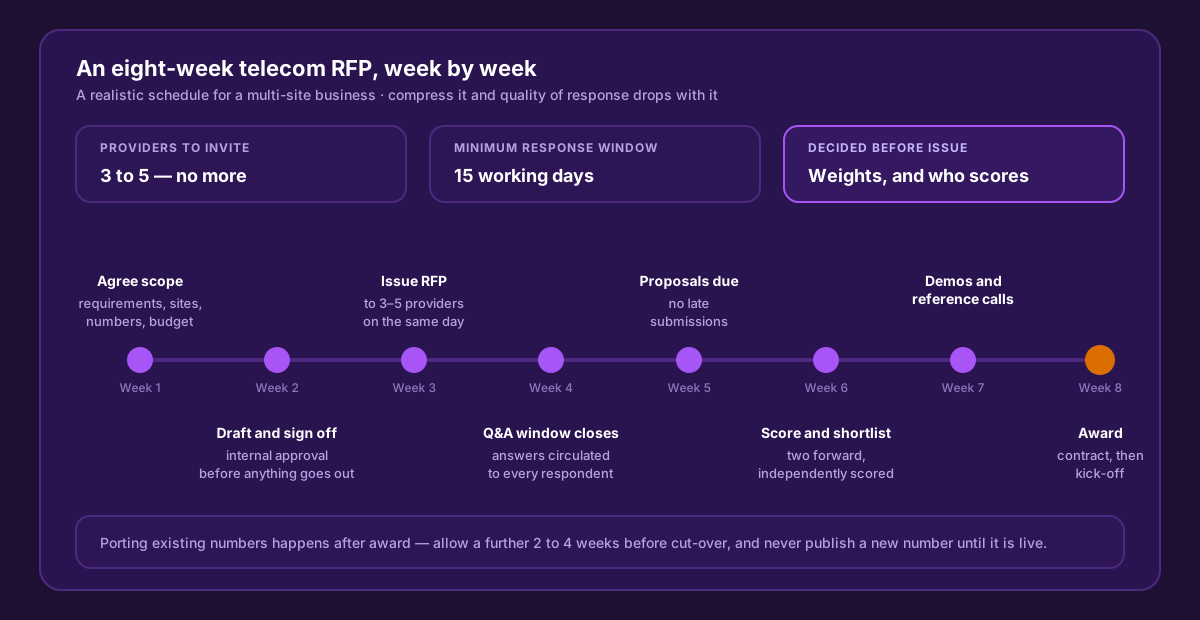
A realistic schedule. Number porting happens after award — allow another two to four weeks before cut-over, and never publish a new number until it is live.
Two timing rules worth holding to. Issue to every provider on the same day, and circulate every question and answer to all respondents — it keeps the process fair and it stops the same clarification being asked five times. And invite three to five providers, not twelve. Each additional respondent adds scoring hours without adding decision quality.
Score with weights, and decide the weights first
Scoring is where good procurement is won. Without a weighted matrix, the decision drifts toward whichever number is easiest to compare — the monthly headline — and the rest of the proposal becomes decoration.
Use a 1–5 score per criterion, multiplied by an agreed weight. Here is a worked example with three respondents:
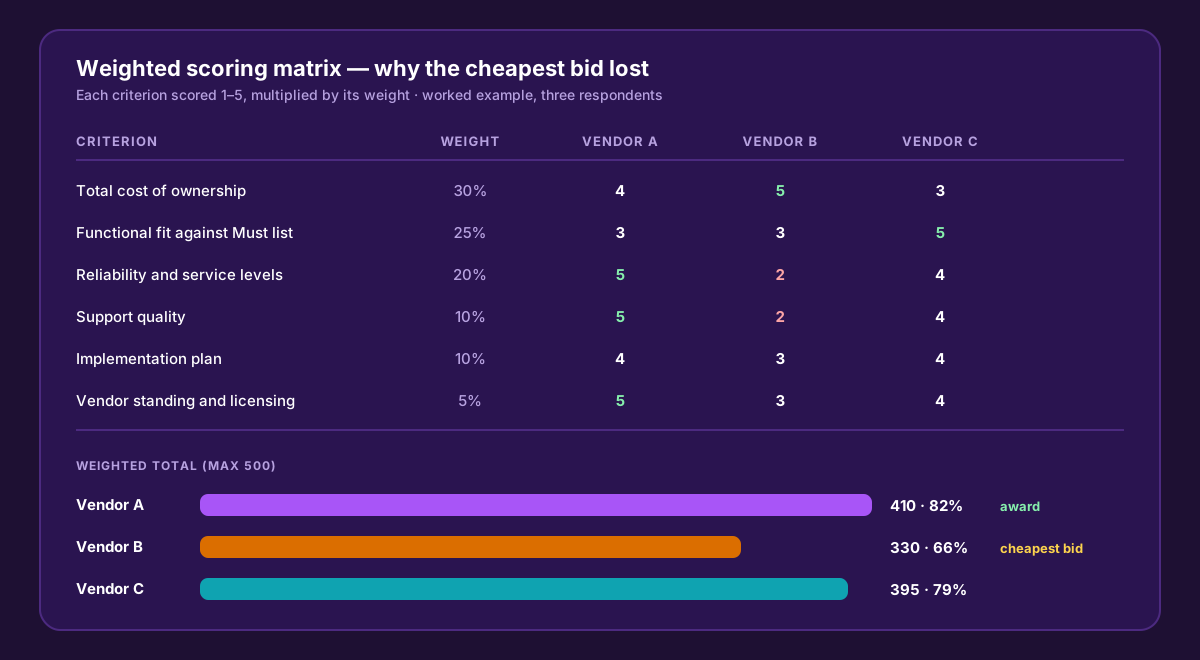
Vendor B is the cheapest bid and scores full marks on cost — and finishes third, because weak service levels and support are worth more of the total than the price gap.
Notice what the matrix does: it does not stop you choosing the cheapest provider. It makes you say out loud how much reliability is worth relative to price, and then hold to it. If cost genuinely is 60% of your decision, weight it at 60% — just decide that before you know who is cheapest.
Two scoring disciplines matter. Score independently first, then meet to reconcile — group scoring collapses to whoever speaks with most conviction. And score the three-year total cost, not the monthly figure: one-time charges, recurring charges, expected usage, and any hardware refresh inside the term.
Seven mistakes that cost buyers money
- Comparing monthly headline prices. One proposal includes handsets, another leases them, a third assumes you already have them. Only a three-year total is comparable.
- Leaving usage out of the schedule. Per-minute rates on the destinations you actually call can outweigh the subscription difference entirely.
- No number inventory. If you do not list the numbers to be ported, you will find out about the ones you forgot at cut-over.
- Asking for everything. Requirements nobody uses eliminate providers who would have served you well, and inflate every quotation.
- Ignoring exit terms. The cost of leaving is part of the cost of joining.
- Skipping references. Ask each shortlisted provider for customers of similar size, then actually call them and ask about faults, not features.
- Letting the RFP expire into a demo. Demos sell. Score the written response first, then use demos to confirm the shortlist — not to reopen it.
After the proposals arrive
Shortlist two. Run structured demos where you drive the scenarios — an after-hours call, a transfer between sites, a change made live in the admin portal. Make reference calls. Then negotiate on the terms that were weakest in the winning proposal, because that is the moment you have the most leverage and the least risk of losing the deal.
Finally, take the accepted proposal and attach it to the contract as a schedule. Anything promised in a response but absent from the agreement will be absent from the service.
If you want a second pair of eyes
We answer these documents regularly, so we know what a weak proposal looks like from the inside. If you are writing an RFP for voice services in Jamaica and want someone to sanity-check the scope and requirements before it goes out, we will review it at no charge — including RFPs we are not bidding on.
And if you would like a response from us: WOCOM is a licensed Jamaican provider operating its own network, delivering Cloud PBX, SIP trunking, virtual 876 numbers and AI call answering with a 99.999% uptime SLA. Call 876-906-7240 or send us your requirements. While you are planning the commercial side, the companion pieces on CapEx versus OpEx and the hidden costs of legacy landlines will help you build the cost case that sits behind the RFP.
Continue exploring
Ready to upgrade your communications?
Talk to our team about the right solution for your business.
Book a Demo Contact SalesMichelle Goss is a data and AI analyst at WOCOM, where she studies how Jamaican businesses use voice, messaging and AI to win and keep customers. With a BSc in Data Science & Analytics, she turns call data, customer trends and AI receptionist performance into practical guidance owners can act on. Michelle writes WOCOM's coverage of AI call handling, call analytics, customer growth and industry trends.