The Hidden Costs of Legacy Landlines: What Copper Really Charges a Jamaican Business
Ask an owner in Kingston, Mandeville or Montego Bay what their phone lines cost and you will almost always get a single figure: the monthly rental. It is the number on the invoice, the number that goes into the budget, and the number that gets quoted when someone suggests changing providers.
It is also, in most businesses we look at, less than half the true cost.
The rest is spread across maintenance contracts, technician call-outs, replacement handsets, PBX cards, battery packs, a higher rate of GCT than most owners realise they are paying, and the quiet operational cost of a system that cannot be changed without someone driving to your building. None of that appears on the line that says line rental. All of it is real money leaving the account.
This article puts every one of those costs in the same table, with a modelled example you can substitute your own figures into. Nothing here requires you to switch anything — the first step is simply knowing the real number.
Start with the number you are quoting yourself
Take a typical small Jamaican business: four analogue lines running into a small key system or legacy PBX, a handful of desk phones, one line kept aside for the fax or the card machine. Ask what the phone system costs and the answer is the rental — call it J$4,500 per line, so J$18,000 a month.
Now open the file cabinet. The maintenance agreement with the vendor who installed the system. The invoice from the technician who came out in March when two extensions went dead. The quote for the replacement handsets bought last year. The battery pack for the backup unit that gets swapped every couple of years. The GCT line at the bottom of the phone bill, charged at the telephone rate rather than the standard one. Add those to the rental and the picture changes completely.
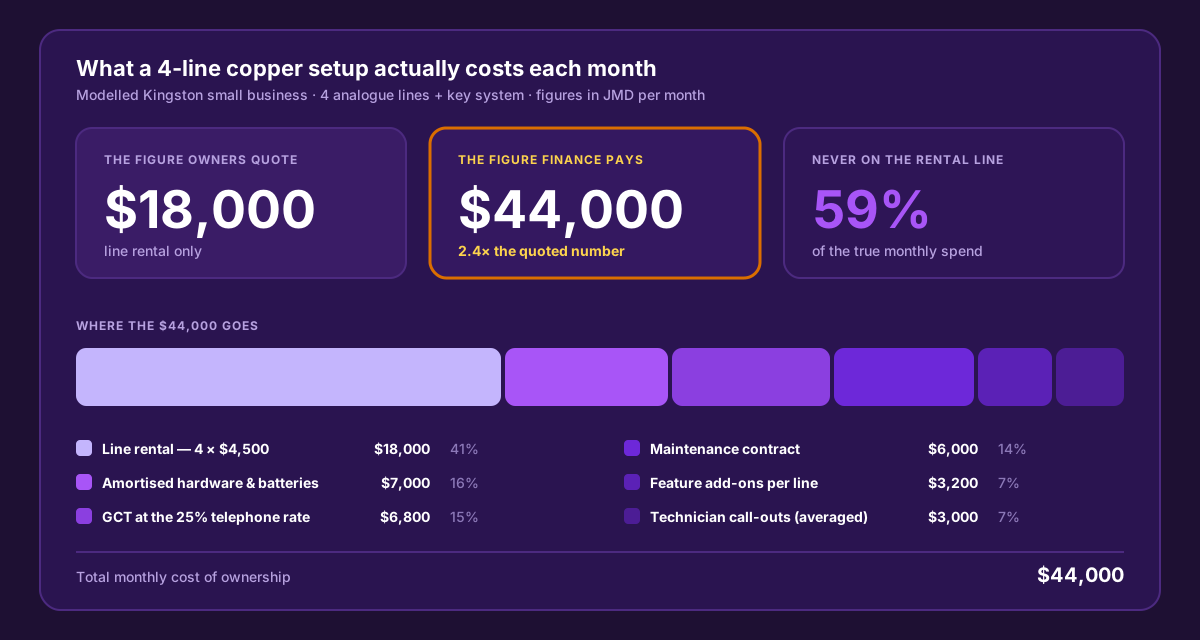
A modelled four-line setup. The rental everyone quotes is J$18,000. The monthly cost of ownership is J$44,000 — and 59% of it sits on lines nobody reads out when asked what the phones cost.
These are modelled figures, not a quotation. Substitute your own — the buckets are what matter, and every one of them exists in every legacy installation we have surveyed.
Cost one: maintenance you pay for whether you use it or not
Copper infrastructure is mechanical. Punch-down blocks corrode in coastal humidity. Insulation cracks. Water gets into a junction box after a heavy rain and one pair goes noisy. A rat chews through a run in the ceiling. None of this is unusual — it is the normal ageing behaviour of metal wire in a Jamaican building.
Businesses handle that in one of two ways, and both cost money:
- A maintenance contract. A fixed monthly or annual fee to the vendor who installed the system, which buys you a response commitment and covers some parts. You pay it in the eleven months when nothing breaks too.
- Pay per visit. No contract, but every fault means a call-out charge, an hourly rate, and parts at the vendor’s price. Two visits a year at J$18,000 each is J$36,000 — J$3,000 a month averaged out, and that is a quiet year.
There is a second, larger cost buried inside the first: the wait. A dead extension on a copper system is not fixed remotely. Somebody has to come. Between the report and the repair, that extension is not taking calls — and if it is the line customers actually dial, you are paying for the fault twice.
Cost two: the tax line, at the rate most owners never check
Jamaica’s standard rate of General Consumption Tax is 15%. Telephone service is not charged at the standard rate. The provision of telephone services — including handsets and phone cards — attracts GCT at 25%, a higher rate applied specifically to telecommunications.
Pull your last bill and check it. On a J$27,200 base of rental, features and maintenance, that difference between 15% and 25% is roughly J$2,700 a month — J$32,000 a year — that exists purely because of how the service is classified.
Two honest points, because the accounting has to work in both directions:
- The rate does not disappear when you move to cloud voice. Business telephone service is telephone service. What changes is the base the rate is applied to. Tax is a percentage of a number — shrink the number and the tax shrinks with it. A setup that costs J$27,200 in taxable services carries J$6,800 of GCT; one that costs J$15,000 carries J$3,750.
- There are levies underneath the tax line too. Jamaica’s Universal Service Fund is funded by a levy collected on international calls terminating on local networks — US$0.03 a minute on calls landing on fixed lines, US$0.02 on mobile. You do not see it itemised as a customer, but it is priced into the fixed-line rates you pay, and fixed lines carry the higher of the two rates.
The takeaway is not “taxes are unfair.” It is that every avoidable J$1,000 of legacy service costs you J$1,250, because the tax rides on top of it.
Cost three: the hardware cycle nobody budgets for
This is the cost that does the most damage, because it does not arrive monthly — it arrives all at once, usually at the worst possible time.
Legacy phone hardware is a depreciating asset with a replacement cycle, and in Jamaica it is an imported depreciating asset. Every item on this list is a capital purchase that has to be repeated:
| Item | Why it gets replaced | Typical cycle |
|---|---|---|
| Desk handsets | Cords fray, keypads fail, displays die, drops | 4–6 years |
| PBX / key system line cards | Failure, or you need more ports than the chassis has | On failure or growth |
| PBX control unit | Vendor discontinues support; parts stop being available | 8–12 years, then forced |
| Backup batteries / UPS | Chemical ageing — they fail whether used or not | 2–3 years |
| Internal cabling & blocks | Corrosion, moisture, rodents, building works | Ongoing |
Two things make this worse than the sticker price suggests. First, imported hardware carries duty, freight and GCT on landing, so the shelf price is not the delivered price. Second, obsolescence is not your decision. When a manufacturer ends support for a control unit, there is no negotiating — spare cards dry up, and the next failure becomes a full replacement project. Businesses that have run the same system for twelve years are not saving money; they are accruing a bill.
Spread across a five-year horizon, with no price increases assumed, the modelled four-line business looks like this:
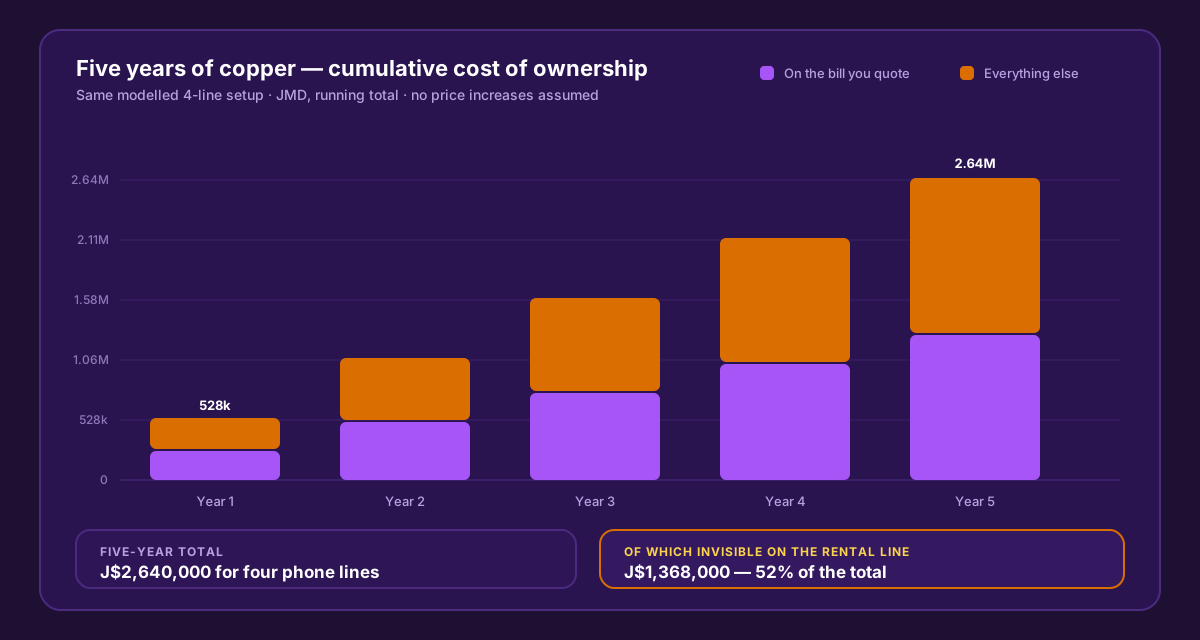
J$2.64 million over five years for four phone lines — and 52% of it in costs the business never counted when it said “our phones cost J$18,000 a month.”
The costs that never reach any invoice
Everything above can at least be found in a file. These cannot, and they are usually bigger.
- Missed calls during faults and after hours. A copper line that is engaged or dead does not queue, overflow or notify anyone. The caller rings out and dials the next business. There is no report showing you what that cost.
- Moves, adds and changes on vendor time. Adding an extension, changing a hunt group, or moving a phone to a different desk means a service request and a visit. On a cloud system those are self-service changes made in minutes.
- Seasonal inflexibility. Jamaican businesses are seasonal — tourism, back-to-school, Christmas trading. Copper lines cannot flex up for eight weeks and back down again. You buy for the peak and pay for it all year.
- Site risk. When the phone system lives in a cupboard in your building, a storm, a flood, a break-in or a prolonged outage takes your phone number off the air with it. Numbers that live in the network do not have a building to lose.
- Copper theft and degradation. Physical infrastructure has physical failure modes. The repair is somebody else’s schedule, not yours.
Audit your own copper bill in thirty minutes
You do not need a consultant for this. Pull twelve months of records and fill in six numbers:
- Rental. Monthly line rental × number of lines × 12. Include the fax and card-machine lines — people forget those.
- Features. Anything billed per line per month: voicemail, caller ID, hunt groups, call forwarding.
- Maintenance. Contract fees for the year, plus every call-out invoice, plus parts.
- Hardware. Everything bought for the phone system in the last five years, divided by five.
- Tax. Check the rate actually applied on your bill and add the GCT line — do not assume 15%.
- Downtime. Count the days any line was out of service in the last year. You do not have to price it; just look at the number.
Divide the total by twelve. That is your real monthly cost of ownership — the number to compare against any alternative, and the only fair basis for a decision.
What changes when the line becomes software
The reason cloud voice removes these costs is not that it is newer. It is that the four expensive things about copper — physical wire, on-site hardware, vendor visits, and per-line pricing — stop existing.
| Cost line | Legacy copper | Cloud voice |
|---|---|---|
| Line rental | Per physical line, fixed | Per user or channel, adjustable |
| Maintenance contract | Required, ongoing | None — the platform is maintained by the provider |
| Technician call-outs | Per visit, per fault | Configuration changes made in a portal |
| Hardware replacement | Capital cycle every few years | Handsets optional; apps run on devices you own |
| Adding a line | Site survey, cabling, lead time | Minutes, self-service |
| Features | Billed individually per line | Included in the plan |
| Tax base | Applied to a larger bill | Same rate, smaller base |
WOCOM’s Cloud PBX plans start at J$15,000 per user per month and include a local 876 number, four voice channels, 500 minutes to the USA and Canada, an auto-attendant, call transfer and conferencing, mobile extensions, and the AI receptionist — with a desk phone included in the plan rather than bought separately. If you would rather keep the PBX you already own and only replace the copper feeding it, a Flexi-SIP trunk starts at J$10,000 a month for four channels. Full pricing is on the pricing page.
And if you want the dial tone to stay exactly as it is on the handsets your staff already know, that is possible too — see how WOCOM delivers real business landline service over its own network, or read the line-by-line landline versus VoIP cost comparison.
The bottom line
Legacy landlines are not expensive because of the rental. They are expensive because the rental is the only part anyone counts. The maintenance contract, the call-outs, the replacement hardware, the higher tax rate on a larger base, and the calls that ring out during a fault are all real costs — they simply arrive on different pieces of paper, at different times of year, so they never get added up.
Add them up once. Whatever you decide afterwards, you will be deciding with the real number in front of you.
Want a second pair of eyes on it? Send us twelve months of phone bills and we will build the same breakdown for your business — no obligation, and we will tell you plainly if your current setup is already the cheaper option. Call 876-906-7240 or get in touch here.
Continue exploring
Ready to upgrade your communications?
Talk to our team about the right solution for your business.
Book a Demo Contact SalesMichelle Goss is a data and AI analyst at WOCOM, where she studies how Jamaican businesses use voice, messaging and AI to win and keep customers. With a BSc in Data Science & Analytics, she turns call data, customer trends and AI receptionist performance into practical guidance owners can act on. Michelle writes WOCOM's coverage of AI call handling, call analytics, customer growth and industry trends.