CapEx vs OpEx: Should Your Business Buy a Phone System or Subscribe to One?
Every business communications decision eventually lands on the same desk, and the person sitting at it asks a question the sales conversation rarely answers directly: are we buying this, or renting it?
That is the CapEx versus OpEx question. Capital expenditure means you buy the equipment, own it, put it on the balance sheet, and write it down over its useful life. Operating expenditure means you pay a recurring fee for a service, own nothing, and take the cost through the profit and loss account as you incur it.
Most articles on this subject argue that subscriptions always win. They do not. Over a stable five years, owning a phone system is often cheaper in raw cash — and any accounting that hides that is not worth reading. What follows is the full picture, with the numbers, so you can decide which one fits your business rather than which one fits somebody’s sales pitch.
What each model actually looks like in a Jamaican business
Take a four-user office. Under the two models the money behaves completely differently.
| Own it (CapEx) | Subscribe (OpEx) | |
|---|---|---|
| Day one | PBX or key system, handsets, cabling and installation — a single large payment | No capital outlay; service starts on a monthly fee |
| Books | Fixed asset, depreciated over its useful life; capital allowances claimed per the tax rules | Operating expense, deducted in the period it is incurred |
| Monthly | Line rental, maintenance contract, power and battery replacement | One flat per-user or per-channel figure, inclusive of features |
| Every few years | Refresh: cards, handsets, batteries — and eventually a full replacement when the vendor ends support | Nothing. Platform upgrades happen on the provider’s side |
| When you grow | New ports, possibly a new chassis, a site visit and a lead time | Add users or channels in the portal |
| When you shrink | You own the hardware either way | Reduce the subscription |
The single most important difference is not the total. It is the shape of the cash flow.
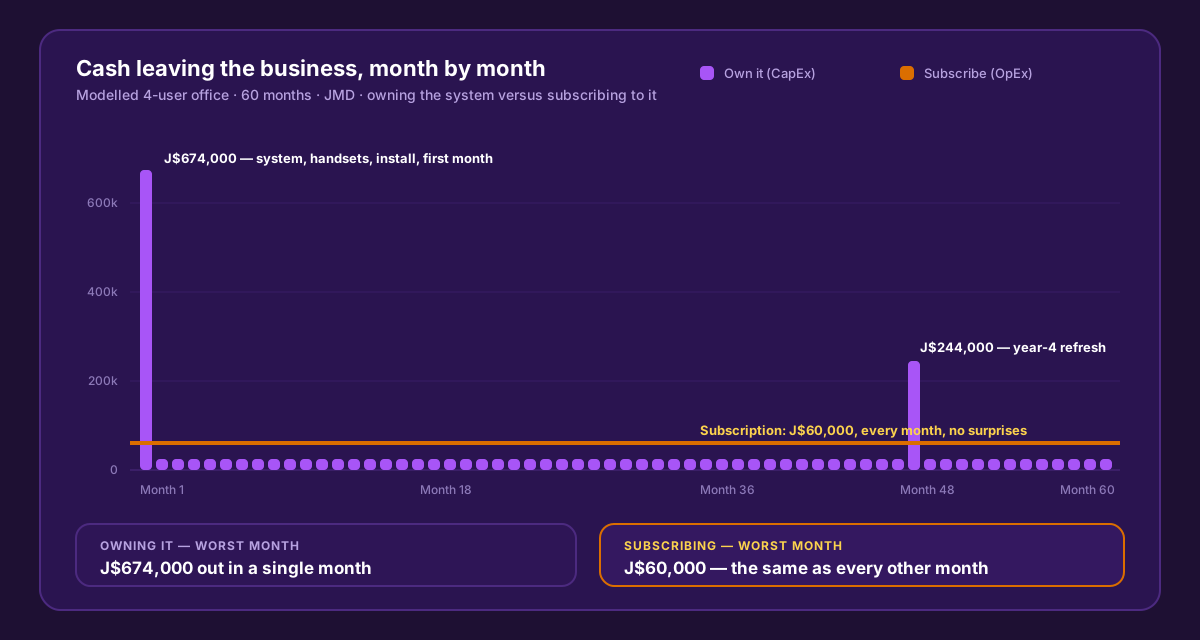
Modelled four-user office. Ownership costs little most months and a great deal in two of them. The subscription costs the same amount sixty times in a row.
For a business with strong cash reserves and predictable trading, the spiky line is perfectly manageable. For a business where December is strong and September is thin, a J$674,000 month is the difference between a good quarter and an overdraft conversation. Neither is wrong — they are different businesses.
The three ownership costs that rarely make it into the business case
1. The capital is locked up. J$650,000 spent on a phone system is J$650,000 not spent on stock, a delivery vehicle, a marketing push, or simply held as working capital. If that money would have earned or saved anything elsewhere, the phone system costs more than its invoice. If it is borrowed, the interest is a real line item that never appears in the vendor’s quotation.
2. Obsolescence is not your decision. You choose when to buy. The manufacturer chooses when the platform stops being supported. When spares for a control unit dry up, the next failure stops being a repair and becomes a replacement project — on their timetable, not yours. Every year a system runs past its supported life, that risk grows.
3. You buy for the peak and pay for it always. Owned capacity is fixed. A hotel that needs extra lines for winter season, a distributor that doubles call volume before Christmas, an office that hires four people in March — all of them size the purchase for the busiest week of the year and carry that cost for the other fifty-one.
The honest five-year comparison
Here is the same modelled office run over sixty months, cumulatively, with no price increases assumed on either side.
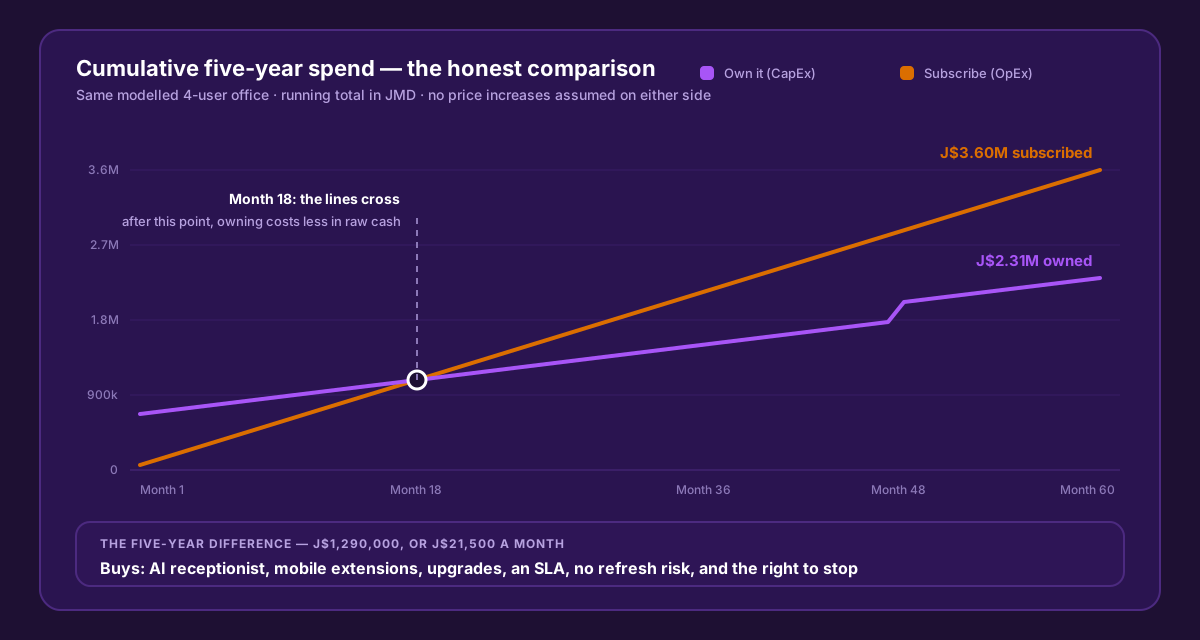
The lines cross at month 18. After that, ownership is cheaper in raw cash — J$2.31 million against J$3.60 million over five years. The question is what the J$1.29 million difference buys.
That crossover is real and we are not going to pretend otherwise. If your headcount will be the same in 2031 as it is today, if nothing breaks badly, if you have the capital sitting idle, and if the feature set you need never changes — buying is the cheaper option on paper.
Now look at what sits inside the subscription line and not inside the ownership line. On a WOCOM Cloud PBX plan, the monthly fee includes the desk phone, a local 876 number, voice channels, an allowance to the USA and Canada, auto-attendant, mobile extensions for staff working away from the desk, call reporting, every platform upgrade, a 99.999% uptime SLA — and the AI receptionist, which answers calls the team cannot reach. Priced on its own, the AI capability alone runs from J$25,000 a month. The modelled difference between the two columns is J$21,500 a month.
In other words: at this scale the subscription premium is roughly the price of the capability the owned system does not have at all. That is the comparison worth having — not J$2.31M against J$3.60M, but two different bundles of capability, priced differently and carrying different risk.
When the numbers flip
The crossover assumes a static business. Four things move it, and all four are common:
- Headcount changes. Grow by three staff and the owned system may need ports, a card, cabling and a visit. Shrink by three and you have bought capacity you cannot return. Subscriptions move in both directions within the month.
- The refresh lands early. Our model assumed a modest year-four refresh. A control-unit failure out of support is a different number entirely, and it arrives without notice.
- Imported hardware is FX-exposed. Phone hardware is bought in foreign currency and landed with duty, freight and GCT. A replacement purchase in five years is priced in five years’ exchange rate, not today’s. A subscription billed in Jamaican dollars is not.
- Downtime has a price. An owned system that fails waits for a technician. Every hour of that is calls ringing out. One bad week can erase a year of the ownership saving — and it does not show up anywhere in the business case that justified the purchase.
A decision framework you can apply in ten minutes
| Buying (CapEx) fits when… | Subscribing (OpEx) fits when… |
|---|---|
| You have capital available and no better use for it | Cash flow matters more than the five-year total |
| Headcount and call volume are stable and predictable | You are growing, seasonal, or unsure of headcount |
| You have in-house technical staff who can manage the system | Nobody on staff wants to own a PBX |
| Your feature requirements are fixed and basic | You want AI answering, remote working and upgrades included |
| You can absorb an unplanned replacement without pain | An unexpected J$650,000 month would hurt |
| The tax treatment of a capital asset suits your position | You would rather deduct the cost as you incur it |
On that last row — the accounting and tax treatment of a capital asset versus an operating expense differs, and it depends on your company’s position. Ask your accountant to model both before you sign anything; it is a ten-minute conversation that occasionally changes the answer on its own.
The middle path most businesses miss
CapEx and OpEx are not the only two options, and the best answer for a business that has already bought a PBX is usually neither.
If your system is healthy and supported, you do not have to throw it away to stop paying for copper. A Flexi-SIP trunk connects the PBX you already own to a modern carrier network — the capital you spent keeps working, the lines feeding it become software, and the monthly cost drops to a subscription that scales with channels rather than physical lines. From J$10,000 a month for four channels, you convert the expensive half of ownership to OpEx and keep the half you already paid for.
That is often the strongest financial position of the three: no new capital, no stranded asset, and a running cost that flexes.
The bottom line
Ownership buys you a lower five-year cash total, if nothing changes. Subscription buys you predictability, capability, and the right to change your mind. The correct answer depends on which of those your business is short of.
What is never correct is comparing an upfront purchase price against a monthly fee and calling that an analysis. Compare the same five years, count the refresh, count the maintenance, count the capital you tied up — and count what each option actually includes.
We will do that comparison with you, using your figures, and tell you plainly which side it lands on. If you have a system worth keeping, we will say so. Call 876-906-7240, see the numbers on our pricing page, or talk to us here. You may also want to read the companion piece on the hidden costs of legacy landlines, which breaks down the maintenance and tax lines in detail.
Continue exploring
Ready to upgrade your communications?
Talk to our team about the right solution for your business.
Book a Demo Contact SalesMichelle Goss is a data and AI analyst at WOCOM, where she studies how Jamaican businesses use voice, messaging and AI to win and keep customers. With a BSc in Data Science & Analytics, she turns call data, customer trends and AI receptionist performance into practical guidance owners can act on. Michelle writes WOCOM's coverage of AI call handling, call analytics, customer growth and industry trends.