Business Continuity Communication Plan Jamaica: Template for 2026
Your business continuity plan probably covers operations, IT systems, and finance. But when the crisis hits — a Category 3 hurricane, a JPS blackout that stretches into its third day, or a cyberattack that locks your email — what you need in the first hour is a communications continuity plan: a focused document that tells your team how to reach each other, how to update customers, and how to keep incoming calls handled when your normal channels have failed.
Most Jamaican businesses either skip this document entirely or bury communications inside a broader BCP where nobody can find it under pressure. This guide gives you a practical template you can complete in an afternoon and test before the next disruption arrives.
What a Communications Continuity Plan Actually Covers
A communications continuity plan (CCP) is separate from your IT disaster recovery plan (which covers servers, data, and systems) and your operational BCP (which covers staff roles and service delivery). Your CCP answers three specific questions:
- How do we notify our own team when normal channels — email, office phones, internal messaging — are unavailable?
- How do we communicate with customers and suppliers during a disruption, and what do we tell them?
- What infrastructure do we fall back to when our primary phone system, internet connection, or office is inaccessible?
The plan should be short enough to act on under stress, specific enough to hand to someone who has never seen it before, and stored somewhere accessible when your usual systems are down. A document that lives only on the office server is not a continuity document.
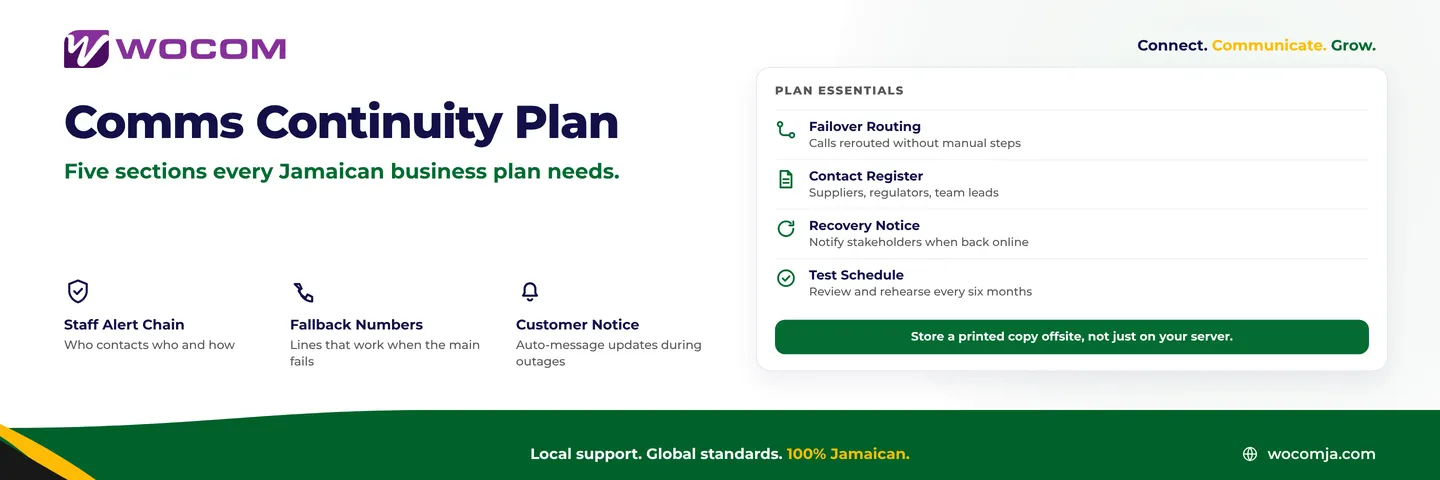
Section 1: The Staff Notification Chain
When something goes wrong at your Kingston or Montego Bay office, the first bottleneck is almost always internal: managers cannot reach staff, and staff do not know whether to come in or stay home. Your notification chain removes that bottleneck before the disruption starts.
Build your chain as a simple tiered tree:
- Tier 1 — Crisis Owner: One named individual — typically the managing director or operations manager — is responsible for declaring a disruption and triggering the chain. Include their personal mobile number, not just their work extension.
- Tier 2 — Department Heads: Each head receives the alert directly from Tier 1 and contacts their direct reports. List names, personal mobile numbers, and the WhatsApp group or SMS broadcast list they will use for their team.
- Tier 3 — All Staff: A company-wide WhatsApp broadcast or SMS blast as the final step, confirming the situation and any instructions for the day.
The critical rule: the chain must not depend on your office phone system or corporate email. Both may be unavailable simultaneously. Personal mobile numbers and pre-established WhatsApp groups are the only reliable backbone during a Jamaican power or connectivity outage. Set up the groups now, before you need them.
Section 2: Customer and Stakeholder Communication
Customers calling your business during a disruption need to hear something that sets expectations — not silence, a busy signal, or the same greeting as a normal day. Your plan should specify the following in advance:
- Auto-attendant or voicemail message: Pre-record an alternate greeting that explains the disruption, gives an estimated restoration time if known, and provides an alternate contact method. With a cloud PBX, a manager can update this message remotely from a smartphone without accessing the office at all.
- Website and Google Business Profile update: Assign someone to post a brief status update within two hours of a declared disruption. Google Business Profile hours and messaging can be updated immediately from any mobile device.
- WhatsApp or SMS broadcast to customers: For businesses with a customer contact list, a brief message — "Our phones are experiencing disruption. We will restore service by [time]. Reach us at [alternate number]." — does more for retention than any apology after the fact.
- Social media post: A Facebook or Instagram update is particularly relevant for retail and service businesses in Kingston, Portmore, and Spanish Town where customers follow social channels for real-time updates.
The businesses that retain customers through disruptions are not the ones that never have problems — they are the ones that communicate honestly and quickly when problems occur.
Section 3: Fallback Channels and Failover Routing
This section defines the alternate infrastructure your team activates when primary systems fail. It should be specific enough to execute without troubleshooting at two in the morning.
- Alternate phone routing: A cloud PBX with SIP trunking can automatically reroute inbound calls to a mobile number, a different branch, or a call queue when your main internet connection drops. Document this failover path and confirm it has been tested within the last six months. If your system does not have automatic failover configured, treat this as an action item before filing the plan.
- Mobile data fallback: Identify which staff members have strong mobile data coverage and can use a softphone app to handle business calls if the office internet is down. List those staff names, the devices they will use, and the number callers should reach them on.
- Alternate internet connection: If your primary connection is a fixed broadband line, document whether you have an LTE or Starlink backup, along with the configuration steps any IT-capable staff member can follow to activate it without calling technical support first.
- Physical alternate work location: For outages longer than 24 hours, designate a backup site — a partner's office, a serviced workspace in New Kingston or Half Way Tree — where your customer-facing communications staff can operate with basic equipment.
Each fallback must have a named owner who knows how to activate it. "We have a backup line" is not a plan. "Maria activates the mobile softphone group within 30 minutes of a declared outage" is a plan.
Section 4: Critical Contacts Register
Your plan should include a one-page contacts register — printed, laminated if possible, and stored offsite — with direct mobile numbers for the following:
- Your telecom and internet provider's technical fault line, not the general customer service queue
- JPS emergency fault reporting for your service area
- Your backup generator supplier or fuel delivery contact
- Key clients who must be personally notified if service will be disrupted beyond four hours
- Your cloud PBX or SIP trunk provider's emergency support contact
- Your insurance broker's claims line
The test of this register is straightforward: can any manager reach every contact on the list from a personal mobile phone, without logging into any company system? If the answer is no, the register is not ready.
Section 5: Recovery Communications
Businesses invest real effort in crisis communications but routinely neglect the recovery message — the notification that normal service has resumed. Recovery communications matter for two reasons: they close the loop with customers who are holding off on re-engaging, and they create a record of your actual response time that informs the next planning cycle.
When service is restored, the plan should direct staff to:
- Update the auto-attendant greeting back to normal immediately — not the next morning.
- Send a brief customer-facing message: "Our phone and communication services are fully restored. We apologise for any inconvenience and are ready to assist you."
- Log the event: start time, end time, root cause, actions taken, and any gaps the plan failed to cover.
- Schedule a plan review within two weeks while the experience is still fresh and specific.
Make Your Infrastructure Match Your Plan
A communications continuity plan is only effective when the underlying infrastructure can support it. If your current phone system requires physical access to the office to change routing, update greetings, or redirect inbound calls, your plan has a structural gap that no document can close.
WOCOM's Cloud PBX and SIP trunking services are designed with continuity in mind. Inbound calls can be automatically rerouted to mobile numbers or alternate sites when your primary connection fails. Auto-attendant messages can be updated from any smartphone. Failover paths can be pre-configured and tested on a schedule — so when a disruption happens, the phone system responds without any manual action from your team.
If you are building or reviewing your communications continuity plan and want to check whether your current phone infrastructure closes the gaps this template identifies, contact WOCOM today. Our team works with businesses across Kingston, Montego Bay, and every parish to ensure their communications infrastructure is ready for what Jamaica's weather, power grid, and internet reliability can throw at it.
Call us at 876-300-8888 or visit wocomenterprise.com to speak with a business communications specialist.
Continue exploring
Ready to upgrade your communications?
Talk to our team about the right solution for your business.
Book a Demo Contact SalesEverett Kildare is WOCOM's voice and infrastructure specialist, with more than 25 years of experience designing and running carrier-grade voice, SIP and virtualization infrastructure. Holding a BSc in Information Technology, he has built, secured and migrated phone systems for businesses of every size. Everett writes WOCOM's technical coverage of SIP trunking, cloud PBX, contact centres, business continuity and migration.