Staying Reachable: Failover, Redundancy and the 99.999% Question for Jamaican Businesses
For most Jamaican businesses, the phone is still the front door. A missed call can mean a lost sale, a frustrated patient, or a customer who simply rings the competitor next. So the real question is not just whether your phone system works on a calm Tuesday afternoon, but whether it keeps working when the power dips, the rain comes down, or the internet link to your office goes quiet. Business continuity is the discipline of staying reachable no matter what the day throws at you.
The Caribbean operating reality
Jamaica is a wonderful place to do business, but it has its own conditions that any serious phone system has to respect. Power cuts happen. Hurricane season runs from June through November, and even a passing storm can knock out electricity or damage infrastructure for hours. And while mobile coverage is excellent, fixed broadband is not nearly as widespread. Fixed broadband reaches only about 16 connections per 100 people, which means the wired internet link feeding many offices can be a single, fragile point of failure.
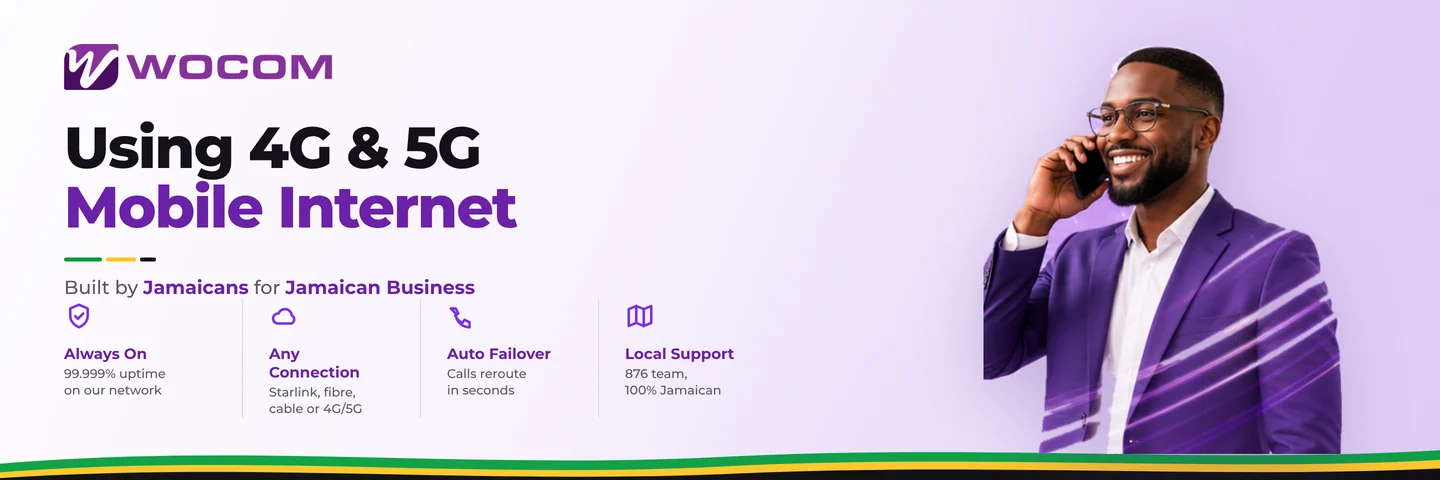
The good news is that the picture is far brighter on mobile. Roughly 99 per cent of the island has 4G coverage. That mobile network becomes the safety net that a well-designed business phone system can lean on when everything else wobbles. The trick is making sure your system actually uses it, automatically, without anyone having to scramble.
Why automatic failover matters more than anything
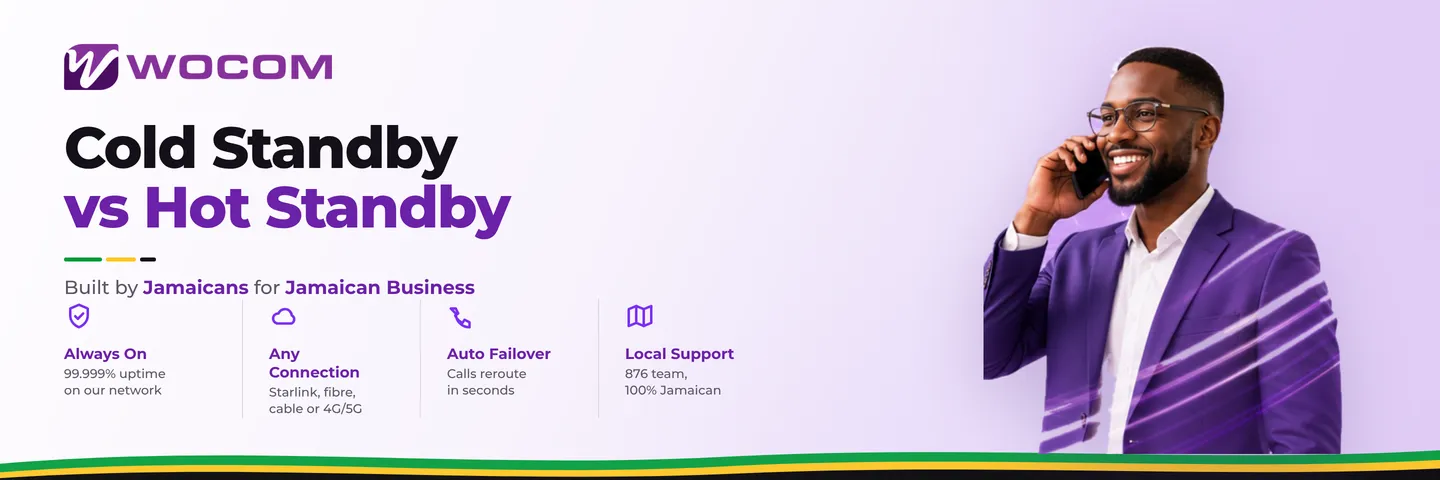
Failover is the feature that quietly saves your reputation. It means that the moment your office internet or power drops, calls are automatically rerouted somewhere they can still be answered, typically to mobile or 4G endpoints, a staff member's cell phone, or a backup location. No frantic phone calls to your provider. No customers hearing dead air. The redirection happens in seconds because the system was built to expect trouble.
Contrast that with a setup that simply goes dark when the link drops. Your customers do not see a power cut or a cut fibre line. They just see a business that did not answer. Automatic failover turns an outage into a non-event, and that is exactly what business continuity is supposed to feel like.
Real resilience goes a step further with redundant call routing and geographically diverse infrastructure. If calls can take more than one path, and if the equipment handling them sits in more than one physical location, then no single failure, whether a storm in one parish or a hardware fault in one data centre, takes your whole phone system offline.
What an uptime number actually means
Providers love to advertise uptime figures, but the numbers deserve a closer look because the difference between them is enormous. Uptime is usually expressed in "nines", and each extra nine is a big jump in reliability.
- 99% uptime sounds good, but it allows for more than 7 hours of downtime every month. That is most of a working day, gone.
- 99.9% uptime ("three nines") narrows that to roughly 43 minutes a month.
- 99.999% uptime ("five nines") permits only about 26 seconds of downtime a month.
The gap between "two nines" and "five nines" is the difference between a phone system you have to apologise for and one you can quietly rely on. When you are comparing providers, ask which figure they actually commit to, not just what their marketing implies.
And here is the part that matters most: an uptime figure is only meaningful if it is backed by a written Service Level Agreement. An SLA puts the promise on paper, with clear restoration commitments that spell out how quickly service will be restored if something does go wrong. A number on a website is marketing. A number in a signed SLA is a commitment.
Why who you buy from changes everything
This is where many businesses get caught out. There is a meaningful difference between buying from a reseller and buying from a provider that owns its own network.
A reseller packages and resells someone else's service. When an outage hits, the reseller is in the same waiting room as you, depending on the underlying carrier to fix things. They cannot guarantee uptime or restoration times they do not control, because the engineers, the equipment, and the network all belong to someone else.
A provider that owns and operates its own network can stand behind its uptime promise, because it controls the infrastructure, the routing, and the engineers who restore service.
When the network is yours end to end, an SLA is not a hopeful estimate. It is a commitment you are in a position to keep, with your own people doing the restoring on your own timeline.
A hurricane-season preparedness checklist
With storm season already upon us, now is the time to pressure-test your continuity plan. A few practical questions to work through:
- Does your phone system fail over automatically to mobile or a backup endpoint when the office internet or power drops, without manual intervention?
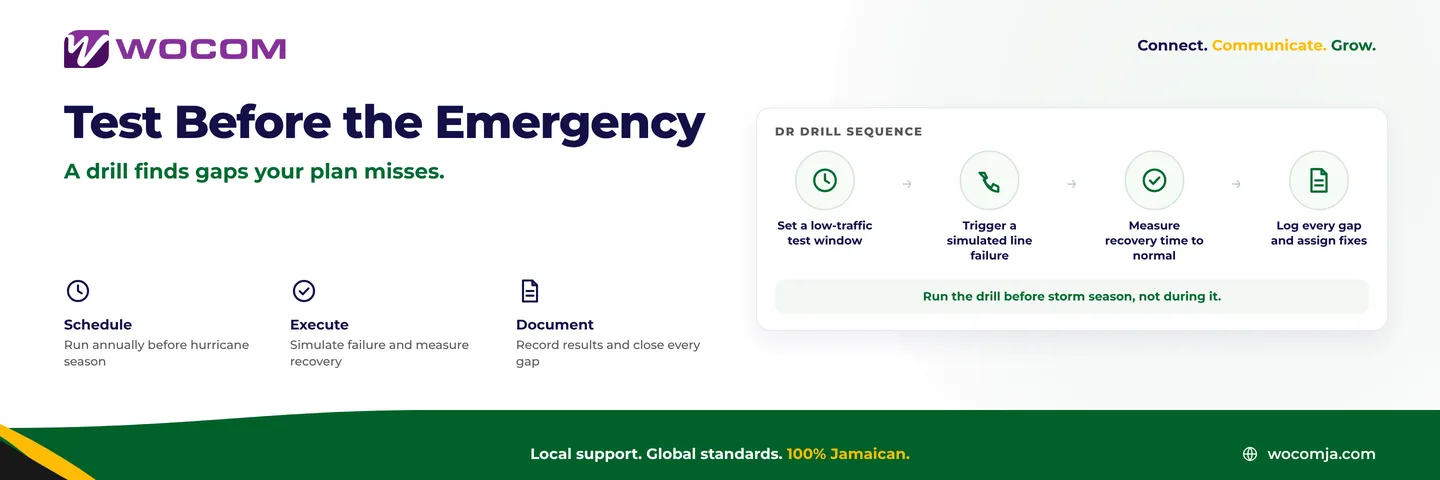
- Have you tested that failover recently? A plan you have never rehearsed is a guess, not a plan.
- Is your call routing redundant, with more than one path calls can take if one link fails?
- Is your provider's infrastructure geographically diverse, so a problem in one location does not take everything down?
- Do you have a written SLA with a real uptime commitment and clear restoration times?
- Do you know who restores service, and whether they are the people who actually own the network?
- Are your key numbers and DIDs portable and centrally managed, so you can redirect them quickly if a site goes offline?
If you cannot answer most of these with confidence, your business continuity plan has gaps that a storm, or just an ordinary power cut, will eventually find.
Staying reachable, whatever the weather
WOCOM is a licensed Jamaican business phone provider that owns and operates its own network, which is precisely why we can back our service with a 99.999% uptime SLA and built-in failover to mobile. Our 876 business numbers, SIP trunks, Cloud PBX, AI receptionist Alex, call analytics, and contact center all sit on infrastructure we control, restored by WOCOM's own engineers, with local 876 support when you need it. If you want a phone system that keeps answering through power cuts and hurricane season alike, we would be glad to show you how it works. Book a demo or call us at 876-906-7240, visit wocomja.com, or email sales@wocomja.com.
Continue exploring
Ready to upgrade your communications?
Talk to our team about the right solution for your business.
Book a Demo Contact SalesEverett Kildare is WOCOM's voice and infrastructure specialist, with more than 25 years of experience designing and running carrier-grade voice, SIP and virtualization infrastructure. Holding a BSc in Information Technology, he has built, secured and migrated phone systems for businesses of every size. Everett writes WOCOM's technical coverage of SIP trunking, cloud PBX, contact centres, business continuity and migration.