☁️ Cloud PBX · Guided tours
Send after-hours calls to the AI receptionist
You will be able to read a flow from the inbound number to the fallback, tell a ring group from a call queue, and understand why "closed" and "nobody answered" need two different rules.
Open the call-flow canvas
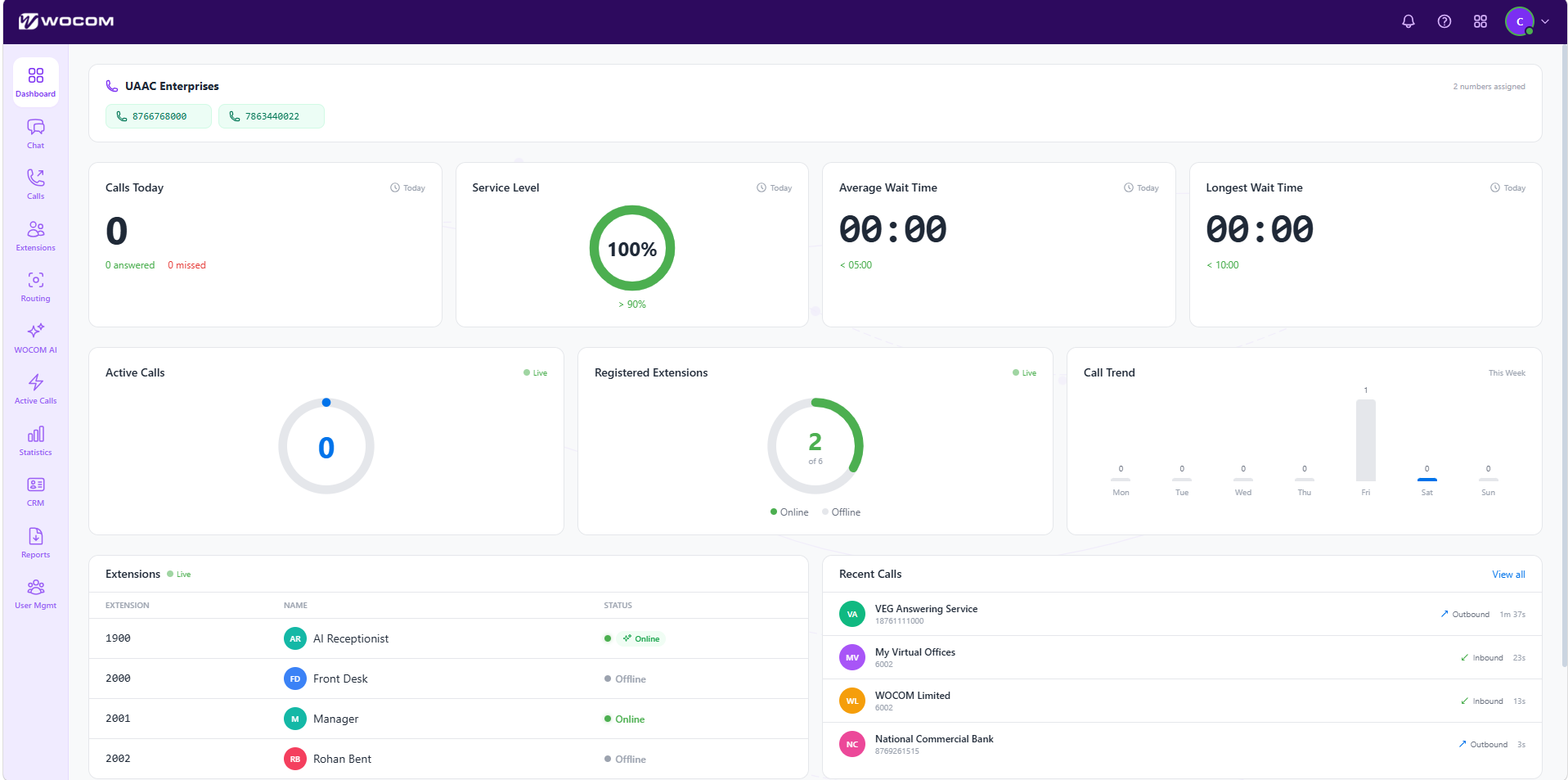
Out of hours, calls should not simply ring an empty office. In this walkthrough we will read the flow that decides where an inbound call goes, and hand the ones nobody answers to the AI receptionist.
Out of hours, calls should not simply ring an empty office. In this walkthrough we will read the flow that decides where an inbound call goes, and hand the ones nobody answers to the AI receptionist.
Read the walkthrough step by step
- Start from the number itself. 876 676 8000 is what customers dial. Routing is the set of rules that number runs through before a phone rings anywhere.
- Calls Today is where you come back afterwards to check the change worked: answered against missed, for today.
- Routing is in the left rail. Click it to open the canvas.
So: one number, one flow, and one place to check afterwards. Let us open it.
These are full-size portal screens. On a phone, tap ⤢ Full screen under the picture and turn the handset sideways — the walkthrough zooms in on each control as it reaches it.
Read the flow
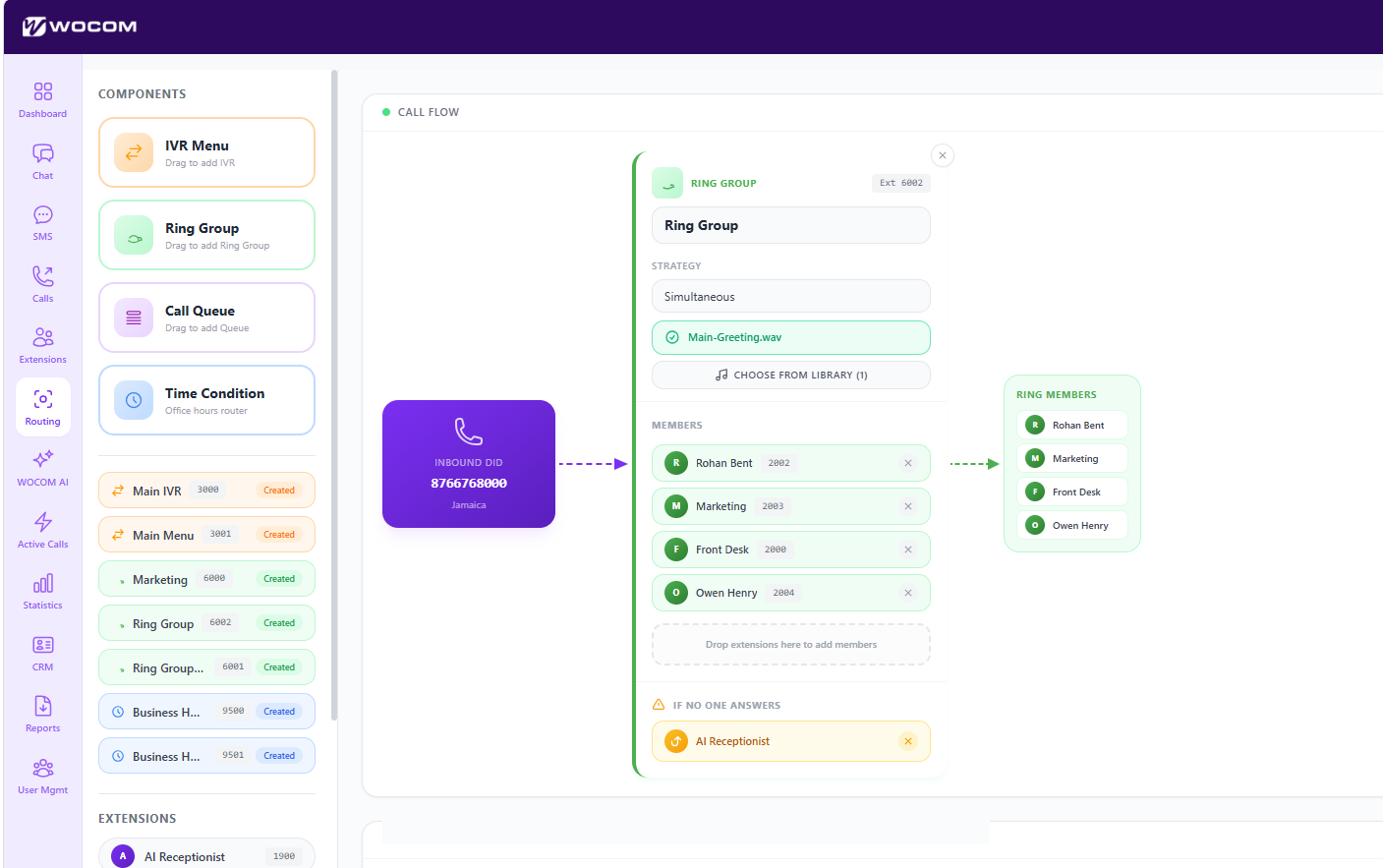
This is the call-flow canvas. What you draw here is what the switch actually does — there is no second configuration hiding behind it.
This is the call-flow canvas. What you draw here is what the switch actually does — there is no second configuration hiding behind it.
Read the walkthrough step by step
- Every flow starts at an inbound DID — the purple node. This is 876 676 8000, the Jamaican number on the account.
- The arrow points at the first destination. Here it is a ring group on extension 6002, so the call rings a set of people rather than one desk.
- Strategy decides how they ring. Simultaneous rings everyone at once. The alternative rings them one at a time in order, which is slower for the caller but stops four people reaching for the same call.
- Main Greeting is what the caller hears while it rings. Choose From Library holds the prompts already uploaded to the account, so you are picking rather than recording.
- Members are the extensions that ring: Rohan Bent, Marketing, Front Desk and Owen Henry. The panel to the right is the same list, confirmed.
- To add somebody you drag their extension from the list on the left into this drop zone. To remove them, the small cross on their row.
So: number, ring group, strategy, greeting, members. That is an inbound call up to the moment somebody answers.
These are full-size portal screens. On a phone, tap ⤢ Full screen under the picture and turn the handset sideways — the walkthrough zooms in on each control as it reaches it.
Decide what happens after hours
Now the part that matters at half past six: what happens when nobody picks up, and what happens when the office is closed. They are two different questions and they need two different rules.
Now the part that matters at half past six: what happens when nobody picks up, and what happens when the office is closed. They are two different questions and they need two different rules.
Read the walkthrough step by step
- If No One Answers is the fallback, and on this account it is the AI Receptionist. The caller is answered, asked what they need, and you get the message — instead of a voicemail nobody checks.
- Closed is not the same as unanswered, and Time Condition is the component that knows the difference. Drag it onto the canvas to route by the clock rather than by whether a phone was picked up.
- Two are already built here, on extensions 9500 and 9501. A time condition has two exits: inside your hours the call carries on to the ring group, outside them it goes straight to the AI receptionist or to voicemail without ringing a single desk.
- An IVR menu is the press one for sales tree, and it is worth having after hours as well as during them. A closed office can still let a caller choose between leaving a message and hearing your opening times.
- Call Queue is the fourth building block. Use it instead of a ring group when callers should wait in line and be told their position, rather than ring out and be sent somewhere else.
So: a time condition splits open from closed, the ring group handles open, and the AI receptionist catches everything else. Build it once and nothing rings an empty office again.
These are full-size portal screens. On a phone, tap ⤢ Full screen under the picture and turn the handset sideways — the walkthrough zooms in on each control as it reaches it.
✅ That is the whole job
You will be able to read a flow from the inbound number to the fallback, tell a ring group from a call queue, and understand why "closed" and "nobody answered" need two different rules.
Still stuck? Support is on 876 676 8000 or send us the details — quote the extension or the number and the time of the call and it saves a round trip.
The whole tour, in writing
Every step of every chapter, in the order it happens — for skimming, for printing, and for pasting into a ticket.
Open the call-flow canvas
Out of hours, calls should not simply ring an empty office. In this walkthrough we will read the flow that decides where an inbound call goes, and hand the ones nobody answers to the AI receptionist.
- Start from the number itself. 876 676 8000 is what customers dial. Routing is the set of rules that number runs through before a phone rings anywhere.
- Calls Today is where you come back afterwards to check the change worked: answered against missed, for today.
- Routing is in the left rail. Click it to open the canvas.
So: one number, one flow, and one place to check afterwards. Let us open it.
Read the flow
This is the call-flow canvas. What you draw here is what the switch actually does — there is no second configuration hiding behind it.
- Every flow starts at an inbound DID — the purple node. This is 876 676 8000, the Jamaican number on the account.
- The arrow points at the first destination. Here it is a ring group on extension 6002, so the call rings a set of people rather than one desk.
- Strategy decides how they ring. Simultaneous rings everyone at once. The alternative rings them one at a time in order, which is slower for the caller but stops four people reaching for the same call.
- Main Greeting is what the caller hears while it rings. Choose From Library holds the prompts already uploaded to the account, so you are picking rather than recording.
- Members are the extensions that ring: Rohan Bent, Marketing, Front Desk and Owen Henry. The panel to the right is the same list, confirmed.
- To add somebody you drag their extension from the list on the left into this drop zone. To remove them, the small cross on their row.
So: number, ring group, strategy, greeting, members. That is an inbound call up to the moment somebody answers.
Decide what happens after hours
Now the part that matters at half past six: what happens when nobody picks up, and what happens when the office is closed. They are two different questions and they need two different rules.
- If No One Answers is the fallback, and on this account it is the AI Receptionist. The caller is answered, asked what they need, and you get the message — instead of a voicemail nobody checks.
- Closed is not the same as unanswered, and Time Condition is the component that knows the difference. Drag it onto the canvas to route by the clock rather than by whether a phone was picked up.
- Two are already built here, on extensions 9500 and 9501. A time condition has two exits: inside your hours the call carries on to the ring group, outside them it goes straight to the AI receptionist or to voicemail without ringing a single desk.
- An IVR menu is the press one for sales tree, and it is worth having after hours as well as during them. A closed office can still let a caller choose between leaving a message and hearing your opening times.
- Call Queue is the fourth building block. Use it instead of a ring group when callers should wait in line and be told their position, rather than ring out and be sent somewhere else.
So: a time condition splits open from closed, the ring group handles open, and the AI receptionist catches everything else. Build it once and nothing rings an empty office again.