What Is a DID Number? Direct Inward Dialling Explained
The Short Answer
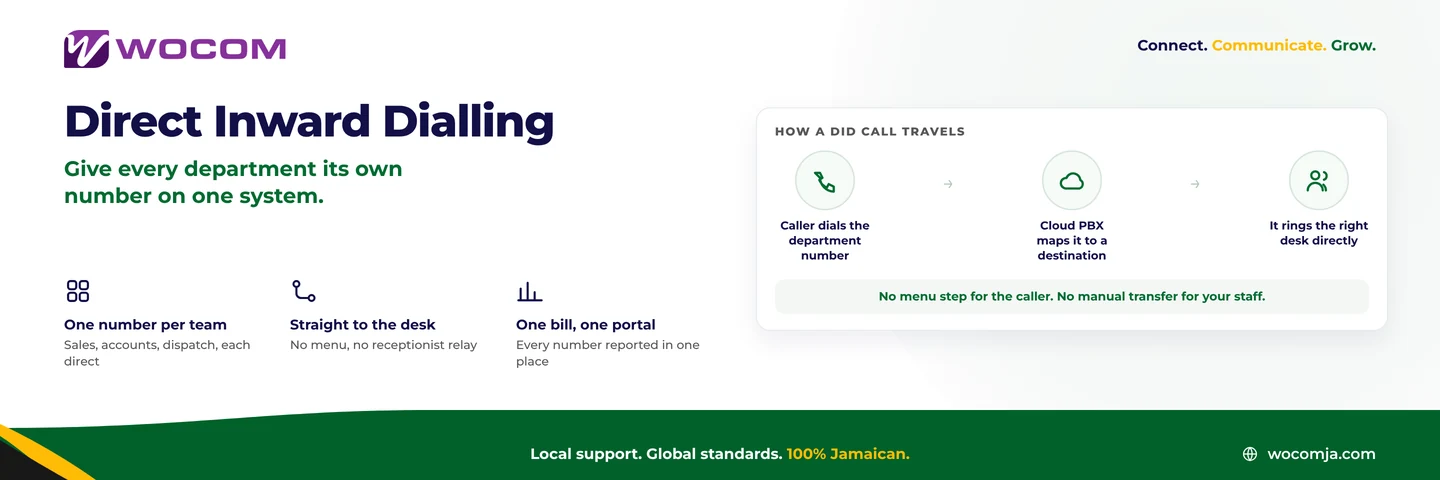
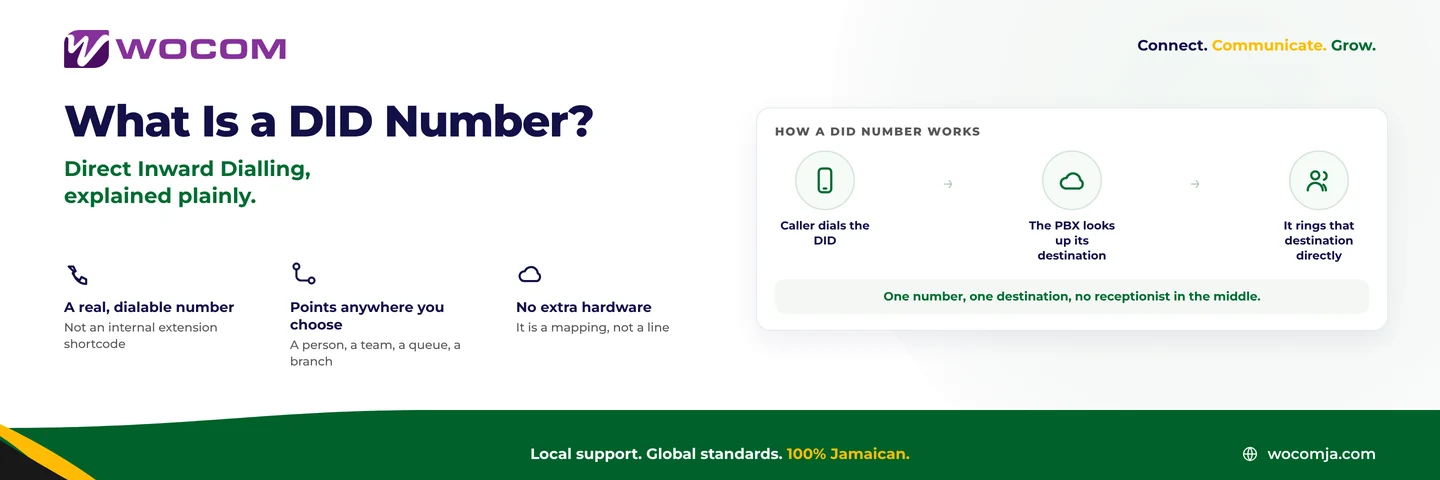
A DID number — Direct Inward Dialling — is a real, publicly dialable phone number that rings a specific destination inside your phone system without going through a receptionist or a menu.
That is the whole idea. Everything else is detail about what “a specific destination” can mean.
Why the Term Exists at All
The name is a leftover from how business phone systems used to work. On an old PBX, outside callers reached one main number and an operator connected them onward. Direct inward dialling was the feature that let an outside caller bypass the operator and reach an internal extension directly — dialling inward, directly.
On a modern cloud system there is no operator and no patch panel, but the term survives because the distinction it describes still matters: some numbers are the front door, and some numbers go straight to a room.
DID Number vs Extension
This is the confusion worth clearing up first, because the two are constantly used as if they were the same thing.
An extension is internal. Three or four digits, dialable only from inside your own phone system. Your colleague on extension 204 cannot be reached on 204 by a customer, because 204 means nothing on the public network.
A DID number is external. A full ten-digit number that anyone with a phone can dial, which your system then maps to an internal destination.
They work together: the DID is the public address, the extension is the internal one. Our guide to numbers, extensions, channels and lines sorts out the full set of terms.
What a DID Can Point At
Not just a person. On a cloud PBX a DID can be mapped to:
- An individual extension — a named person on their desk phone, softphone or mobile app
- A ring group — several phones ringing together or in sequence
- A queue — with hold music and position announcements
- A branch or location — its own call flow, its own hours
- An announcement or voicemail box — for a number that exists to inform rather than connect
- An AI receptionist — answering that number specifically, with its own greeting
The mapping is a setting. Changing where a DID points takes a minute in the admin portal and requires no visit, no rewiring and no new number.
What Businesses Actually Use Them For
Departments. Accounts, sales, dispatch and service each get their own number. Customers who know where they are going stop queueing behind customers who do not.
Named contacts. A partner in a professional firm puts a direct number on their card. Clients reach them without explaining themselves to reception first.
Branches. Each location has a local-looking number while head office sees all the call data in one dashboard.
Campaign tracking. A different number on a radio ad, a billboard and a print listing tells you exactly which one produced the calls — without any third-party tracking service.
Out-of-hours routing. A number that behaves differently at 8pm to how it behaves at 10am, because the mapping is time-aware.
Think of extensions as the door numbers inside the building, and DIDs as the street signage that tells a visitor which door to walk to.
How Many Should You Have?
Not one per employee. A useful rule:
- One per department that takes external calls in its own right
- One per location customers think of as a separate place
- One per senior person who hands out a direct number
- One per marketing campaign you want to measure
- One main number for everyone who does not know where they are going
A ten-person firm usually lands on four to six. A fifty-seat contact centre may want twenty or more. For the department-by-department version of this, see giving every department its own number.
What It Does Not Cost You
The reason DIDs are underused in Jamaica is a memory of what extra lines used to mean: another physical line, another contract, another install. On a cloud PBX a DID is a number mapped onto capacity you already have. It does not consume a channel until somebody actually calls it, and it needs no hardware at all.
What it does need is a clear plan for where each number points and who is responsible for answering it. A DID pointing at an extension nobody watches is worse than not having it.
Adding Direct Numbers
WOCOM provisions 876 local numbers, US and Canadian numbers and toll-free numbers onto your existing Cloud PBX, usually live the same day. Every plan includes the AI receptionist, so a direct number that goes unanswered after hours still gets handled.
Call 876-906-7240 in Jamaica or 877-906-7240 from the US, email support@wocomja.com, or use the contact page.
Continue exploring
Ready to upgrade your communications?
Talk to our team about the right solution for your business.
Book a Demo Contact SalesEverett Kildare is WOCOM's voice and infrastructure specialist, with more than 25 years of experience designing and running carrier-grade voice, SIP and virtualization infrastructure. Holding a BSc in Information Technology, he has built, secured and migrated phone systems for businesses of every size. Everett writes WOCOM's technical coverage of SIP trunking, cloud PBX, contact centres, business continuity and migration.