Phone Number vs Extension vs Channel vs Line: What's the Difference?
Four Words, Used As If They Were One
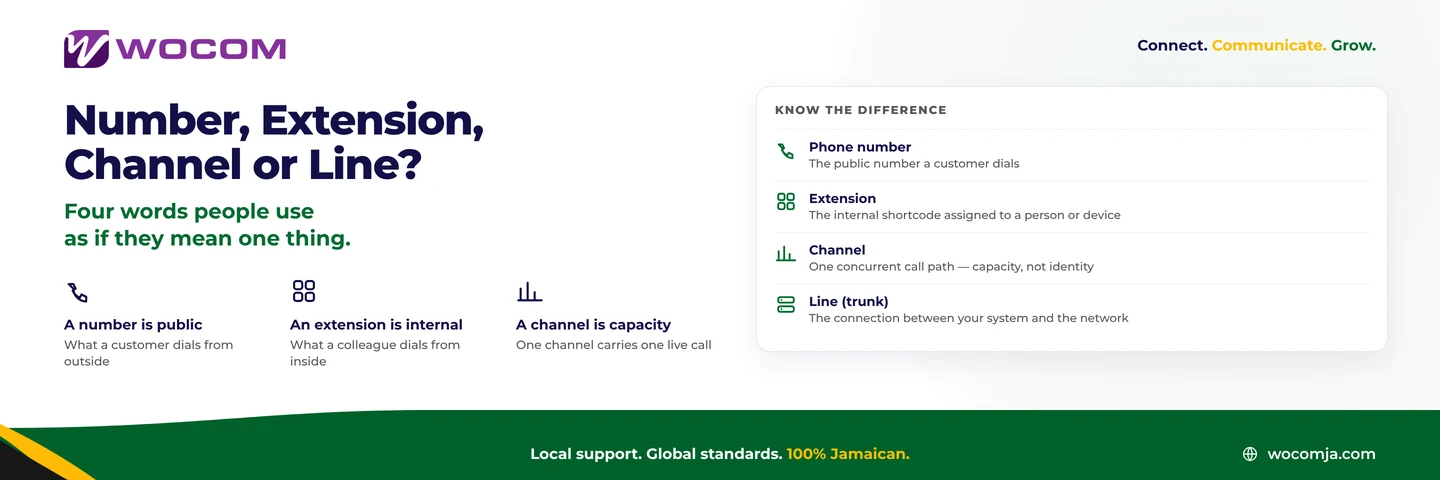
Phone number. Extension. Channel. Line. In most conversations about business phone systems these get used interchangeably, and the confusion costs real money — usually when a business buys twelve of something it needed four of, or four of something it needed twelve of.
They mean four genuinely different things. Here is each one, with the practical consequence of getting it wrong.
Phone Number: The Public Address
A phone number is what a customer outside your business dials to reach you. Ten digits in Jamaica, of the form 876–XXX–XXXX.
The important property is that a number is an address, not a connection. It identifies a destination; it does not itself carry anything. Your system decides what a number does when someone dials it, and that decision can change in a minute without the number changing.
This is why a business can have twenty numbers and four channels, or one number and twenty channels, and both can be correct. The numbers are how people find you. See the 876 numbering system for how the digits are structured.
Extension: The Internal Address
An extension is a short code — usually three or four digits — that identifies a person or device inside your phone system. Dial 204 from a desk phone in your office and you reach whoever holds extension 204.
Extensions do not exist on the public network. A customer cannot dial 204 from outside. If you want an outside caller to reach that person directly, you map a public number to their extension — which is exactly what a DID number is.
The practical consequence: extensions are effectively free and you should be generous with them. Number of extensions is a question about how many people and devices you have. It is not a question about capacity or cost.
Channel: The Capacity
A channel is one concurrent call path. One channel carries one live call. Two people on the phone at the same time uses two channels, regardless of which numbers were dialled or which extensions are involved.
This is the one that costs money, and the one most often misunderstood. Channels are a shared pool. They are not assigned to a person, a number or a desk — any call takes any free channel, and releases it when the call ends.
So the question “how many channels do I need?” is never about headcount. It is about the largest number of calls you will ever have live simultaneously. Our guide to how many lines your business needs works through the sizing.
Extensions are how many people you have. Channels are how many of them can be talking at once. Confusing the two is how businesses end up paying for capacity they never use.
Line or Trunk: The Connection
A line — more precisely a trunk — is the connection between your phone system and the outside network. On traditional telephony a line was a physical pair of copper wires carrying exactly one call, which is why the words “line” and “channel” became synonyms and have stayed tangled ever since.
On a modern system the trunk is a SIP trunk: a single logical connection over your internet link that carries as many concurrent calls as you have channels. One trunk, many channels. Nothing physical is added when you add capacity. See SIP trunking explained.
The old one-to-one relationship between lines and calls is the single most persistent piece of outdated thinking in business telephony, and it is why so many Jamaican businesses are still paying for four copper lines that do less than one SIP trunk would.
Putting It Together
A worked example. A distribution business in Portmore with fourteen staff:
- Numbers: five — a main number, plus direct numbers for accounts, dispatch, the warehouse and the sales manager
- Extensions: eighteen — fourteen people, plus a warehouse phone, a conference room, the front counter and a spare
- Channels: six — their peak simultaneous call count is four, plus headroom
- Trunk: one — a single SIP trunk carrying all six channels
Five, eighteen, six and one. Four different numbers for four different questions, and no reason for any of them to match.
Where the Confusion Costs You
- Buying channels by headcount. Fourteen channels for the business above would be more than double what they need, every month, forever.
- Rationing extensions. Sharing a handset between two people to “save a line” saves nothing at all.
- Assuming one number means one call. A single main number can carry all six concurrent calls. Businesses buy numbers they do not need to solve a capacity problem numbers do not affect.
- Keeping copper lines for capacity. Four analogue lines is four channels and nothing else. One SIP trunk does the same and more.
Get Yours Mapped
If you are not sure which of the four you actually have, WOCOM will map your current setup — numbers, extensions, channels and trunks — and show you where the mismatch is. It is usually the fastest saving available on a phone bill.
Call 876-906-7240 in Jamaica or 877-906-7240 from the US, email support@wocomja.com, or use the contact page.
Continue exploring
Ready to upgrade your communications?
Talk to our team about the right solution for your business.
Book a Demo Contact SalesEverett Kildare is WOCOM's voice and infrastructure specialist, with more than 25 years of experience designing and running carrier-grade voice, SIP and virtualization infrastructure. Holding a BSc in Information Technology, he has built, secured and migrated phone systems for businesses of every size. Everett writes WOCOM's technical coverage of SIP trunking, cloud PBX, contact centres, business continuity and migration.