VoIP Phone Backup Power Jamaica: Keep Your Calls Running When the Light Goes
The old copper landline had one thing going for it: when the light went, the phone still rang. The line carried its own current from the exchange, so your PSTN phone stayed alive even as every other device in the building went dark.
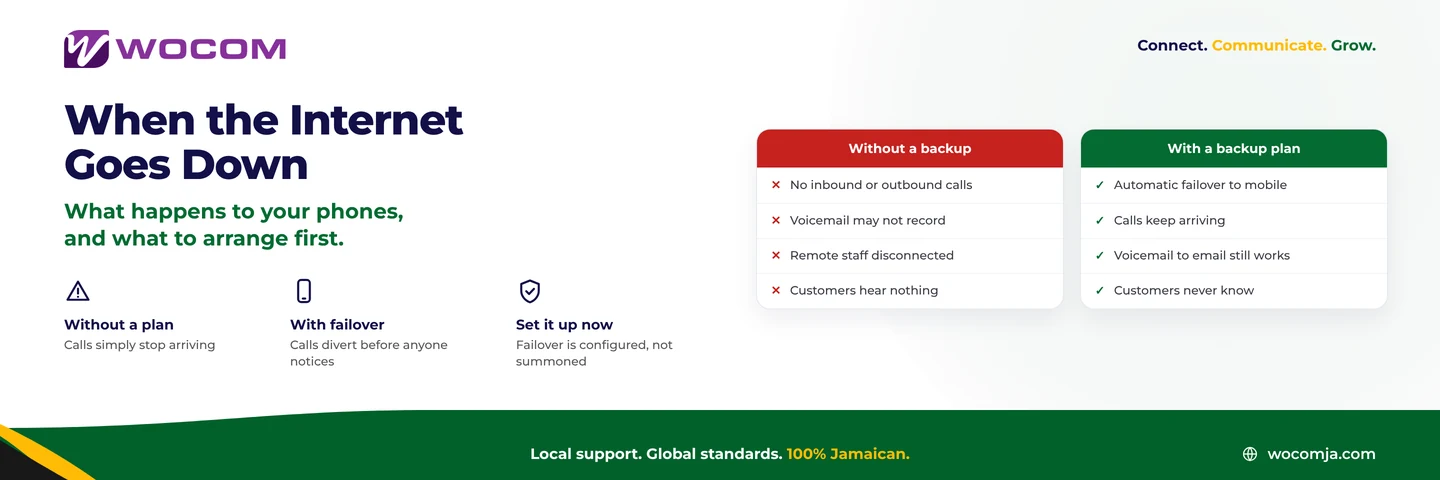
VoIP phones do not work that way. Your desk phone, your router, your internet modem — all of them need mains power. The moment JPS cuts, every one of those devices drops, and your business number goes silent. For a Cloud PBX customer in Kingston or Montego Bay, that silence can last minutes or hours depending on the outage.
The good news is this is a completely solvable problem. With the right backup power stack and a properly configured Cloud PBX, your calls can keep routing even while the rest of the office is on generator. This guide walks you through exactly what to buy, what to protect, and how to set it up.
Why VoIP Phones Lose Power When the Light Goes
A VoIP call travels as data packets, and data packets need three things powered on simultaneously: your desk phone (or softphone device), your local network switch, and your internet connection. If any one of those three fails, the call path breaks.
Traditional PABX systems kept the phone handsets alive because they were wired directly to the exchange with dedicated copper pairs. Cloud PBX replaces that copper with your internet connection — which is far more flexible and far cheaper, but introduces a new dependency on mains power at your premises.
Understanding this dependency is the first step. The fix is installing uninterruptible power supplies (UPS) at each failure point so the chain never breaks.
The Three Failure Points Every Jamaica VoIP Business Must Protect
When you lose mains power, your VoIP setup fails in one of three places — and you need to protect all three:
- The broadband modem or ONT. This is the physical device your ISP installed. No power, no internet, no calls. Even if every other device is on battery, a dead modem kills everything upstream of it.
- The router or firewall. This manages your internal network and routes traffic between your devices and the internet. On medium and larger sites in places like New Kingston or the industrial areas of Portmore, a rack-mount router or firewall sits between the modem and the office switch.
- The PoE switch feeding your desk phones. Most modern VoIP desk phones draw power through the Ethernet cable via Power over Ethernet (PoE). The switch supplies that power. If the switch goes down, every desk phone on the floor goes dark simultaneously.
Softphone users on laptops have a fourth point: the laptop battery. Laptops handle this automatically, so if your staff use the WOCOM mobile app or a softphone on a company laptop, they are already better protected for short outages than desk phone users.
UPS Sizing: What to Buy for a Jamaican Office
A UPS is a battery unit that sits between the wall socket and your equipment. When power cuts, it switches to battery in milliseconds — fast enough that most devices never notice. Here is how to size one for each failure point:
- Modem and router: These draw very little power — typically 10–30 watts combined. A small 600VA / 360W UPS will give you four to six hours of runtime on just the modem and router alone. This is the single most important purchase you can make. Brand: APC Back-UPS 600 or equivalent, available from hardware suppliers in Kingston and Half Way Tree.
- PoE switch: Runtime depends on how many phones are connected. A 24-port PoE switch feeding 10 active phones might draw 80–120 watts total. A 1500VA / 900W UPS will give roughly one to two hours of runtime. For longer outages, pair with a generator and use the UPS only to bridge the gap while the generator starts.
- Individual desk phones: If your switch is not on UPS, you can also buy small desktop UPS units per phone. This is less elegant but works for critical positions like reception or the sales desk.
The practical target for most Jamaican SMEs is two hours of battery runtime on the modem, router, and core switch. That covers the vast majority of JPS outages in urban areas. For longer outages, your generator handles the heavy lifting and the UPS bridges the 30–90 second generator startup gap.
The Cloud PBX Advantage: Calls Route Even When Your Office Is Down
Here is where Cloud PBX gives you an edge that no on-premise PABX can match: the intelligence lives in the cloud, not in your building.
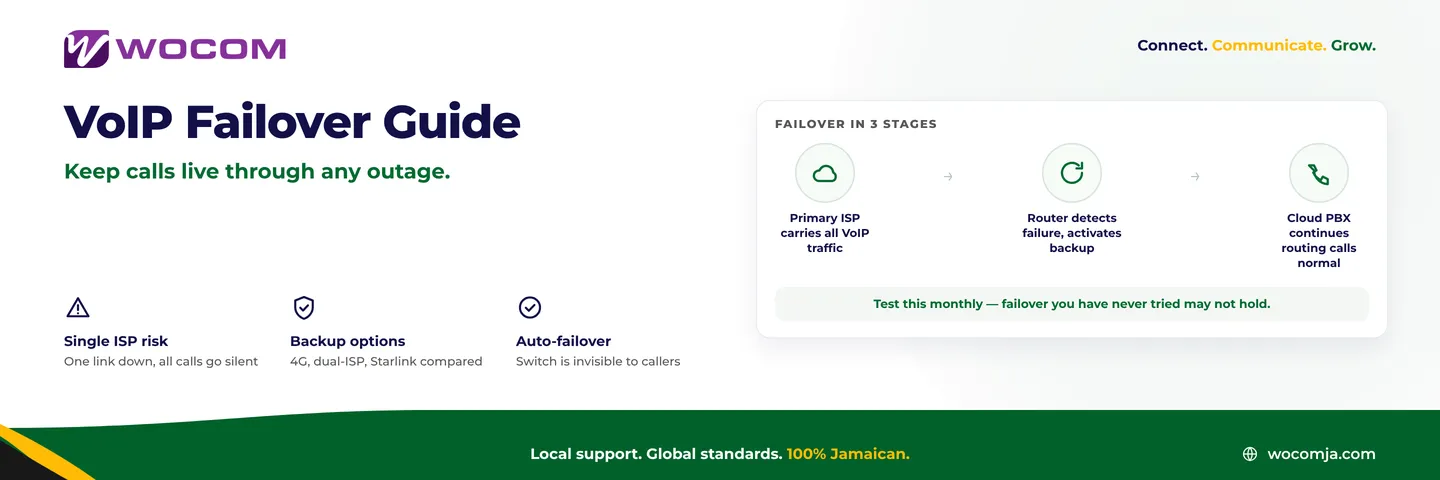
If your office loses power completely and your internet goes down, your Cloud PBX does not crash. The system keeps running on WOCOM's infrastructure. What changes is your routing. You can pre-configure your Cloud PBX to do any of the following automatically when your office lines become unreachable:
- Forward all inbound calls to staff mobile numbers
- Route to a different office or branch that still has power
- Play a custom message and offer a callback option
- Divert to your AI receptionist (WOCOM Alex) to capture the caller's name and number for follow-up
This is the real business continuity argument for Cloud PBX. An on-premise PABX box sitting in your server room goes down with the building. A Cloud PBX hosted in WOCOM's data centre keeps routing your calls regardless of what is happening at your physical location in Liguanee or May Pen or Ocho Rios.
Set this up in your WOCOM admin panel under call routing rules. WOCOM support can walk you through configuring a failover destination that activates automatically when your registered devices go offline.
Putting Together a Practical Backup Power Stack
For a typical Jamaican SME with 5–20 VoIP extensions, here is a straightforward hardware stack that covers most outage scenarios:
- Layer 1 — Modem + router UPS: 600VA unit on a dedicated outlet. Budget: J$15,000–J$25,000. Runtime goal: 4+ hours.
- Layer 2 — PoE switch UPS: 1500VA unit feeding your network switch. Budget: J$35,000–J$55,000. Runtime goal: 1–2 hours, bridging to generator.
- Layer 3 — Generator: Existing generator or inverter system covers extended outages. VoIP equipment draws modest power — a small 2kVA inverter generator handles an entire office phone stack with room to spare.
- Layer 4 — Cloud PBX failover rules: Pre-configured in your WOCOM portal before any outage occurs. Zero hardware cost, takes 10 minutes to set up.
Tip: Test your backup stack before a hurricane season. Cut mains power at the breaker panel on a quiet afternoon, confirm calls are still routing, and check how long the UPS holds. A five-minute drill can save your business during a Category 2 storm.
What About Internet Backup?
A UPS keeps your router powered but cannot restore internet service if your ISP's local infrastructure goes down. For businesses that cannot afford any internet downtime — financial services, BPO operations, contact centres — a secondary internet connection is worth considering. Starlink works well as a backup path for VoIP in parishes where terrestrial fibre is less reliable. WOCOM's Cloud PBX is connection-agnostic: it registers over whatever internet path your router is currently using, so switching to a backup ISP is transparent to the system.
Ready to Outage-Proof Your Business Phone System?
WOCOM's Cloud PBX was built with Jamaican infrastructure realities in mind — including the light going at the worst possible time. Between smart failover routing in the cloud and the right backup power hardware at your premises, your business number stays reachable through power cuts, storms, and anything else Jamaica can throw at it.
Talk to the WOCOM team about configuring your failover rules and auditing your current phone setup for outage vulnerabilities. Call us at 876-300-1111 or visit wocomja.com to get started.
Continue exploring
Ready to upgrade your communications?
Talk to our team about the right solution for your business.
Book a Demo Contact SalesEverett Kildare is WOCOM's voice and infrastructure specialist, with more than 25 years of experience designing and running carrier-grade voice, SIP and virtualization infrastructure. Holding a BSc in Information Technology, he has built, secured and migrated phone systems for businesses of every size. Everett writes WOCOM's technical coverage of SIP trunking, cloud PBX, contact centres, business continuity and migration.