VoIP Codecs Explained: G.711 vs G.729 and When Each One Is the Right Choice
Every VoIP call involves a decision most people never see: which codec the two ends agree to use. The codec turns your voice into data at one end and back into sound at the other, and the algorithm chosen determines both how much bandwidth the call consumes and how good it sounds.
Two codecs dominate business telephony. G.711 sends audio essentially uncompressed and sounds like a traditional landline. G.729 compresses it heavily, fitting roughly three times as many calls into the same connection, with a small but real loss of fidelity.
Neither is correct in every situation. This article explains what each one does, what compression breaks, and how to decide.
What a codec is doing
Your voice enters the phone as an analogue waveform. To travel over a network it has to be sampled, digitised, packaged into small packets — typically one packet every 20 milliseconds — and reassembled at the far end. The codec defines how that is done.
G.711 takes the straightforward route. It samples 8,000 times a second at 8 bits per sample, producing a 64 kbps stream, and applies no compression to the speech itself. There are two regional variants: μ-law (used in the Caribbean and North America) and A-law (Europe). Because it barely processes the audio, it introduces almost no encoding delay and reproduces exactly what the microphone heard within its frequency range.
G.729 uses a speech model. Rather than transmitting the waveform, it analyses each frame and transmits parameters that let the far end reconstruct something that sounds like the original — at 8 kbps, one-eighth of the data. That works remarkably well for human speech. It works poorly for anything that is not human speech, which is the source of most G.729 complaints.
The bandwidth difference, honestly calculated
Codec bit rates are quoted as payload only. What your connection actually carries is the payload plus IP, UDP and RTP headers, plus the Ethernet frame — roughly 23 kbps of overhead per call at 20 ms packetisation. That overhead does not compress.
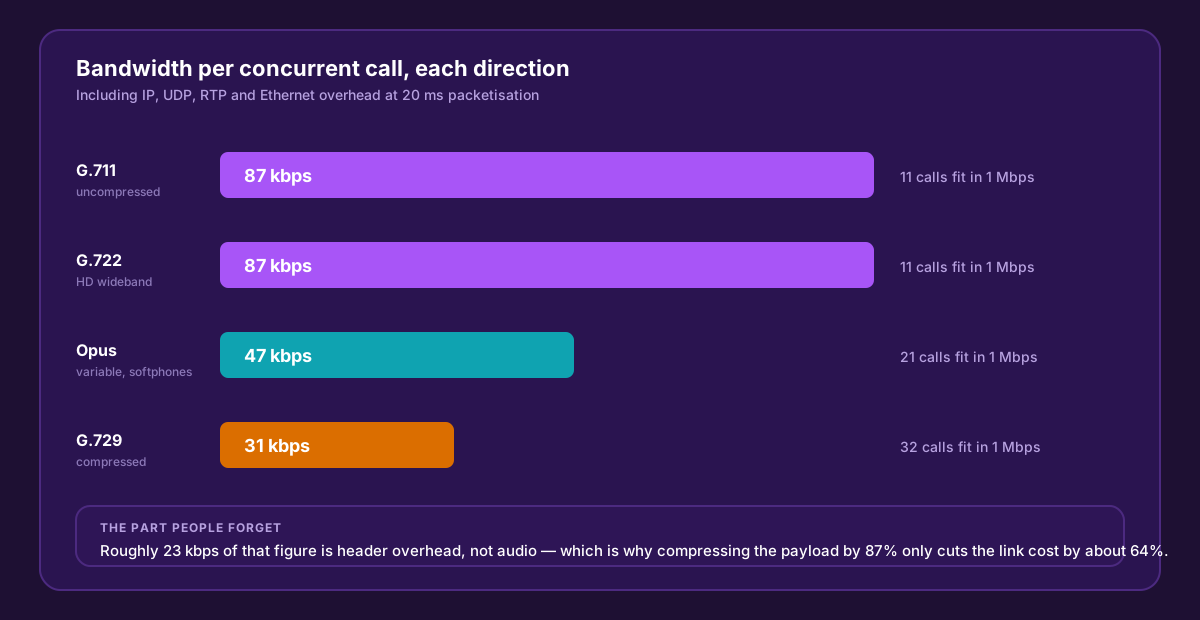
Compressing the payload by 87% only reduces the link cost by about 64%, because headers are a fixed cost per packet regardless of codec.
Practically: on a 2 Mbps upload, G.711 gives you around 22 simultaneous calls with nothing else running, and G.729 gives you around 64. For a ten-person office with a peak of six concurrent calls, both fit comfortably and the choice should be made on quality. For a thirty-seat contact centre on a modest link, the difference decides whether the system works at all.
One useful trick before switching codecs: increasing packetisation from 20 ms to 30 ms reduces the number of packets per second and therefore the header overhead — about 15% saving on G.711 — at the cost of slightly more delay and a bigger loss if a packet goes missing.
The quality difference
Quality is measured as Mean Opinion Score, a 1-to-5 scale derived from listener testing. The published typical values:
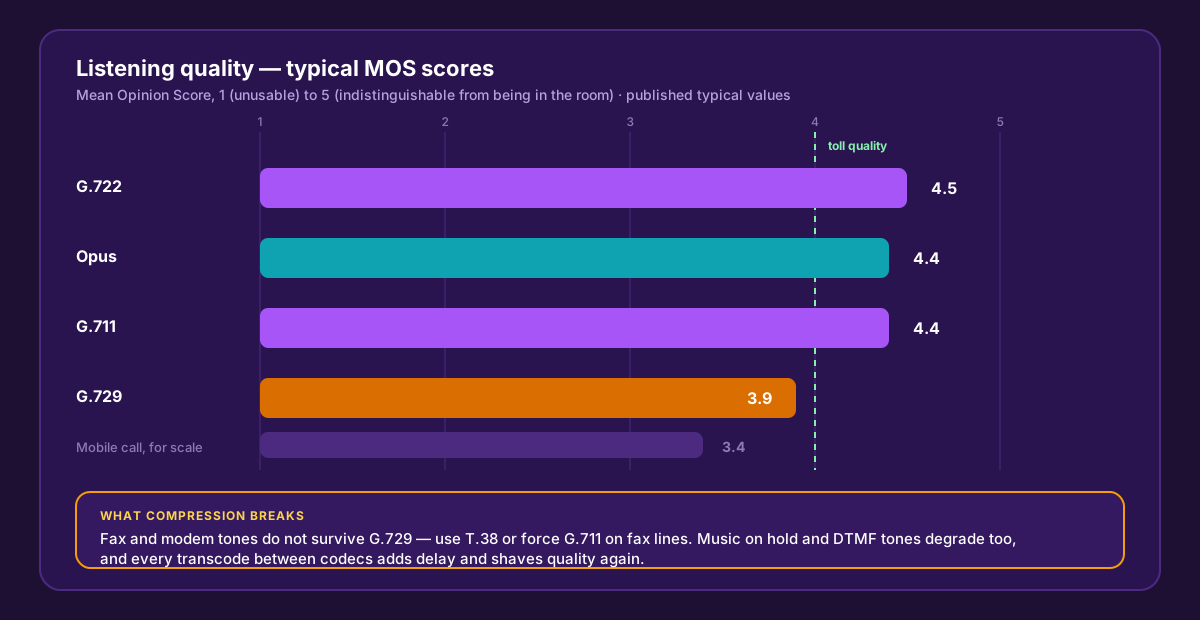
G.729 is not bad — it scores close to toll quality and above a typical mobile call. It is simply not as good as G.711, and the gap widens the moment anything goes wrong on the network.
On a clean network, most people cannot reliably tell a G.729 call from a G.711 call in casual conversation. The difference shows up in three places: unfamiliar accents, background noise, and names or numbers being spelled out — exactly the situations where a business call matters most.
There is also a compounding effect. A G.729 call that loses 1% of packets sounds noticeably worse than a G.711 call losing the same 1%, because each compressed frame carries more information. Compression reduces your margin for error.
What compression breaks outright
- Fax. Fax tones are not speech, so a speech model mangles them. Fax over G.729 fails, intermittently and confusingly. Use T.38 fax relay, or force G.711 on fax paths. This is the single most common cause of “our fax stopped working after we moved to VoIP.”
- Modems, alarm panels and card machines. Same reason. Anything that sends tones down a phone line needs G.711.
- Music on hold. Music is not speech either. On G.729 it sounds thin and warbly — and hold music is what callers judge you by while they wait.
- DTMF keypad tones. Compressed tones can be mis-detected by IVR systems. Send DTMF out of band (RFC 2833 / telephone-event) rather than relying on the audio path — good practice on any codec, essential on G.729.
- Repeated transcoding. Every conversion between codecs adds delay and shaves quality again. A call that goes G.729 → G.711 → G.729 across a chain of systems sounds worse than either leg suggests.
The two codecs people forget
G.722 is wideband — it carries roughly double the frequency range of G.711, so voices sound fuller and more natural, and it does this at the same 64 kbps payload. If both ends support it and bandwidth is not your constraint, it is the best-sounding option on this list. It only works end to end: a G.722 call that leaves your network for the public telephone network is transcoded down to narrowband anyway, so its benefit is largest for internal calls between sites and staff.
Opus is the modern variable-bitrate codec used by most softphones and browser-based calling. It adapts to conditions, handles packet loss gracefully, and sounds excellent across a wide range of bit rates. If your staff use apps rather than desk phones, you are likely already using it without having chosen it.
Choosing, in practice
| Situation | Use | Why |
|---|---|---|
| Office on fibre or good business broadband | G.711 | Bandwidth is not the constraint; take the quality |
| Calls between your own sites or staff | G.722 | Wideband end to end, no transcoding penalty |
| Contact centre with many concurrent calls | G.729 | Three times the concurrency on the same circuit |
| Constrained or shared uplink | G.729 | Fits within what the link can actually carry |
| Remote staff on mobile data | Opus / G.729 | Tolerates variable conditions and lower throughput |
| Fax, alarms, card machines | G.711 or T.38 | Tones do not survive a speech codec |
| Long international legs | G.729 | Less data to carry over a long, congested path |
The usual answer for a Jamaican business on a decent connection is: G.711 as the preferred codec, G.729 offered as a fallback. Most PBX platforms let you order the codec list per trunk or per extension, so the system negotiates the best available and drops back gracefully when it cannot.
Two practical notes. Set the codec priority the same on both ends where you can — mismatched preference lists cause needless transcoding. And on fax paths, remove G.729 from the list entirely rather than relying on it to negotiate away.
Before you switch codecs, check the queue
Businesses often move to G.729 to fix call quality, and it does not help — because the problem was jitter, not bandwidth. If the connection has capacity but calls still break up, the fix is prioritisation at your router, not compression. Our QoS configuration guide for Cisco, Ubiquiti and SonicWall covers that, and the bandwidth guide shows how to size the link properly in the first place.
Compress because you genuinely need the concurrency. Do not compress to paper over a network fault — you will lose quality and still have the fault.
We will set this up for you
WOCOM operates its own carrier network, so codec selection is something we tune with you rather than something you inherit. On a Flexi-SIP trunk we will recommend the codec order for your concurrency and connection, keep fax paths on G.711 or T.38, and configure DTMF correctly so your IVR and card systems keep working.
Call 876-906-7240 or talk to our engineers — including if you are on someone else’s trunk and simply want a second opinion on why calls sound the way they do.
Continue exploring
Ready to upgrade your communications?
Talk to our team about the right solution for your business.
Book a Demo Contact SalesEverett Kildare is WOCOM's voice and infrastructure specialist, with more than 25 years of experience designing and running carrier-grade voice, SIP and virtualization infrastructure. Holding a BSc in Information Technology, he has built, secured and migrated phone systems for businesses of every size. Everett writes WOCOM's technical coverage of SIP trunking, cloud PBX, contact centres, business continuity and migration.