From Switchboard to Cloud PBX: The Evolution of Business Telephone Systems
Why the History Is Worth Ten Minutes
Almost every confusing thing about business phone systems is a fossil. The words we use, the way capacity is sold, the assumption that a number is tied to a place — all of it made complete sense at some point, and most of it stopped making sense decades ago.
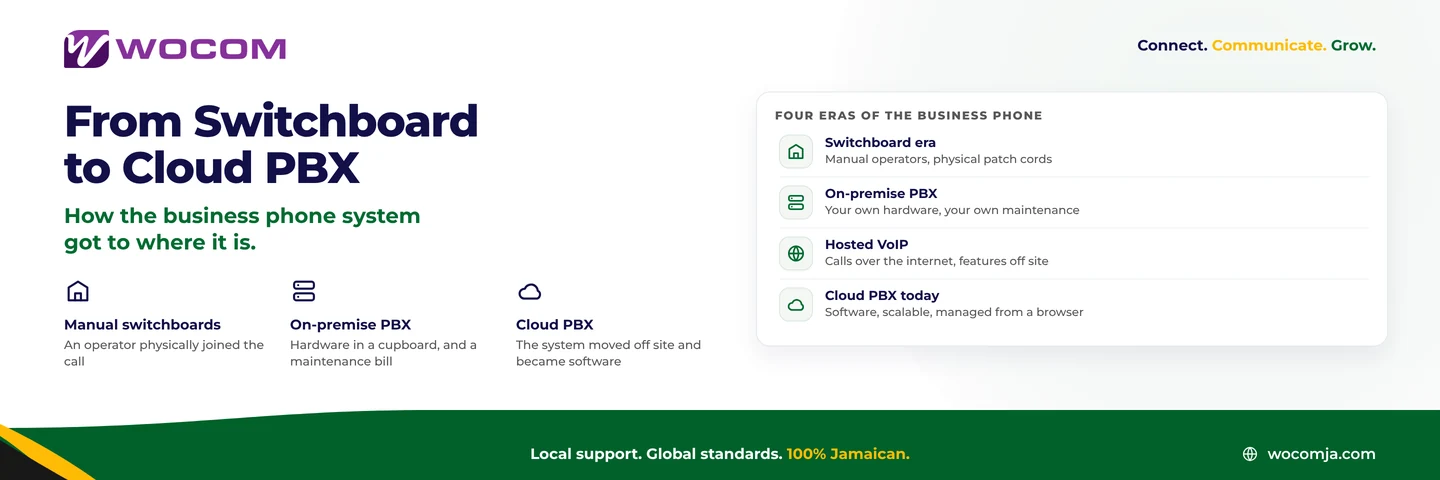
Four eras, and what each one left behind.
Era One: The Manual Switchboard
An operator sat at a board of sockets with a handful of patch cords. A call came in, she asked who you wanted, and she physically connected two circuits by plugging a cord into a socket.
Everything was literal. A “line” was a wire. A “connection” was a piece of metal touching another piece of metal. Being “put through” described an actual act. Capacity was the number of cords the operator had, and if they were all in use you waited.
What it left behind: the whole vocabulary. We still say line, connect, put through and hold, and every one of those words describes a physical action nobody has performed since.
Era Two: The On-Premise PBX
From the middle of the twentieth century the switchboard was replaced by a Private Branch Exchange — a cabinet of equipment in your own building that did the switching automatically.
This was a genuine leap. Internal calls between extensions became free and instant. Features arrived that had previously required a human: transfer, hold, conference, voicemail, and eventually direct inward dialling, which let outside callers reach an extension without going through the operator at all.
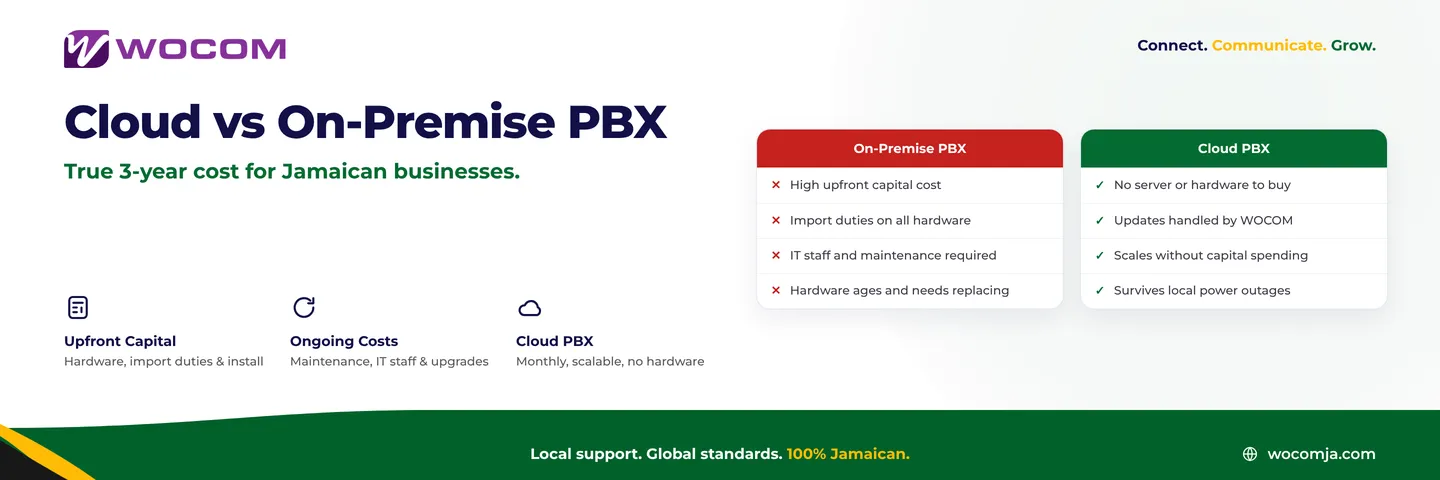
It also created the shape of business telephony that many Jamaican companies still live inside. The system was capital equipment. It sat in a cupboard, it needed a maintenance contract, it needed a specialist to change anything, and its capacity was fixed on the day it was installed. Adding ten extensions could mean a new card, or a new cabinet.
What it left behind: the instinct that changing your phone system is a project. Businesses still ring us expecting a site visit to add an extension.
Era Three: VoIP and Hosted Systems
From the late 1990s, voice became data. Instead of dedicated circuits, calls were packets travelling over the same networks as everything else — the journey described in what happens when you make a business phone call.
Two things followed, and they were bigger than they looked at the time.
First, the cost of distance collapsed. If a call is packets, a call between Kingston and Miami costs no more to carry than a call between two desks. The entire pricing structure of long distance was built on an assumption that had stopped being true.
Second, the phone stopped being tied to a place. A number is an address the system resolves, not a wire terminating at a socket. An extension could be anywhere there was a connection.
Early hosted VoIP moved the switching off site but was often thin on features and heavily dependent on connections that were not yet good enough — which is where much of the lingering scepticism about VoIP call quality in Jamaica comes from. That scepticism is now about a decade out of date; the relevant measures are latency, jitter and packet loss, and on a properly provisioned link they are not a problem.
Era Four: Cloud PBX
The current era is not simply hosted VoIP with a better connection. The difference is that the phone system became software you administer rather than a service you request changes to.
What that changes in practice:
- Capacity is a setting. Adding channels for a seasonal peak takes minutes and is reversible.
- Configuration is self-service. Ring strategies, hours, routing and extensions change in a browser, immediately.
- Location is irrelevant. Office, branch, home and mobile are the same to the system — the basis of phone systems for remote workers.
- Intelligence is included. Transcription, call scoring and an AI receptionist are features of the system rather than separate products.
- Resilience is configuration. Failover is something you set up rather than something you install — see what happens when the internet goes down.
The switchboard operator physically joined two circuits. The cloud PBX makes the same decision in software, several hundred times a second, and lets you rewrite the rules from a browser.
What Has Not Changed
Worth saying, because technology stories tend to imply that everything is different now.
A customer still rings a number and wants a person. They still judge the business by how long that takes and who they get. Every era of this technology has been an attempt to answer faster and route better, and the measure of success has never moved: was the call answered, and did the caller get what they rang for?
The tools got better. The job is the same one the operator with the patch cords was doing.
Where Your Business Sits
Plenty of Jamaican businesses are still somewhere in era two, with a cabinet in a cupboard and a maintenance contract. Plenty more are in a hybrid state — some copper, some cloud, held together by habit.
If you want to know which era your setup actually belongs to and what moving would involve, the cloud PBX overview is the place to start. Then call 876-906-7240 in Jamaica or 877-906-7240 from the US, email support@wocomja.com, or use the contact page.
Continue exploring
Ready to upgrade your communications?
Talk to our team about the right solution for your business.
Book a Demo Contact SalesMichelle Goss is a data and AI analyst at WOCOM, where she studies how Jamaican businesses use voice, messaging and AI to win and keep customers. With a BSc in Data Science & Analytics, she turns call data, customer trends and AI receptionist performance into practical guidance owners can act on. Michelle writes WOCOM's coverage of AI call handling, call analytics, customer growth and industry trends.