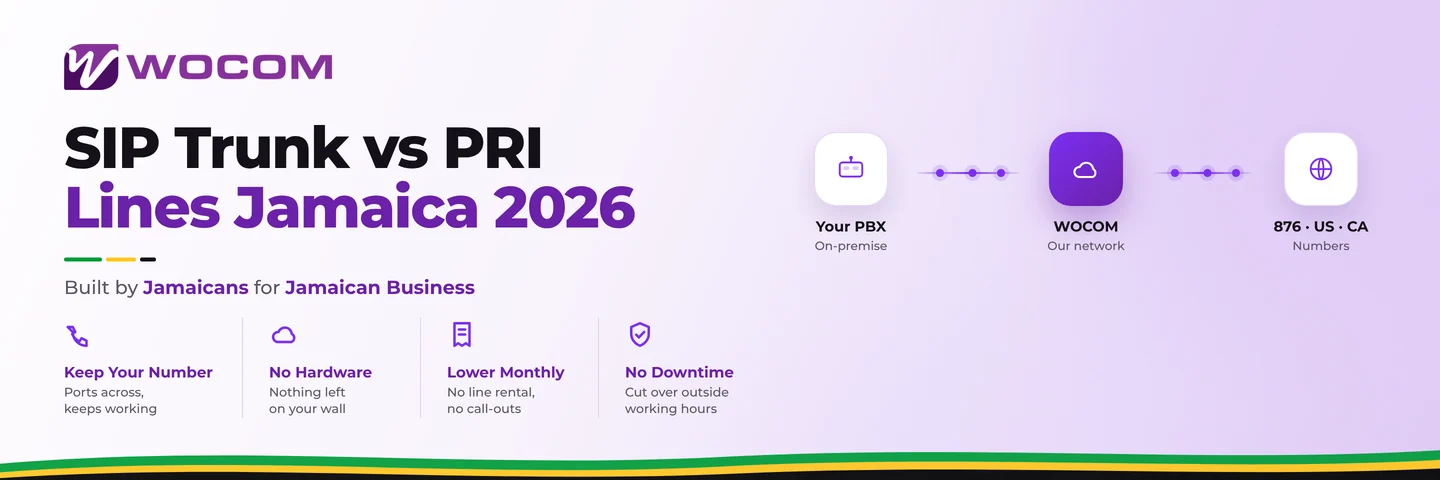
SIP Trunk vs PRI Lines Jamaica 2026: Head-to-Head Comparison for IT Managers
What Is a PRI Line and Why Does Jamaica Still Have Them?
A Primary Rate Interface (PRI) is a dedicated physical circuit — delivered over a T1 cable — that carries 23 simultaneous voice channels into a PBX. Each channel handles one call. Fill all 23 and the next caller gets a busy signal. Organisations that needed more capacity stacked additional PRI circuits: two PRIs for 46 channels, three for 69, and so on.
PRIs arrived in Jamaica in the late 1990s and became the benchmark for any business too large for basic analogue lines but not yet on internet-based voice. New Kingston banks, BPO floors in Portmore and along the north coast, contact centres, and government ministries all built their telephony infrastructure around them. Many still operate on PRI today — because a multi-year carrier contract has not expired, because the existing PBX lacks a SIP interface, or because the internal business case for switching has never been formally made.
If that describes your organisation, this comparison is for you.
What Is SIP Trunking and How Does It Work?
SIP (Session Initiation Protocol) trunking delivers voice calls digitally over your existing internet connection. Instead of a physical circuit with a fixed channel ceiling, you get a configurable number of concurrent call paths — managed in software by your provider. Need to absorb a surge of inbound calls during a product launch or a Kingston traffic crisis? Add channels without dispatching a technician. Heading into a slow quarter? Reduce your channel count and lower the bill accordingly.
WOCOM's SIP trunks connect into Jamaica's PSTN through carrier-grade infrastructure, so calls reach any local landline, Jamaican mobile, or international destination exactly as they would from a PRI — without the copper, without the channel bank hardware, and without the weeks-long provisioning cycle.
PRI vs SIP Trunk: Head-to-Head
Here is how the two technologies compare across the dimensions that matter most to IT managers and financial decision-makers in Jamaica.
- Monthly cost: A single PRI in Jamaica typically costs significantly more than an equivalent block of SIP channels covering the same concurrent call volume. Hardware leasing, maintenance contracts, and per-minute charges for international calls inflate the PRI total further. SIP trunking consolidates these into a predictable channel fee plus usage, with international rates that are a fraction of PRI carrier pricing.
- Capacity and scalability: PRI capacity jumps in fixed blocks of 23. If you need 25 concurrent calls, you pay for 46 channels whether you use them or not. SIP channels scale by single units — buy exactly what current call data shows you need.
- Hardware requirements: PRI requires a T1 interface card or channel bank connected to your PBX, plus a physical handoff point from the carrier. SIP trunking requires only a stable internet connection and a SIP-capable PBX or gateway — hardware most organisations built after 2010 already have.
- Provisioning time: A new PRI circuit in Jamaica can take four to eight weeks for the carrier to install, test, and hand over. A WOCOM SIP trunk can be activated and call-tested within hours of signing up.
- Redundancy and failover: A cut fibre or failed T1 card takes your entire PRI down with no automatic recovery. SIP trunking can be configured to fail over to a secondary internet connection — 4G LTE, a second fixed-broadband circuit, or Starlink — automatically, keeping your business lines live even when your primary connection is disrupted.
- Geographic flexibility: PRI circuits are anchored to a physical location. SIP trunks follow your internet connection. A Kingston employee working remotely in Montego Bay, or your entire team sheltering at home during a hurricane warning, stays reachable on the same business numbers and extensions.
- Features: SIP trunking supports direct inward dialling (DID), caller ID presentation and manipulation, call recording feeds, and API integration natively. PRI systems can technically support most of these, but each feature typically requires additional hardware or a carrier configuration change that carries its own lead time and cost.
- Maintenance overhead: PRI hardware fails. Channel banks need firmware updates. T1 interface cards need replacing. SIP trunking shifts that maintenance burden to your provider's network — off your server room and out of your team's incident queue.
When PRI Still Makes Sense
To be direct: the genuine use cases for keeping PRI in Jamaica in 2026 are narrow.
- Legacy PBX with no SIP capability: If your on-site PBX is so old that it has no SIP interface and no compatible voice gateway exists for it, you may need to retain the PRI until the PBX itself is replaced. In this scenario the real decision is the PBX upgrade — the trunk question resolves itself once you have a SIP-capable system.
- Genuine internet connectivity gaps: A small number of rural or industrial Jamaican sites still lack reliable fixed broadband, and mobile LTE coverage can be inconsistent in some parishes. If your specific site has robust PRI but inadequate internet and no Starlink line-of-sight, PRI may be the more stable choice in the short term. This is increasingly rare, but it is a legitimate edge case.
- Contractual lock-in with punishing exit fees: If you are 18 months into a 3-year PRI agreement with significant early termination penalties, the arithmetic of breaking early may not favour you. In this case, plan your SIP migration around the contract end date and start technical groundwork now — so you are ready to flip on the day your renewal arrives, not months after.
Outside these specific situations, the case for retaining PRI in Jamaica on cost, features, or resilience grounds is very difficult to make.
How to Migrate from PRI to SIP Trunking in Jamaica
A PRI-to-SIP migration does not have to be a high-risk cutover. A phased approach lets you validate call quality before decommissioning the legacy circuit.
- Audit your current PRI usage. Pull 90 days of call data. Identify your peak concurrent call count and your busiest hours. This tells you exactly how many SIP channels to order — usually fewer than you expect, because most organisations overpay for PRI capacity they rarely use.
- Confirm your PBX is SIP-ready. Most PBXes sold after 2010 support SIP trunking natively or via a gateway card. If yours does not, a voice gateway from brands like Grandstream or AudioCodes converts your existing PBX to accept SIP at a fraction of the cost of a full replacement.
- Assess your internet connection. SIP trunking needs a stable, low-latency connection with QoS configured to prioritise voice packets. If you are running voice over a shared general-purpose internet line, invest in QoS configuration or a dedicated internet access (DIA) circuit first. WOCOM can advise on minimum requirements based on your target channel count.
- Port your numbers. Your existing Jamaican numbers can be ported to WOCOM's SIP trunking platform. Number porting typically takes 5–15 business days. During the port your PRI and SIP trunks run in parallel, so there is no interruption to incoming calls.
- Run parallel for 30 days. Once SIP is live, keep the PRI active for a month. Route outbound calls through SIP, confirm call quality and channel capacity hold up under real load, then redirect inbound and decommission the PRI at month end. Most migrations complete without a single reported call-quality complaint.
Ready to Review Your PRI Contract? Talk to WOCOM.
WOCOM is Jamaica's licensed business phone provider with carrier-grade SIP infrastructure purpose-built for the local network. If your PRI contract is approaching renewal — or if you are simply ready to stop paying for infrastructure that no longer fits — our team will run a free audit of your current call volumes and show you side-by-side what SIP trunking would cost by comparison.
Most Jamaican organisations that switch from PRI to WOCOM SIP trunking reduce their monthly line costs by 40–60 percent while gaining instant scalability, built-in failover, and full geographic flexibility for remote teams.
Bring your latest PRI invoice and your call volume data. We will do the numbers together. Contact WOCOM at sales@wocomja.com or visit wocomja.com/contact to book your migration consultation — no pressure, just an honest comparison so you can make the right call before the next renewal deadline arrives.
Continue exploring
Ready to upgrade your communications?
Talk to our team about the right solution for your business.
Book a Demo Contact SalesEverett Kildare is WOCOM's voice and infrastructure specialist, with more than 25 years of experience designing and running carrier-grade voice, SIP and virtualization infrastructure. Holding a BSc in Information Technology, he has built, secured and migrated phone systems for businesses of every size. Everett writes WOCOM's technical coverage of SIP trunking, cloud PBX, contact centres, business continuity and migration.