Business Phone Vendor Lock-In Jamaica: The Contract Clauses That Trap You
Why This Problem Is Bigger in Jamaica Than Most Businesses Realise
When a Jamaican business signs up for a phone system — whether it is a traditional PABX, a hosted PBX, or a basic business line — the focus tends to land on cost per minute and feature count. Few businesses read the fine print carefully enough to spot the mechanisms that make switching painful or expensive eighteen months later.
Vendor lock-in in telecoms is not accidental. It is engineered. Proprietary handsets, carrier-owned numbers, multi-year service agreements, and long notice periods all work together to make inertia cheaper than change — even when the service is no longer competitive. This article explains what to look for before you commit, and what a genuinely flexible arrangement looks like.
Five Lock-In Clauses Most Businesses Miss
1. Auto-Renewal Without Notification
Many business phone contracts include an auto-renewal clause: if you do not give written notice of cancellation within a specified window — often 90 to 180 days before the contract end date — it rolls over automatically, usually for the same original term. A two-year contract becomes a four-year commitment by default, with no reminder from your provider that the window is closing.
What to ask before signing: "Does this contract auto-renew, and what is the written cancellation notice period?"
2. Numbers Owned by the Carrier
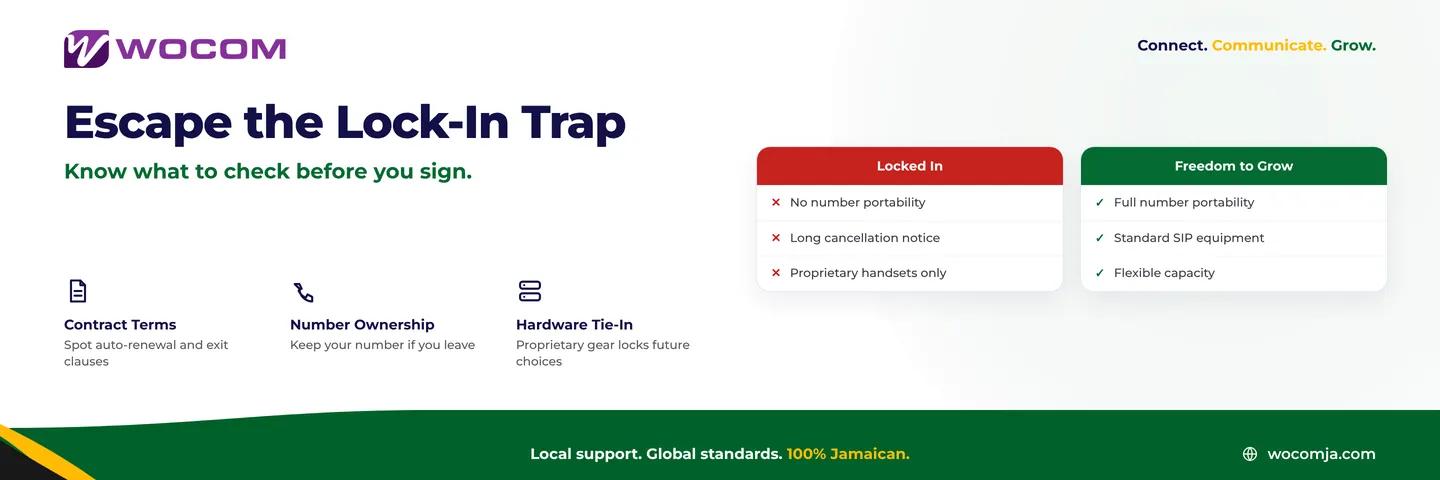
Some providers, particularly those operating proprietary platforms rather than licensed carrier infrastructure, issue phone numbers that technically belong to them rather than to your business. When you leave, you cannot take the number with you. The number on your website, your Google Business Profile, and your business cards becomes their asset — and you start over.
What to ask: "If I leave, can I port my number to another provider? Are there any restrictions on outbound porting?"
3. Proprietary Hardware Requirements
A provider who insists you use only their branded handsets or gateways is telling you something important: their platform cannot work with standard SIP equipment. Every desk phone you purchase is an investment that survives only as long as you stay with that provider. When you switch, the hardware is written off.
What to ask: "Does this system work with standard SIP-compatible phones? Can I use equipment I already own?"
4. Early Termination Fees
These are the most straightforward form of lock-in: a flat penalty, or the sum of all remaining monthly charges, becomes due the moment you cancel early. On a three-year contract at $25,000 JMD per month, exiting at the midpoint triggers a bill north of $450,000 JMD — enough to make a poor product feel acceptable by comparison.
What to ask: "What is the early termination fee if I cancel at month 12? At month 18?"
5. Bundled Services You Cannot Unbundle
Some contracts bundle internet, hardware maintenance, and phone service into a single inseparable package. If your internet connectivity becomes uncompetitive — a real risk as Starlink and other alternatives reshape the Jamaican market — you cannot move your internet without also surrendering your phone service.
What to ask: "Can I keep the phone service if I change internet provider?"
The Real Cost of Staying Stuck
Lock-in is not just an inconvenience. It carries measurable business cost that most owners only calculate after the fact.
- You pay for capacity you do not use. A business that downsized after a difficult year still pays for the channels committed at signing. Scaling down requires a renegotiation the provider has no incentive to offer.
- You miss features your competitors gain. Cloud-based phone systems receive continuous updates. If your contract ties you to a hardware PBX version frozen in 2022, every feature your competitor's cloud provider releases is out of reach until renewal — if it ever arrives.
- Your number is held hostage. Businesses across Kingston and Montego Bay that have built customer recognition around a specific number face a real dilemma when their provider owns it: absorb the exit fee, or rebuild brand recognition around a new number. Both paths cost money.
- Support becomes leverage. A provider who knows you cannot leave easily has less incentive to resolve issues quickly or offer competitive terms at renewal. The balance of power shifts the moment you sign.
What a Lock-In-Free Arrangement Actually Looks Like
Genuine flexibility in a business phone contract has four characteristics that you can check before committing to anything:
- Standard SIP compatibility. The platform works with any SIP-certified desk phone, softphone, or gateway — including equipment you already own. You are not buying into a closed hardware ecosystem where every upgrade flows through the same vendor.
- Number portability in both directions. You can bring your existing number in, and you can take it with you if you ever leave. The number is registered to your business, not to the provider.
- Capacity you can adjust without renegotiating. Adding a SIP trunk channel for a busy season or removing one when you downsize should be a configuration change, not a contract event. Elastic capacity is a basic feature of properly structured SIP trunking — it should not be treated as a premium.
- Clear, short notice periods. A provider confident in their service does not need 180 days of notice to hold you. Reasonable notice periods of 30 days are a signal that the product earns retention rather than requiring it.
How WOCOM Is Structured Differently
WOCOM is a licensed telephone service provider in Jamaica — we own and operate the network infrastructure rather than reselling capacity from another carrier. That distinction matters for number ownership: your phone numbers are registered on a licensed Jamaican carrier, giving you outbound port rights that a reseller arrangement often cannot provide.
Our SIP trunking and Cloud PBX services run on open SIP standards. If you use a 3CX PBX, a Grandstream gateway, or a Yealink desk phone, it connects to our trunks without modification. We do not require proprietary handsets, and we do not lock features behind hardware you must purchase from us.
Businesses in Kingston, Montego Bay, Spanish Town, and across the island use WOCOM alongside their existing infrastructure — porting in numbers they have built recognition around, adding capacity where needed, and scaling without a renegotiation every time something changes in their business.
The best time to read the fine print is before you sign. If your current contract is up for renewal, the five questions in this article take less than ten minutes to get answers to — and those answers will tell you almost everything you need to know about the next three years.
Ready to Compare Your Options?
WOCOM's team works with Jamaican businesses at every stage — whether you are locked into a contract you want to plan an exit from, evaluating providers before a renewal, or setting up communications for a new location. We will give you a straight answer about what fits your situation, including the cases where our service is not the right match.
Call us at 876-929-0000 or visit wocomenterprise.com/contact to speak with an account manager who knows the Jamaican market and can review your current arrangement honestly.
Continue exploring
Ready to upgrade your communications?
Talk to our team about the right solution for your business.
Book a Demo Contact SalesMichelle Goss is a data and AI analyst at WOCOM, where she studies how Jamaican businesses use voice, messaging and AI to win and keep customers. With a BSc in Data Science & Analytics, she turns call data, customer trends and AI receptionist performance into practical guidance owners can act on. Michelle writes WOCOM's coverage of AI call handling, call analytics, customer growth and industry trends.