PCI DSS and Call Recording Jamaica: What Every Business Taking Card Payments Needs to Know
Call recording is one of the most valuable tools a Jamaica business can deploy. It supports staff training, protects you in disputes, and gives supervisors the evidence they need to coach agents to higher standards. Most businesses that record calls are doing the right thing — except for one scenario that very few have considered: what happens when a customer reads their credit card number out loud on a recorded call?
If your team accepts card payments on calls — even occasionally — that recording is now storing sensitive payment card data. Under the Payment Card Industry Data Security Standard (PCI DSS), that is a compliance violation. The consequences range from fines imposed by card schemes through your acquiring bank, to suspension of your ability to accept card payments entirely. For a Kingston retailer, a Montego Bay hotel, or any Jamaican service business that has ever told a customer "just call us and we can take your card," this is a live risk worth understanding.
What PCI DSS Is and Why It Applies to Your Jamaica Business
PCI DSS is a global security standard maintained by the Payment Card Industry Security Standards Council and enforced by the major card networks — Visa, Mastercard, and Diners Club. Any business that stores, processes, or transmits cardholder data is required to comply, regardless of size or geography. In Jamaica, compliance is enforced through your acquiring bank — NCB Merchant Services, Scotiabank Jamaica, JN Bank, JMMB, and others all require merchants to attest to PCI DSS compliance as a condition of accepting card payments.
PCI DSS version 4.0, which became the mandatory standard in 2024, tightened requirements around data storage and audit logging. It applies to every business that processes Visa or Mastercard transactions — including small operators running a single terminal and businesses that take card payments infrequently. If you accept cards, you are in scope.
The Specific Problem With Recording Calls That Include Card Data
PCI DSS Requirement 3.3 is clear: sensitive authentication data must not be stored after authorization is complete. This includes:
- The full 16-digit Primary Account Number (PAN) — the card number itself
- The card verification value (CVV2 or CVC2) — the 3 or 4 digit security code
- The card expiry date when stored alongside the PAN
- PIN data of any kind
When a customer reads any of these aloud and your system records the call, the audio file becomes a stored record of sensitive authentication data. The PCI DSS does not care whether the data is in a database, a spreadsheet, or an audio file. It cares that the data exists in a retrievable form after the transaction is processed. An MP3 of a customer saying "four-five-seven-three, nine-eight-one-two..." meets that definition.
This is not a theoretical concern. Card scheme audits, data breach investigations, and bank-initiated merchant reviews have identified call recordings as a compliance gap at businesses that otherwise had good security practices in place.
Which Jamaica Businesses Are Most Exposed
Any business where a staff member verbally collects card details from a caller and processes the payment carries this risk. In the Jamaican market, that includes:
- Retailers and distributors who take telephone orders from trade customers or the public
- Hotels, guest houses, and villas confirming bookings and deposits from local and international callers
- Insurance brokers and agents collecting premium payments
- Healthcare and diagnostic centres processing co-payments or procedure deposits
- Car rental companies holding security deposits against a card number provided verbally
- Event promoters and ticketing operations selling tickets to callers who do not have access to the online portal
- Any utility or service provider who offers a phone payment option as a convenience
If your business appears in that list and you currently record calls without a pause mechanism, the compliance gap is open right now.
Four Recording Mistakes That Create a PCI Problem
Most businesses running into PCI recording issues are not cutting corners on purpose. The problems usually fall into one of four patterns:
- Recording full calls with no pause capability. The system records everything. There is no way for the agent to stop and restart recording mid-call. Every card read-out since the system went live is sitting in storage.
- Agents forgetting to pause even when the feature exists. The pause button is there, but under pressure — long queues, impatient callers, multitasking — agents skip it. Without logging, there is no way to know it happened.
- Indefinite retention of recordings. PCI DSS does not set a maximum retention period for all call recordings, but it does require that cardholder data be protected wherever it exists. Storing years of unreviewed recordings containing card data significantly increases your audit exposure.
- No access controls on the recording archive. PCI DSS Requirement 10 requires that access to cardholder data environments be logged and auditable. If your call recordings sit on a shared drive accessible to any staff member, that is another gap.
How Pause-Resume Call Recording Solves the Problem
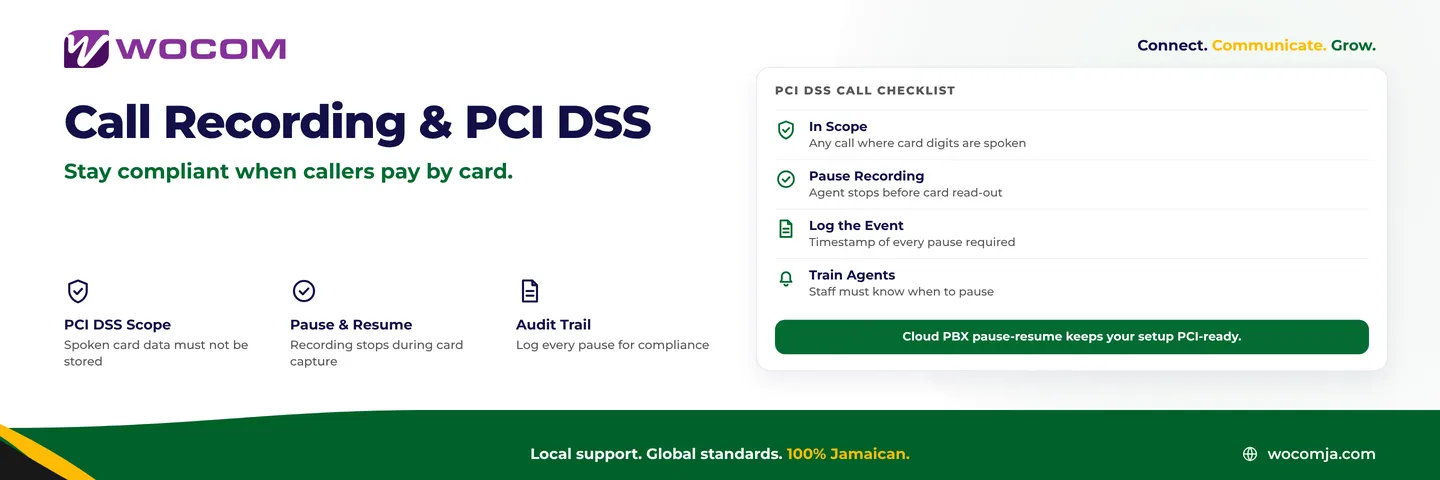
The industry-standard approach to PCI-compliant call recording is agent-triggered pause-resume. Before the customer reads their card number, the agent presses a clearly labelled button on their desk phone or softphone application to pause the recording. The system logs the pause event with a timestamp. Once the card data has been entered or the payment is processed, the agent resumes recording for the remainder of the call.
A second approach is DTMF masking — if the customer enters card digits using their phone keypad rather than reading them aloud, the system captures tones rather than spoken digits and substitutes them with silence or placeholder characters in the recording. This is ideal for IVR-driven payment flows where no agent is involved.
WOCOM's Cloud PBX platform supports agent-triggered pause-resume recording directly from the agent interface. The pause event is timestamped in the call log, giving your compliance team the audit trail they need to demonstrate that card capture was excluded from the recording. This is the same capability that enterprise contact centres use to pass PCI DSS assessments — available to Jamaica businesses of any size on a Cloud PBX plan.
What a Compliant Call Recording Setup Looks Like in Practice
If your business takes card payments on calls, a compliant setup should include all of the following:
- Pause-resume recording accessible from every agent's workstation, with a single, clearly labelled control
- Timestamped pause logs so you can demonstrate that card capture segments were excluded — this is your evidence during an assessment
- A written agent procedure that specifies exactly when to pause and when to resume — make it a step on your card payment checklist, not an afterthought
- A recording retention policy that defines how long recordings are kept, who can access them, and how they are deleted at end-of-retention
- Access controls on the recording archive — only staff with a legitimate business need should be able to retrieve recordings, and access should be logged
If you are completing a PCI DSS Self-Assessment Questionnaire (SAQ) — which most Jamaican merchants are required to file annually — the call recording question will appear if your assessment category covers telephone order taking. The right answer requires a pause mechanism and an audit trail, not just a policy document.
The Cost of Getting This Wrong
Card scheme fines for PCI DSS non-compliance start in the range of US$5,000 per month and escalate with time and severity. Following a confirmed data breach involving card data, fines can reach hundreds of thousands of dollars and include mandatory forensic investigation costs that the merchant bears. Beyond the direct financial exposure, a merchant account suspension means your business cannot accept cards until remediation is complete and an assessment passes — a serious operational disruption for any business where card payments are a material revenue stream.
The cost of a compliant cloud phone system is a fraction of that exposure. Getting the setup right from the start is the sensible business decision.
Get Your Call Recording Setup Right With WOCOM
WOCOM provides Cloud PBX with built-in pause-resume call recording, timestamped event logging, and role-based access controls — the features Jamaican businesses need to record calls confidently without creating a PCI liability. Whether you are setting up a new system or reviewing your existing one, our team can walk you through what a compliant configuration looks like for your specific call flow.
Speak to a WOCOM business consultant to review your current setup. Call us at 876-639-8828 or visit wocomenterprise.com to get started.
Continue exploring
Ready to upgrade your communications?
Talk to our team about the right solution for your business.
Book a Demo Contact SalesEverett Kildare is WOCOM's voice and infrastructure specialist, with more than 25 years of experience designing and running carrier-grade voice, SIP and virtualization infrastructure. Holding a BSc in Information Technology, he has built, secured and migrated phone systems for businesses of every size. Everett writes WOCOM's technical coverage of SIP trunking, cloud PBX, contact centres, business continuity and migration.