New Business Phone Setup Jamaica: The Year-One Guide for Startups and Growing Companies
The phone number on your website, business card, and Google Business Profile is often the first real interaction a customer has with your company. Get it wrong in year one — wrong number, missed calls, a personal mobile that nobody answers after 5 p.m. — and you spend the next two years undoing the damage. Customers who called and got nothing simply moved on.
This guide is for Jamaican businesses in their first year of operation, and for those that launched with a basic mobile number and are now ready to do it properly.
What a Professional Phone Setup Actually Looks Like for a New Jamaica Business
Professional does not mean a server room and a bank of desk phones. It means your calls are answered reliably, customers can reach the right person, and your business number belongs to your company — not to whoever's personal SIM is currently listed on the website.
The minimum viable phone setup for most new businesses in Jamaica includes:
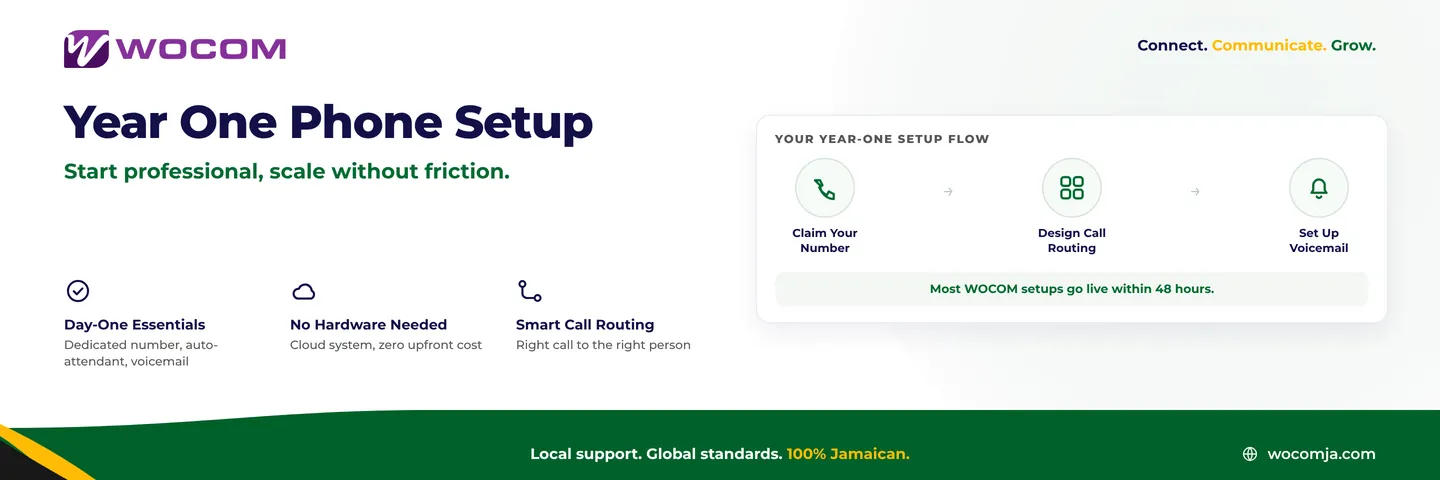
- A dedicated business number — a DID (Direct Inward Dialling) number in the 876 or 658 area code that you own and can take with you if you ever change providers
- An auto-attendant greeting — so callers hear your business name and basic options even when you are not available to pick up
- Voicemail to email — missed calls become audio files in your inbox rather than lost leads
- At least one extension or user seat — even if it is just you, accessible via a softphone app on your existing laptop or mobile
Everything beyond this — call queues, multi-level IVR trees, ring groups, call recording — can wait until you have the volume to justify it. Starting lean and scaling up is far cheaper than starting big and paying for features you never use.
The Most Damaging Year-One Phone Mistake Jamaican Businesses Make
Using a personal mobile number as the business number.
It seems harmless at launch. The number is already active, calls come straight to you, and there is no extra cost. But three problems compound over time, and each one is harder to fix the longer you wait.
First, the number belongs to you personally. If you hire staff, change phones, or the business changes ownership, the number moves with the SIM — not with the company. You cannot point it at a new device without disrupting customers. Second, you lose every professional feature: no auto-attendant, no call routing, no reporting on which calls you are receiving or missing. Third, your personal mobile is not designed for business volume. As calls increase, mixing personal and business traffic on one device means late-night work calls, no separation of records, and no way to know whether your team is answering on time.
A dedicated business number from a licensed provider costs significantly less than most new business owners expect — and it is the single most important step in building a phone-ready operation from day one.
Cloud PBX vs a Traditional Line: Which Makes Sense in Year One
New businesses in Kingston, Montego Bay, Spanish Town, and across Jamaica increasingly launch on cloud-based phone systems rather than committing to physical PBX hardware. The practical reasons are straightforward:
- No capital outlay — no PBX box to purchase, no cabling, no hardware installation fees
- Start with one seat, add more as you hire — cloud PBX scales with your headcount rather than requiring you to buy capacity you do not yet need
- Work from anywhere — staff in the office, at home, or out in the field can take business calls on a softphone app without giving out personal numbers
- Immediate access to features — call routing, hold music, voicemail, and basic call logs are available from day one at no additional cost
For most new Jamaican businesses — especially those with one to five staff members, a mix of in-office and remote workers, or plans to expand — Cloud PBX is the right year-one choice. It keeps your options open without locking you into hardware that becomes obsolete.
Features to Skip Until Year Two (or Later)
One of the most common mistakes early-stage businesses make is choosing a phone system loaded with features they will not touch for years. Every unused feature is complexity you pay to maintain and explain to new staff.
Hold off on these until you genuinely need them:
- Multi-level IVR menus — if you have fewer than three departments, a simple auto-attendant greeting is enough. Deep menu trees frustrate callers at low call volumes and add no value if one person is handling everything anyway.
- Formal call queues — call queues are built for businesses managing more than ten simultaneous callers. In year one, a ring group and a well-configured voicemail setup will handle your load without the overhead.
- Contact centre modules — if you do not have staff whose job function is specifically to handle inbound calls at volume, you do not need contact centre software.
- Compliance call recording — unless you are in financial services, legal, or another regulated industry from the start, basic call logs and voicemail records are sufficient. Formal recording with long-term storage is a year-two or year-three consideration for most businesses.
When Your Year-One Setup Has Outgrown Itself
A well-configured year-one system should carry most Jamaican businesses through their first 12 to 24 months without strain. These are the clear signals it is time to expand:
- You are regularly missing calls because all lines are occupied
- Customers call one number but need to reach distinct departments — billing, support, sales — with no way to route them correctly
- You have hired staff who need their own extensions or dedicated numbers
- You want to measure call volume, average answer speed, or individual staff call performance
- Call handling is becoming a business risk because of volume, not because of any technical limit
None of these are emergencies when they first appear, but each is a clear signal that the system needs to grow. The advantage of starting on a cloud platform is that upgrades are configuration changes — not hardware replacements. Adding a new user or a call queue is an afternoon's work, not a capital purchase.
Four Questions to Ask Any Phone Provider Before You Commit
Before signing with any provider, get clear answers to these four questions:
- Are you a licensed provider? In Jamaica, telephone service providers must hold a licence from the Office of Utilities Regulation. A licensed provider owns their own infrastructure and is accountable to a regulatory body. An unlicensed reseller is not.
- Does my business own the number? Your number should be portable — meaning if you ever switch providers, you take it with you. A number that belongs to the provider, not to you, is a significant business risk as your brand becomes attached to it.
- What happens during an outage? Ask specifically about failover options, backup routing, and historical uptime. A good provider should have a direct answer, not a vague assurance.
- Can I scale without re-signing? Adding users, extensions, or features should be self-service or at most a simple request — not a new contract negotiation every time your business grows.
Get Your Business Phone Right From the Start
The decisions you make in year one shape your phone infrastructure for years. Starting with a dedicated business number, a professional auto-attendant, and a cloud-based system that grows with you costs less than most businesses expect — and it closes the gap between how you operate today and how you want to be perceived by every caller from Kingston to Montego Bay.
Contact WOCOM to set up your business phone system. Our team will walk you through exactly what you need in year one — no unnecessary upselling, no hardware commitments, and no surprises. We are a licensed telephone provider in Jamaica, and your number belongs to you from day one.
Continue exploring
Ready to upgrade your communications?
Talk to our team about the right solution for your business.
Book a Demo Contact SalesEverett Kildare is WOCOM's voice and infrastructure specialist, with more than 25 years of experience designing and running carrier-grade voice, SIP and virtualization infrastructure. Holding a BSc in Information Technology, he has built, secured and migrated phone systems for businesses of every size. Everett writes WOCOM's technical coverage of SIP trunking, cloud PBX, contact centres, business continuity and migration.