Contact Centre Escalation Matrix Jamaica: Define Who Handles What So Nothing Slips
Why Your Contact Centre Needs a Formal Escalation Matrix
Every Jamaican contact centre handles calls that front-line agents cannot resolve alone. A billing dispute at a Kingston insurance company, a service outage complaint routed through a Montego Bay BPO, a compliance query landing in a small collections team — all of these need to move up the chain quickly. Without a written escalation matrix, agents rely on memory, habit, and guesswork. Some escalate too fast; others hold on too long, trying to close a call they were never equipped to handle.
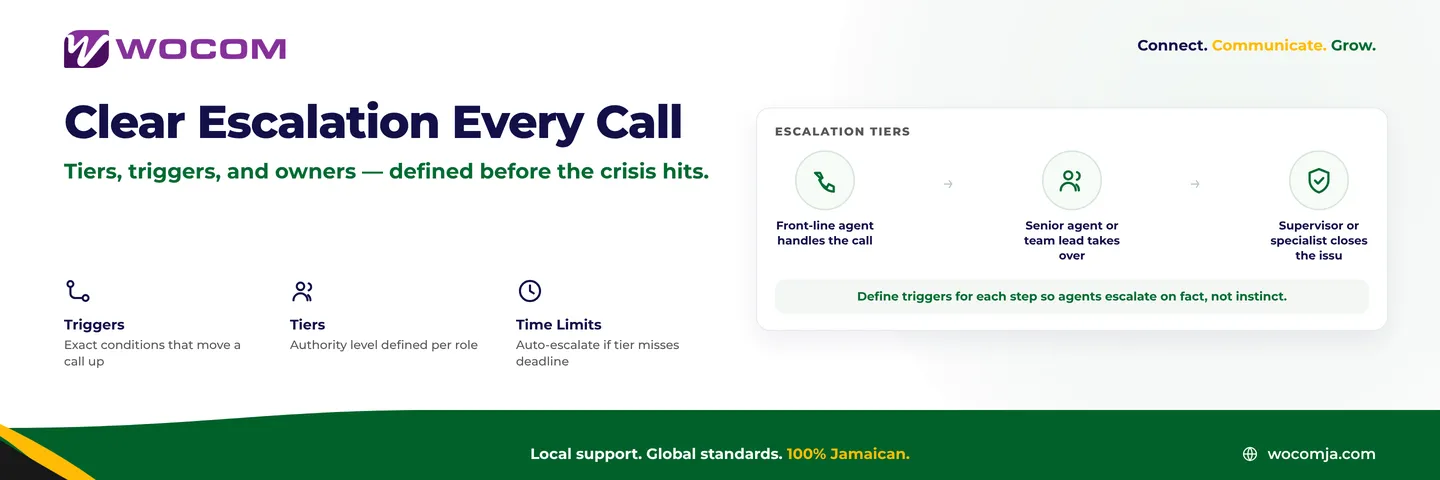
The result is the same either way: a caller who waited longer than they should have, an issue logged against the wrong tier, and a supervisor blind-sided by a complaint they should have seen coming. An escalation matrix is a single reference — a screen visible to every agent — that maps every call type to the correct handling tier, the trigger that moves it upward, the role responsible, and the maximum time allowed at each stage before it auto-escalates again.
The Four Components of an Effective Escalation Matrix
Before you build anything, align your operations and HR teams on these four elements:
- Trigger: The specific condition that initiates an escalation — the caller requests a supervisor, the issue type exceeds agent authority (for example, refunds above a set threshold), an emotion flag such as a caller mentioning legal action or media exposure, or a technical fault the agent cannot diagnose.
- Tier: The destination — Tier 1 (front-line agent), Tier 2 (senior agent or team lead), Tier 3 (supervisor or specialist), Tier 4 (management). Define what authority each tier holds. A Tier 2 lead might approve a J$5,000 credit but not a full account reversal.
- Owner: A named role, not a person. "Senior Billing Agent" rather than "Denise," because Denise is off on Wednesdays. If roles are understaffed, escalations stack — and that gap becomes visible in your reporting data.
- Time limit: The maximum time a call or ticket sits at any tier before it auto-escalates. If your Tier 2 lead does not respond to an escalated call within four minutes, it surfaces automatically to the Tier 3 queue.
Building Your Matrix: A Practical Starting Point
Start by listing your ten most common escalation scenarios. Pull a report from your contact centre system — WOCOM's live call management portal shows call dispositions and wrap-up codes — and find the categories that appear most often alongside a transfer event. Typical Jamaican contact centre escalations include:
- Billing disputes and credit requests
- Service outage complaints, especially relevant for telecoms and utilities
- Caller-initiated escalations ("I want to speak to a manager")
- Technical faults requiring specialist knowledge
- Compliance-sensitive queries such as data access requests or written complaints
- Situations involving threats — legal action, social media, or regulatory reporting
For each scenario, fill in the four components above. Once you have the ten core rows, add a catch-all: "Any issue not listed — agent discretion, maximum three minutes before escalating to Tier 2." Do not build a 40-row spreadsheet that agents cannot scan in under five seconds. A working matrix covers the situations that actually occur. Edge cases belong in a separate reference guide.
How WOCOM Cloud PBX Supports Each Escalation Tier
A well-written matrix on paper is only as useful as the phone system that executes it. WOCOM's Cloud PBX and contact centre platform gives your team the tools that make escalations fast and fully auditable:
- Warm transfer: The agent stays on the call while briefing the receiving tier, then hands over cleanly. The caller hears a natural handoff, not silence followed by ringing into the void.
- Call parking: An agent can park a call on a monitored orbit while locating the right person, then retrieve it from any extension — useful when Tier 2 is momentarily occupied and will be free in under a minute.
- Supervisor whisper coaching: A Tier 2 lead can join an in-progress call and speak only to the agent, not the caller, guiding them through a complex situation without forcing a full transfer.
- Skills-based routing: Route inbound calls directly to the right tier from the start. A caller selecting "billing disputes" lands in a queue staffed by agents trained and authorised to handle billing — reducing the need for internal escalations before they begin.
- Call recording and AI transcription: Every escalated call is recorded and, for WOCOM AI clients, automatically transcribed. Supervisors can review the exact trigger moment and confirm whether the escalation was warranted — invaluable for coaching and compliance audits.
Common Escalation Mistakes Jamaica Contact Centres Make
Over-escalation at Tier 1. When agents send every moderately difficult call to a team lead, Tier 2 becomes a bottleneck and front-line agents never develop the skills to handle complexity. Set clear authority thresholds at Tier 1 and enforce them through coaching, not just policy. The goal is to push authority as close to the caller as competence allows.
No time limit at any tier. Without a clock, escalations sit invisibly in a queue. The caller waits. The issue ages. By the time a supervisor sees it, the caller has already posted their frustration online. Set realistic limits — four minutes for an in-progress live escalation, 30 minutes for a queued ticket — and surface them on your contact centre wallboard so every team lead can see the count in real time.
Escalation mapped to a person, not a role. If the matrix says "escalate to Kevin," Kevin's schedule dictates your service level. Map escalations to the role and use WOCOM's ring groups to reach whoever is carrying that role today.
No post-escalation feedback loop. If agents never learn how their escalations were resolved, they cannot calibrate their judgement. Run a brief weekly review: how many escalations this week, how many resolved at Tier 2 versus Tier 3, and what the most common triggers were. Share this at team briefings — whether your operation is based in New Kingston, Half-Way-Tree, or Portmore.
Turn Your Matrix Into a Living System
A matrix that lives in a PDF nobody reads is a policy, not a process. Publish it on the agent desktop — a pinned tab, a sidebar panel, or a printed card at every workstation. Build the time limits into your contact centre platform as alerts. Review the matrix quarterly: as your products change, regulations shift, and agent capability grows, some escalation triggers that once needed a supervisor can be pushed back to Tier 1.
WOCOM's contact centre reporting gives you the data to do this well. If your Tier 2 team closes 80 percent of escalated billing calls in under five minutes, that signals Tier 1 agents could handle the straightforward subset with the right training and a slightly higher authority threshold. If Tier 3 is regularly receiving calls that should have stopped at Tier 2, that points to a coaching gap or an authority policy that needs revisiting.
A good escalation matrix does two things at once: it protects callers from being bounced endlessly, and it protects front-line agents from being set up to fail on calls that were never theirs to close.
Build a Contact Centre That Escalates With Confidence
WOCOM provides Jamaican businesses with the contact centre infrastructure — Cloud PBX, SIP trunking, skills-based routing, AI call transcription, real-time wallboard reporting, and warm transfer — to back up every tier of your escalation matrix in practice, not just on paper.
Whether you are running a team of five agents or a 50-seat operation, we can configure the call flows and reporting that make your escalation process work on day one. Visit wocomja.com or message us on WhatsApp to speak with a WOCOM solutions specialist and discuss how your contact centre is set up today.
Continue exploring
Ready to upgrade your communications?
Talk to our team about the right solution for your business.
Book a Demo Contact SalesEverett Kildare is WOCOM's voice and infrastructure specialist, with more than 25 years of experience designing and running carrier-grade voice, SIP and virtualization infrastructure. Holding a BSc in Information Technology, he has built, secured and migrated phone systems for businesses of every size. Everett writes WOCOM's technical coverage of SIP trunking, cloud PBX, contact centres, business continuity and migration.