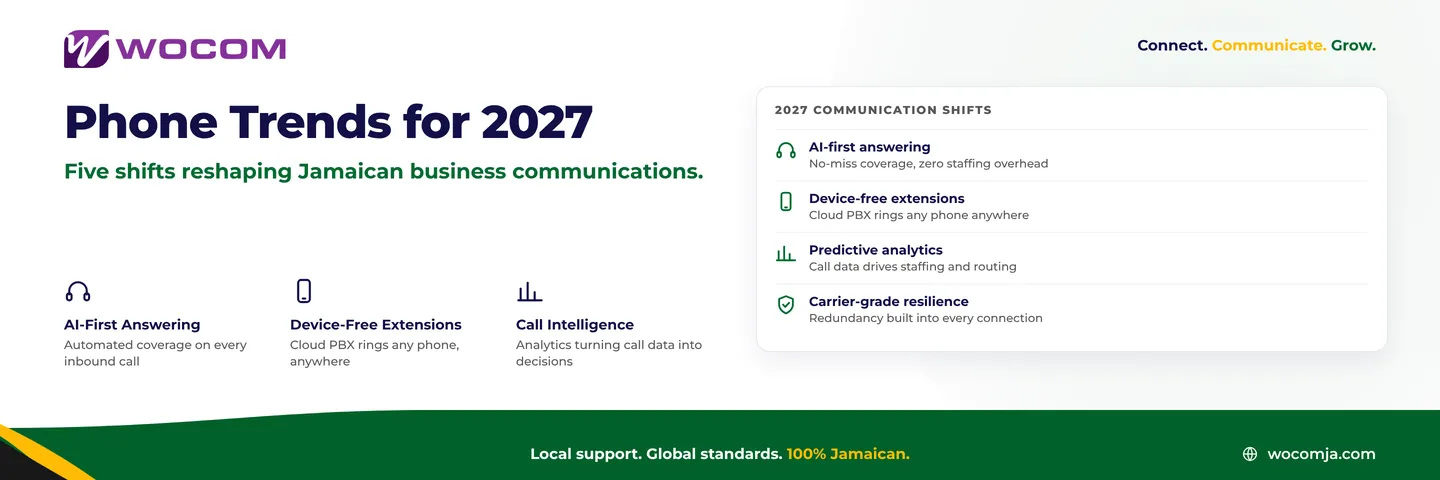
5 Business Phone Trends That Will Define How Jamaican Companies Communicate in 2027
The Pace of Change Is Not Slowing Down
Two years ago, most Jamaican businesses still ran calls through a traditional PABX or a basic hosted system. Today, clients from Kingston law firms to Montego Bay car rental operations are running AI receptionists, cloud PBX with mobile apps, and real-time call dashboards. By 2027, the gap between companies that have adapted their communications infrastructure and those that haven't will become a visible competitive disadvantage — one that shows up in missed revenue, not just missed calls.
These are not predictions about distant technology. The five trends below are already live in Jamaica's business phone ecosystem. What changes next year is the rate of adoption — and the expectations callers bring with them.
Trend 1: AI-First Call Handling Becomes the Standard, Not the Differentiator
In 2026, having an AI receptionist on your main business line is a competitive edge. In 2027, not having one will be noticed. Callers — particularly the under-40 demographic that increasingly drives purchasing decisions at Jamaican businesses — will begin expecting immediate, accurate answers without hold music or voicemail boxes.
AI call handling systems like WOCOM's Alex receptionist are already taking inbound calls across sectors: medical clinics, vehicle dealerships, logistics operators, and retail chains. The capability set is maturing quickly. Beyond basic routing, AI agents can now take messages, quote service hours, handle billing enquiries with PIN verification, and flag calls that need human escalation.
The 2027 shift is this: AI moves from a dedicated after-hours tool to the first point of contact on every call, handing off to staff only when the caller specifically needs it. Businesses that position this correctly will see fewer missed calls, lower front-desk overhead, and more consistent caller experiences regardless of what is happening inside the office at that moment.
Trend 2: The Desk Phone Becomes Optional by Default
The IP desk phone is not dead, but it is no longer the assumed starting point for a business phone system. Cloud PBX platforms that run fully on smartphones, laptops, and web browsers are changing what "a business phone line" means in practice.
For Jamaican businesses with field teams, delivery operations, remote workers, or staff who split time between locations — and that is most businesses in Kingston and the parishes — a softphone app or mobile extension delivers the same extension number, call recording, and transfer capability as a desk set, without the hardware cost.
By 2027, the default question when onboarding a new employee will shift from "do we order a handset?" to "do you actually need one?" Most staff won't. What they'll need is a configured extension on the device already in their pocket. The infrastructure to support this exists today. What changes is that it becomes the default workflow, not the exception.
Trend 3: Call Analytics Becomes a Business Intelligence Tool
For years, call logs were something you checked when something went wrong. In 2027, forward-thinking Jamaican businesses will use their phone system data proactively — before problems surface.
The questions call analytics can already answer include: Which hours generate the most missed calls? Which staff member has the longest handle times on sales enquiries? When does inbound call volume spike, and by how much? What percentage of callers are repeat contacts within 48 hours — a reliable signal that their issue was not resolved the first time?
This data exists today in any business running a cloud PBX or SIP trunk with a reporting dashboard. The trend is businesses beginning to act on it — adjusting staffing rosters, rewriting IVR menus based on where callers drop off, and identifying the call types where AI containment saves the most staff time.
The businesses that treat their call data as a revenue signal rather than a compliance record will outperform those that don't.
Trend 4: Resilience by Design Replaces "We'll Handle It If It Happens"
Jamaica's 2026 hurricane season and a series of parish-level power and internet disruptions reminded businesses that communication infrastructure needs a continuity plan before the event, not during it. By 2027, carrier-grade resilience — automatic failover, redundant SIP paths, call rerouting to mobile numbers during outages — will be a baseline expectation rather than a premium add-on.
The technical components are already standard in hosted telephony: geographic redundancy, SIP trunk failover to a secondary path or mobile endpoint, and cloud routing that keeps calls moving even when the office internet is down. What shifts in 2027 is that businesses will ask for this upfront — not after their first major outage leaves them unreachable to callers for three hours on a Tuesday morning.
Businesses in sectors with zero tolerance for call downtime — pharmacies, medical practices, financial services, logistics coordinators — are already building this in. The trend is the rest of the market catching up.
Trend 5: Voice, SMS, and Messaging Close the Channel Gap
Jamaican customers already expect to reach a business by SMS, WhatsApp, and voice. The problem for most businesses is that these channels live in separate tools, creating a fragmented picture of customer interactions. The 2027 trend is unified communications platforms that bring these channels into a single view.
Practically, this means a caller who texts your business number and then calls gets a consistent experience — the staff member handling the call can see the message thread. Missed call auto-responses via SMS go out automatically. AI tools that already summarise calls extend to summarise message threads, giving supervisors a single timeline of every customer touchpoint.
For Jamaican SMEs, this is not about replacing human relationships. It is about ensuring no interaction falls between channels — and that the context from one touchpoint carries into the next.
Where Your Business Stands Today
You do not need to implement all five of these trends before January 2027. But it is worth taking stock of where your business currently sits. Can callers always reach someone — or a capable AI system — at any hour? Does your phone system run on hardware that needs replacing before it can go cloud-native? Is your call data sitting unused in a log file no one reviews?
The businesses that will lead their sectors in 2027 are building these capabilities into their communication infrastructure now, not waiting until a competitor's edge becomes undeniable.
Talk to WOCOM About Your 2027 Communications Roadmap
WOCOM is Jamaica's licensed business phone provider, operating its own network to deliver SIP trunking, cloud PBX, AI receptionist services, and unified communications to businesses across the island. If any of these trends represent a gap in your current setup, our team can walk you through a straightforward, no-pressure assessment of where you are and what would actually make a difference for your specific operation.
Call or WhatsApp WOCOM at 876-926-6268 to speak with a business communications specialist. We work with businesses in Kingston, Montego Bay, Spanish Town, and across every parish in Jamaica.
Continue exploring
Ready to upgrade your communications?
Talk to our team about the right solution for your business.
Book a Demo Contact SalesMichelle Goss is a data and AI analyst at WOCOM, where she studies how Jamaican businesses use voice, messaging and AI to win and keep customers. With a BSc in Data Science & Analytics, she turns call data, customer trends and AI receptionist performance into practical guidance owners can act on. Michelle writes WOCOM's coverage of AI call handling, call analytics, customer growth and industry trends.