Business Phone System Maintenance Checklist Jamaica: What to Review Monthly, Quarterly, and Annually
Most Jamaican businesses configure their phone system once — then forget about it until something breaks. That approach works right up until a call route silently sends customers to a staff member who resigned four months ago, an unpatched SIP device becomes a toll fraud entry point, or a call recording archive fills to capacity and stops capturing new calls without anyone noticing.
Phone systems don't fail dramatically. They degrade quietly. A structured maintenance routine is how you stay ahead of that degradation instead of discovering it on your busiest day of the year.
Why Phone System Maintenance Gets Skipped — and What It Actually Costs
Phone systems feel stable. Unlike a server that crashes or a website that goes down, a PBX usually keeps routing calls even when something is wrong beneath the surface. That stability creates a false sense that everything is fine.
The real costs accumulate in the background: a DID number you've been paying for that nobody uses, an international call permission left open after a staff member left, a voicemail greeting that still mentions a promotion from two years ago. None of these are emergencies on their own — but together they represent money leaking out and caller trust slowly eroding.
Businesses across Kingston and Montego Bay that run structured reviews typically uncover two or three issues they weren't aware of. The review takes less than an hour per quarter. The problems it prevents can take days to untangle.
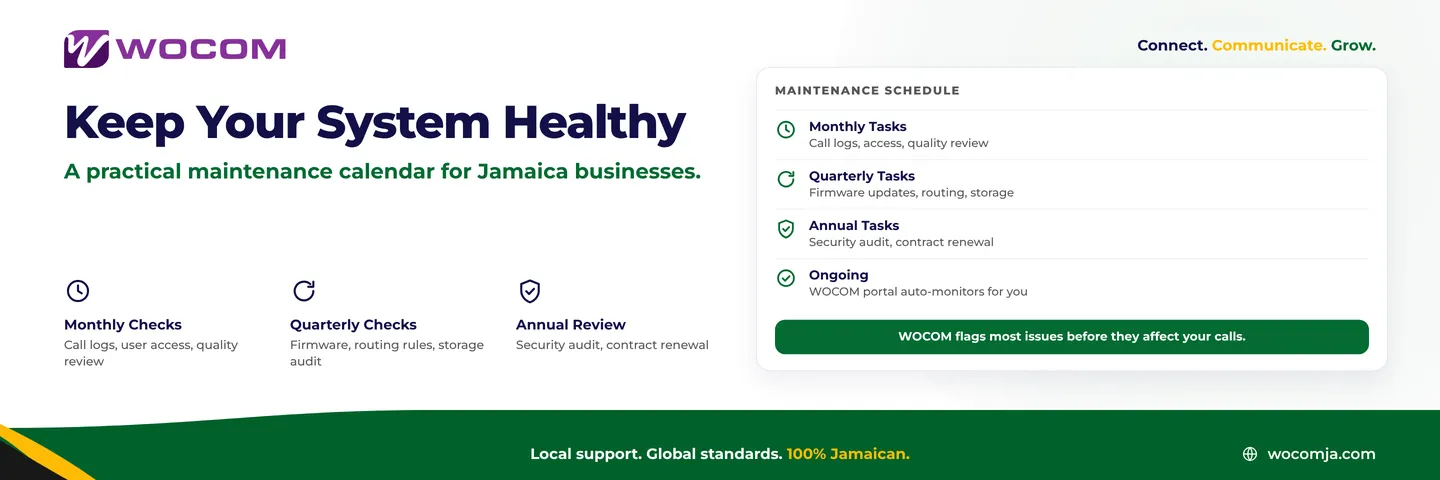
Monthly Checks (15–20 Minutes)
These quick reviews keep the system honest between deeper audits:
- Call log review. Scan for unusual patterns — missed call spikes, calls to unreachable extensions, or routes that consistently hit voicemail during business hours. A sharp increase in abandoned calls on a specific queue usually signals a staffing or routing problem, not a technology fault.
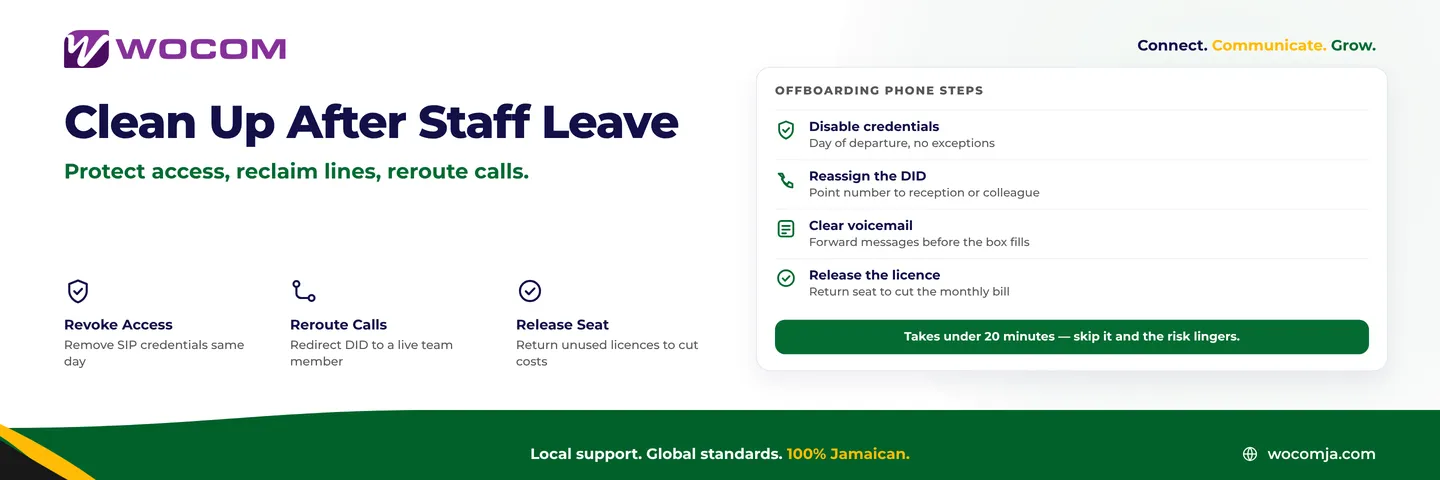
- User account audit. Confirm every active extension belongs to a current employee. Leavers' accounts should be disabled or reassigned the same week they depart — not left open indefinitely with forwarding rules that point nowhere useful.
- Greeting check. Play back your auto-attendant and main voicemail greeting. Business hours, contact names, and service descriptions change. Your greeting should reflect your business as it is today, not as it was configured at install.
- Call recording sample. Listen to three to five recent recordings at random. Poor audio quality or dropped calls often appear in recordings before they generate customer complaints — catching them here gives you time to investigate the cause.
Quarterly Checks (30–45 Minutes)
Quarterly reviews go deeper into configuration, cost, and system resilience:
- DID number audit. List every phone number on your account and identify lines with zero inbound calls over the quarter. Numbers you're not using are money spent for no return — and they accumulate silently on a growing account.
- Call routing rules. Review time-of-day schedules, holiday routing tables, and department hunt groups. Routing rules built for a previous team structure often survive staff reorganisations and create caller confusion that nobody traces back to the configuration.
- Call permission review. Who can dial international? Who has access to premium-rate numbers? These settings should match your current team, not defaults set during installation. A single open permission left behind after a termination can generate thousands of dollars in fraudulent charges before anyone notices.
- Recording storage check. If you store call recordings locally, check how much space they're consuming and compare against your quota. Many businesses discover their storage is full only after recordings silently stop. Set a retention policy — and enforce it automatically if the platform allows it.
- Failover test. Simulate losing your primary internet connection and confirm that failover routing activates correctly. This test takes five minutes. Discovering your failover is misconfigured during an actual outage takes much longer and costs you calls you can't get back.
Annual Checks (Half a Day)
Once a year, your phone system deserves a proper sit-down review:
- Security audit. Review SIP credential strength, admin portal passwords, and access logs for unauthorised registration attempts. Toll fraud typically begins with a weak SIP credential on a forgotten device. An annual password rotation across the system is minimum hygiene.
- Contract and plan review. Compare your actual call volume and channel usage against your current plan. Businesses that have grown often find they're throttling calls on a plan configured for a smaller team. Businesses that have restructured sometimes find they're overpaying for capacity they no longer need.
- Technology review. Cloud PBX platforms add capabilities regularly. Your WOCOM portal may include features you haven't activated — call analytics dashboards, AI receptionist integration, advanced reporting — that would directly benefit your team today at no additional cost.
- Full disaster recovery test. Run through your continuity plan end to end. Verify that failover numbers ring where they should, that staff know the recovery steps, and that the documentation reflects your current setup. A plan that has never been tested is a plan that won't work when you need it.
- Number documentation. Produce a written register of every number, extension, and DID on your account — what it routes to and who owns it. This document is invaluable if you ever need to port numbers, onboard a new IT contact, or respond to a regulatory audit.
What WOCOM Monitors Automatically Between Your Reviews
For businesses on WOCOM Cloud PBX and SIP trunking, several of these checks run continuously in the background rather than waiting for a manual review:
- Real-time call quality monitoring with automatic alerts when audio paths degrade
- Firmware management for cloud-hosted deployments — no manual patching required on your end
- SIP registration anomaly detection for early signs of credential compromise or toll fraud activity
- Usage reporting accessible from the WOCOM portal at any time, not just at month-end
- Proactive outreach from the WOCOM support team in Kingston when a pattern warrants attention before it becomes a problem
Continuous monitoring doesn't replace the annual security and contract review — those require a human with business context making deliberate decisions. But it means the work of watching the system between reviews is handled, not deferred.
Build the Habit Before Something Forces It
The businesses that treat phone system maintenance as a routine are the ones that aren't scrambling when something goes wrong. Forty-five minutes per quarter and a few hours per year is a small investment against the alternative: a toll fraud event, a routing failure on your highest-traffic day, or a contract you've been overpaying for eighteen months.
If you're unsure where your system currently stands, WOCOM can run a no-cost health check on your existing setup and flag anything that needs attention — whether you're already a WOCOM customer or still running a legacy system from another provider.
Get in touch with WOCOM today to schedule a phone system health review for your Jamaica business. Reach us through wocomja.com or call our team directly — the check is free, and what you find is usually worth knowing.
Continue exploring
Ready to upgrade your communications?
Talk to our team about the right solution for your business.
Book a Demo Contact SalesEverett Kildare is WOCOM's voice and infrastructure specialist, with more than 25 years of experience designing and running carrier-grade voice, SIP and virtualization infrastructure. Holding a BSc in Information Technology, he has built, secured and migrated phone systems for businesses of every size. Everett writes WOCOM's technical coverage of SIP trunking, cloud PBX, contact centres, business continuity and migration.