Business Communications Budget Jamaica 2027: 6 Questions to Answer Before You Set the Numbers
Why October Is the Right Month to Review Your Phone Budget
Most Jamaican business owners finalise their 2027 budgets between October and November. Decisions made in these six weeks set the cost and capability of your communications for an entire year. Yet phone systems are almost always the last line item anyone interrogates — right up until a technician bill, a dropped trunk, or a competitor with a faster answer time forces the conversation.
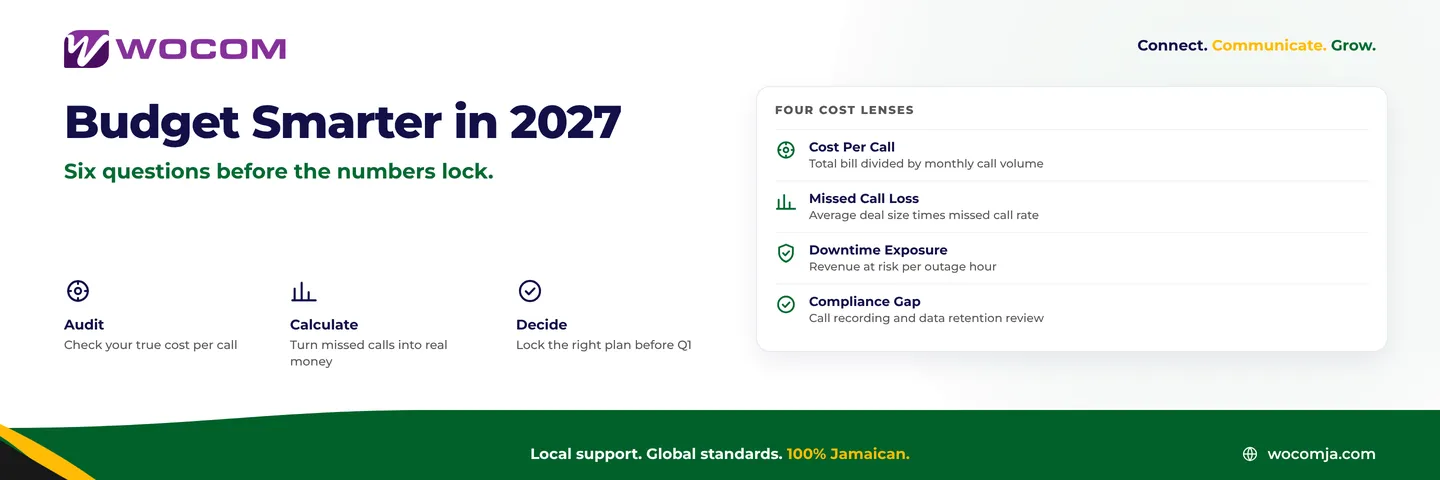
This article gives you six concrete questions to answer before your budget locks. Work through them in order. By the end you will have the numbers you need to make a defensible decision — whether that is staying with what you have, switching to cloud, adding AI, or all three.
Question 1: What Are You Actually Paying Per Call?
Take your last three months of phone bills — the carrier invoice, the hardware maintenance contract if you have one, and any IT or technician callouts. Divide the total by the number of inbound and outbound calls logged in the same period.
Most businesses that run this number for the first time are surprised. Businesses on ageing PABX systems in Kingston regularly find their true cost per call is two to four times what they assumed, once hardware maintenance and technician time is folded in. Businesses on cloud PBX with SIP trunking typically pay a fraction of that.
If you do not have call volume data at all, your phone system is already telling you something important: you cannot manage what you cannot measure. That alone is an argument for a modern platform before 2027.
Question 2: How Much Revenue Leaves With Every Missed Call?
This is the number most owners underestimate. To calculate it: take the average value of a new customer booking or sale, then estimate the percentage of inbound calls your business misses — whether from being closed, understaffed, or already engaged on another line.
Even a conservative estimate is usually sobering. A Montego Bay service business that closes twelve new bookings per month and misses one in five inbound enquiries is surrendering two to three potential bookings every single month. Annualised, that gap typically exceeds the full cost of a cloud PBX subscription and an AI receptionist combined — often by a wide margin.
The purpose of this calculation is not to cause alarm. It is to give any upgrade a real return-on-investment figure you can defend to a business partner, a board, or yourself at year-end.
Question 3: Are You Paying for Capacity You Do Not Use?
SIP trunk channels and cloud PBX user seats are priced on capacity. Businesses that sized their system two or three years ago — or inherited one from a previous tenant — often pay for fifteen or twenty concurrent channels when their actual peak is six or eight.
Pull your call logs and identify the highest concurrent call count you have hit in the last 90 days. Compare it to the channels you are paying for. If there is a persistent gap, you are carrying dead capacity into 2027 and paying for it every month.
The reverse is equally important: if you are regularly hitting your channel ceiling and callers receive a busy signal, your 2027 budget needs to reflect a capacity increase. Otherwise the missed-call revenue number from Question 2 is understated, possibly significantly.
Question 4: What Does One Hour of Downtime Cost Your Business?
Calculate your average revenue per business hour, then ask honestly: in the last twelve months, how many hours was your phone system unavailable, degraded, or otherwise unable to receive calls? For businesses on legacy hardware anywhere in Jamaica, where power fluctuations and internet instability are real operational factors, this number is rarely zero.
A business earning thirty thousand dollars per day carries a downtime exposure of roughly four thousand dollars per hour. One significant outage per quarter — not unusual for on-premise hardware — means your 2027 budget should account for that risk, either as a cost you accept or a problem you solve with redundant infrastructure.
Cloud-based systems with SIP trunking and automatic failover eliminate most of this exposure, but only if they are properly configured with a backup carrier path. If your current provider cannot clearly explain how your calls route when the primary connection fails, that is a budget conversation that cannot wait for next year.
Question 5: Are You Compliant With Jamaica's Data Protection Act?
Jamaica's Data Protection Act 2020 is in full effect. Businesses that record calls are responsible for how those recordings are stored, who can access them, and when they must be deleted. If call recording is part of your operations — for quality monitoring, dispute resolution, or training — your 2027 budget should include a line item for a storage review, access control audit, and formal retention policy.
The questions to ask your current provider: Where are recordings stored, and in which jurisdiction? Who has access to them? Can retention periods be configured? Can recordings be securely deleted on demand? If your provider cannot answer those questions clearly, that is a compliance exposure that grows more serious with every call recorded.
Modern cloud PBX platforms with built-in recording management and configurable retention rules make compliance straightforward — but only if the policies are correctly set and documented before something goes wrong.
Question 6: What Would an AI Receptionist Change About Your Numbers?
Run this as a scenario before your budget finalises. An AI receptionist answers every inbound call, 24 hours a day, seven days a week. It captures names, numbers, and reasons for calling, then transfers or takes messages according to your rules — with no sick days, no lunch breaks, and no variation in tone or accuracy between the first call of the morning and the last call on a Friday evening.
Compare that against your current first-answer cost: a receptionist salary, or the opportunity cost of the team member who currently drops their work to pick up the phone. Add the missed-call revenue figure from Question 2 — the calls that reach voicemail or ring out after hours. Then compare both against the monthly cost of an AI receptionist included in a WOCOM Cloud PBX plan.
For most Jamaican SMEs, the numbers favour AI — not because human staff are not valuable, but because a human receptionist and an AI receptionist are solving different problems. The AI handles volume and availability around the clock; your people handle complexity, judgement, and relationships. Both working together consistently outperforms either one alone.
Build the Budget From the Numbers, Not the Other Way Around
The most common communications budget mistake is taking last year's spend and adding a small percentage. That approach preserves whatever inefficiency already exists and guarantees nothing improves. The six questions above give you a cost baseline, a revenue impact number, a capacity picture, a downtime exposure figure, a compliance checklist, and an AI scenario — all the inputs needed to build a 2027 communications budget that reflects what your system actually costs and what a better one would actually save.
WOCOM works with Jamaican businesses across every parish to run exactly this kind of audit. Whether you are in Kingston running a multi-department operation or in a regional town managing calls across two locations, the framework is the same and the numbers are almost always worth knowing before January.
Ready to run the numbers before your 2027 budget locks? Contact WOCOM at 876-262-3425 or visit wocomenterprise.com for a structured communications cost review. Our team covers Kingston, Montego Bay, and every parish across Jamaica — and we can typically turn around a preliminary audit within a week.
Continue exploring
Ready to upgrade your communications?
Talk to our team about the right solution for your business.
Book a Demo Contact SalesMichelle Goss is a data and AI analyst at WOCOM, where she studies how Jamaican businesses use voice, messaging and AI to win and keep customers. With a BSc in Data Science & Analytics, she turns call data, customer trends and AI receptionist performance into practical guidance owners can act on. Michelle writes WOCOM's coverage of AI call handling, call analytics, customer growth and industry trends.