How Many Phone Lines Does Your Business Really Need?
You Are Probably Counting the Wrong Thing
Ask a business how many lines it needs and the answer usually starts with headcount. Twelve staff, so twelve lines. That answer is wrong in both directions, and it is wrong because “line” no longer means what it meant when the question was first asked.
On a modern system what you buy is channels — concurrent call capacity. One channel carries one live call. It does not belong to a person, a desk or a number. It is a lane, and any call can use any free lane.
So the real question is not how many people you employ. It is: what is the largest number of calls your business will ever have in progress at the same moment?
Why Headcount Misleads
In both directions.
Twelve people rarely produce twelve concurrent calls. In a typical Jamaican office some staff are in meetings, some are on the road, some are doing work that does not involve the phone. Even in a busy sales team, all twelve being on calls at the same instant is unusual.
But four people can easily produce six concurrent calls. One on a desk phone, one on the mobile app, one on a conference bridge, plus an inbound call ringing a group of three phones at once. Ring groups in particular consume more capacity than people expect while they are ringing.
How to Work Out Your Real Number
Four inputs, in order of importance.
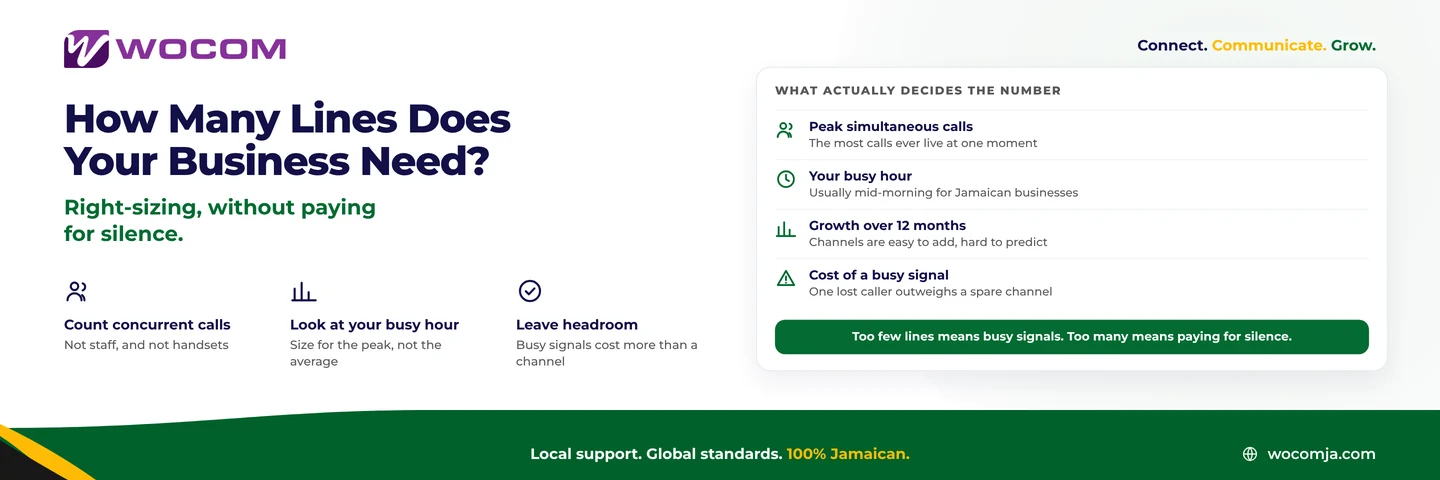
1. Peak simultaneous calls. The single most useful figure. If you already have a cloud PBX, the reports have it. If you do not, count for a week: at your busiest moment each day, how many calls were live?
2. Your busy hour. Call volume is not flat. Most Jamaican businesses see a clear mid-morning peak, often 9:30 to 11:30, and a second smaller one mid-afternoon. Size for the peak, because the peak is when you lose callers.
3. Growth over the next twelve months. Channels are easy to add on a cloud system, but sizing for today exactly and then discovering it every December is a bad annual habit.
4. What a busy signal costs you. This is the input everyone leaves out. A caller who gets a busy signal does not queue politely — they call somebody else. One lost job is worth more than a year of a spare channel for almost every business.
Too few channels means busy signals and lost customers. Too many means paying for silence. The cost of those two mistakes is not remotely symmetrical.
Rules of Thumb, Honestly Labelled
These are starting points to be checked against your own data, not answers:
- A small office, phones incidental to the work — a professional practice, a workshop — roughly one channel per three to four staff.
- A phone-active business — retail, distribution, service dispatch — roughly one channel per two staff.
- A sales or support team where the phone is the job — close to one channel per person, plus headroom.
- Any business at all — never fewer than three, however small. Two channels means one call plus one transfer and nothing left.
Things That Quietly Consume Capacity
Worth adding to the count:
- Ring groups. A call ringing four phones simultaneously may occupy capacity for each leg while it rings. The ring strategy guide covers the trade-off.
- Call recording and monitoring on some configurations.
- Conference bridges — every participant is a call.
- Alarm lines, lift lines, card terminals. Easy to forget until they stop working.
The Advantage of Getting It Wrong on a Cloud System
On traditional lines, being wrong was expensive: a new line meant an order, a wait and an engineer. It is the reason so many Jamaican businesses are still running exactly the number of lines they installed years ago, whatever has happened to the business since.
On a cloud PBX, channels are a setting. Adding capacity for a seasonal peak and removing it in February is normal, and takes minutes. That changes the sizing exercise from a bet into a starting position. Get close, then watch the reports and adjust.
Get It Sized From Your Own Data
If you are on WOCOM already, the peak concurrency figure is in your reports and the support team will read it with you. If you are not, we can size from a week of counting and your call pattern — and the small business phone systems guide covers what else a team of five to twenty needs.
Call 876-906-7240 in Jamaica or 877-906-7240 from the US, email support@wocomja.com, or use the contact page. Ask for a channel sizing review.
Continue exploring
Ready to upgrade your communications?
Talk to our team about the right solution for your business.
Book a Demo Contact SalesEverett Kildare is WOCOM's voice and infrastructure specialist, with more than 25 years of experience designing and running carrier-grade voice, SIP and virtualization infrastructure. Holding a BSc in Information Technology, he has built, secured and migrated phone systems for businesses of every size. Everett writes WOCOM's technical coverage of SIP trunking, cloud PBX, contact centres, business continuity and migration.