Microsoft Teams Direct Routing Jamaica: Use Your SIP Trunk for Teams Calling
What Teams Direct Routing Actually Is
Microsoft Teams includes a calling feature called Teams Phone, but activating it requires either a Microsoft Calling Plan or Direct Routing. Calling Plans are Microsoft's own carrier service — and they simply do not offer Jamaican phone numbers. That leaves Direct Routing as the only path for any Jamaica business that wants to make and receive real calls from inside Teams.
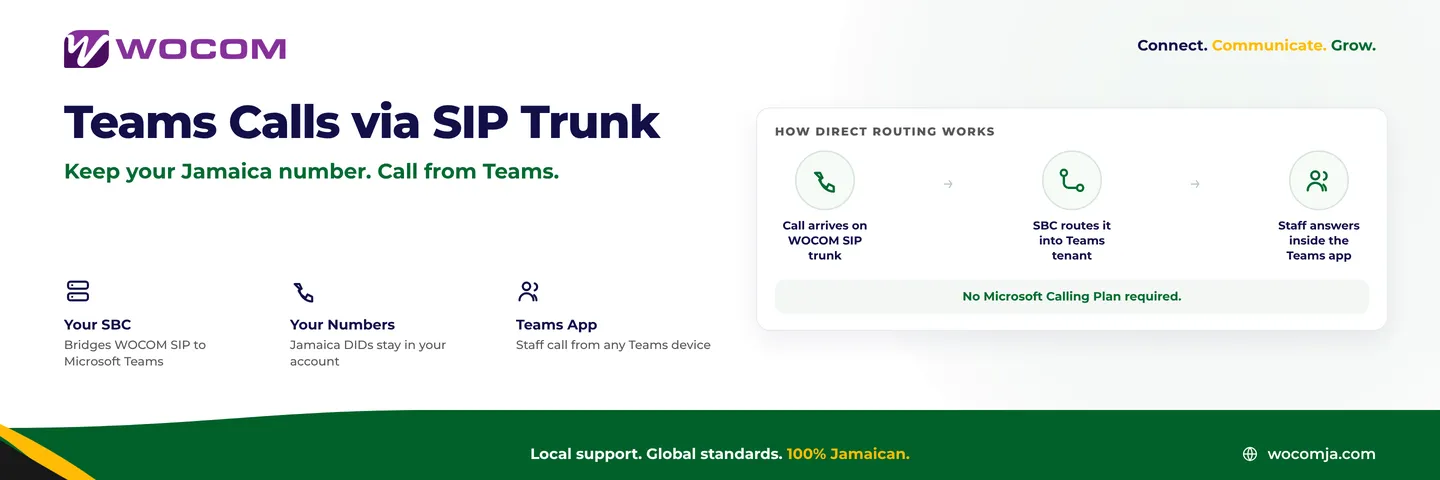
Direct Routing works by placing a Session Border Controller (SBC) between your SIP trunk and Microsoft's Teams infrastructure. The SBC translates between the SIP signalling your carrier uses and the protocols Microsoft's cloud expects. Once in place, calls flow from your Jamaica number through your carrier, through the SBC, and land directly in the Teams app on the staff member's laptop, phone, or desk handset.
The result: a single app for chat, meetings, and business calls — all running on a Jamaica number your business already owns.
Why Microsoft Calling Plans Are Not an Option for Jamaica
Microsoft's domestic Calling Plans are only available in selected markets. As of late 2026, Jamaica is not on that list. If you try to provision a Calling Plan for a Jamaican Teams tenant, Microsoft will not assign a local +1-876 or +1-658 number. You will be offered a US or UK number instead, which is commercially useless for a business that wants Jamaican customers to reach it without dialling internationally.
Operator Connect — Microsoft's newer carrier-partnership model — also has no Jamaican carrier partner signed to the programme. This again leaves Direct Routing as the practical route for any Jamaica business serious about Teams calling.
It is worth noting that this is not a limitation of VoIP or SIP technology. It is a licensing geography that Microsoft controls. Direct Routing simply routes around it by connecting you to a carrier — like WOCOM — that holds your numbers directly on the Jamaican network.
What Your Business Needs Before Setup Begins
Teams Direct Routing has three hard requirements beyond a standard Teams licence:
1. A Teams Phone licence for each user. Microsoft sells this as a standalone add-on called Teams Phone Standard (formerly Phone System), or it is included in Microsoft 365 E5. Without it, the Direct Routing configuration options are simply not visible in the Teams admin centre.
2. A compatible Session Border Controller. The SBC is the hardware or cloud software that bridges your SIP trunk to Microsoft's infrastructure. Microsoft maintains a certification list; tested vendors include AudioCodes, Ribbon, Oracle, and several cloud-hosted SBC services. Many WOCOM clients use a hosted SBC so there is no on-premise device to manage — configuration happens through a web portal.
3. A SIP trunk with a Jamaican carrier. Your SIP trunk provides the actual phone numbers and PSTN connectivity. WOCOM holds licences issued by the Office of Utilities Regulation (OUR) to terminate and originate calls on the Jamaican network. That matters for inbound reliability — a reseller who does not own the route can degrade quality, especially during peak hours in Kingston or Montego Bay business districts.
You will also need control over your domain's DNS records to publish the SBC hostname, and the ability to open specific firewall ports for Microsoft's media IP ranges.
How a Call Flows End to End
Understanding the call path helps enormously when troubleshooting later.
For an inbound call: a customer dials your Jamaica number. WOCOM's network receives the call and sends it over your SIP trunk to your SBC. The SBC presents the call to your Microsoft Teams tenant. Teams rings the assigned user. The staff member answers in the Teams desktop app, mobile app, or a certified Teams desk phone. Audio streams between the customer's handset and the Teams client, with the SBC handling the relay.
For an outbound call: the staff member dials from Teams. Teams passes the call to the SBC via the Direct Routing interface. The SBC sends it out over your WOCOM SIP trunk with your Jamaica number as the outbound caller ID. The call reaches the PSTN and rings the destination normally.
The SBC handles the translation in both directions — codec negotiation, DTMF relay, media encryption, and signalling conversion. A well-configured SBC is essentially invisible to the end user.
Setup Timeline: What to Expect Week by Week
A clean Direct Routing deployment for a small to mid-size Jamaica business typically takes five to ten business days end to end:
- Days 1–2: Teams Phone licences assigned; DNS records published for the SBC hostname; SBC provisioned and registered to the Teams tenant.
- Days 3–4: WOCOM SIP trunk configured on the SBC; test calls placed between internal extensions and to external Jamaica numbers to verify inbound and outbound audio quality.
- Days 5–7: Dial plans configured (how Teams users dial local, Caribbean, and international numbers); voice routing policies assigned per user; call queues or auto-attendants built if required.
- Days 8–10: Parallel running — the existing phone system stays live while Teams calling is tested in production. Numbers are pointed to the new SIP trunk only once calling is confirmed stable under real conditions.
The longest variable is number porting. If your Jamaica numbers currently sit with another carrier, the port-out process runs on that carrier's timeline. Submitting the porting request early — before you need the cutover — avoids a forced migration window.
Is Direct Routing the Right Fit for Your Business?
Teams Direct Routing works best for businesses where:
- Staff already spend most of their day inside Microsoft Teams and asking them to open a separate softphone app creates real friction.
- The organisation has ten or more users who each need individual Teams Phone licences — the per-seat licensing cost becomes easier to justify at that scale.
- IT administration is centralised and someone has the access to manage the Teams admin centre alongside the SBC configuration.
It is less suited to very small businesses that just need a basic phone line, or organisations whose staff work primarily from desk phones with limited daily computer use. For those, a SIP trunk connected directly to a Cloud PBX — with apps available on mobile and desktop when needed — typically achieves the same outcome with considerably less infrastructure overhead.
Hybrid configurations are also valid and common: some users on Teams Phone via Direct Routing, others on traditional desk phones or a softphone client, with shared call queues handling all incoming calls for the whole team regardless of which device each person prefers.
Direct Routing is not a workaround. For Jamaica businesses already committed to the Microsoft 365 ecosystem, it is the correct and supported architecture — it just requires a local carrier who owns the route.
Talk to WOCOM Before You Build
WOCOM holds the SIP infrastructure on the Jamaica network and can provision the trunk side of a Direct Routing deployment. If you already have a Teams tenant and need to confirm your SBC, DNS configuration, and dial plan are set up correctly, we can walk through a readiness check with your IT team before any configuration is committed.
Getting the architecture right before go-live is significantly simpler than debugging a live deployment where staff are already expecting calls to ring through. Reach us through the WOCOM portal, call our business line, or ask your account manager to schedule a technical review. We work with businesses across Kingston, Montego Bay, and parishes island-wide — wherever your Teams tenant needs a Jamaica number behind it.
Continue exploring
Ready to upgrade your communications?
Talk to our team about the right solution for your business.
Book a Demo Contact SalesEverett Kildare is WOCOM's voice and infrastructure specialist, with more than 25 years of experience designing and running carrier-grade voice, SIP and virtualization infrastructure. Holding a BSc in Information Technology, he has built, secured and migrated phone systems for businesses of every size. Everett writes WOCOM's technical coverage of SIP trunking, cloud PBX, contact centres, business continuity and migration.