Wireless Office Phones Jamaica: DECT and Wi-Fi Handsets for Staff Who Can't Stay at a Desk
Your Cloud PBX is configured. Extensions are assigned. Call routing is clean. Then you hire a warehouse supervisor, and that person spends the entire shift running between racking bays with no way to receive a transferred call without someone physically tracking them down.
Fixed desk phones are built for fixed desk workers. For the large share of Jamaica's workforce that moves constantly — clinic staff walking between consulting rooms, retail assistants covering a shop floor, hotel housekeeping supervisors managing multiple levels, mechanics in a vehicle bay — the desk phone sits empty while the employee is unreachable. Callers get bounced or abandoned. Internal coordination falls back to shouting or personal mobile numbers.
Wireless office phones solve this. DECT and Wi-Fi handsets let any employee carry a full business extension wherever they go inside a building, with the same transfer, voicemail, ring group and call recording features as any desk phone on the system.
DECT vs Wi-Fi Phones: What Is the Difference?
Two wireless technologies power business phones, and they work in fundamentally different ways.
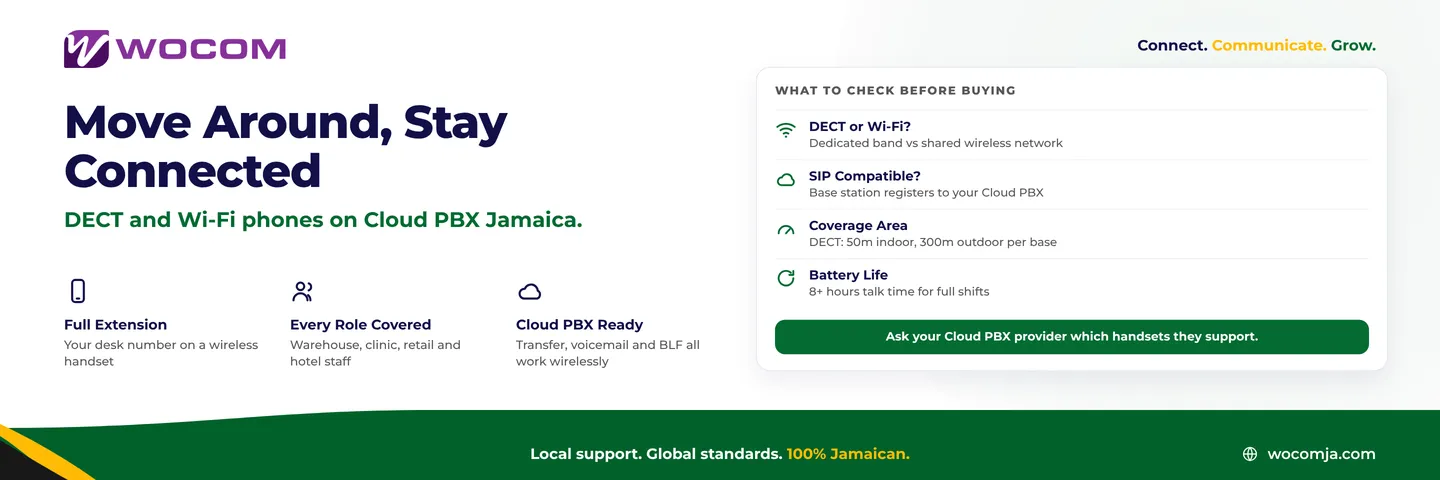
DECT (Digital Enhanced Cordless Telecommunications) uses a dedicated radio frequency that does not share spectrum with your Wi-Fi network. A base station plugs into your network switch, registers to the Cloud PBX as a SIP endpoint, and communicates with handsets on its own band. DECT gives you:
- Reliable range — typically 50 metres indoors and up to 300 metres in open outdoor areas per base station
- No congestion from laptops, cameras, tablets or other wireless devices sharing the same band
- Multi-cell systems that link several bases together and hand off calls as an employee walks across a large space
- Battery life of 10 to 24 hours depending on the model, suitable for full working shifts
Wi-Fi phones connect to your existing wireless LAN like any other device. They are cheaper to deploy in buildings that already have solid Wi-Fi coverage, but call quality depends entirely on the wireless network. If your Wi-Fi is shared with video streaming, security cameras and staff devices, voice traffic will suffer unless QoS rules prioritise it. For most Jamaica businesses deploying wireless handsets, DECT is the more reliable choice. Wi-Fi phones make sense in offices that already run enterprise-grade Wi-Fi with VoIP QoS properly configured.
Which Jamaica Businesses Benefit Most from Wireless Handsets
Wireless office phones fit any operation where staff move while on duty. That covers a wider range of Jamaican businesses than most people expect.
Warehouses and distribution centres in areas like Spanish Town, Portmore and industrial Kingston are often large enough that a fixed phone on the supervisor's desk is useless. A DECT handset means the floor supervisor can receive transferred calls, check in with the front office and handle customer collection queries without stopping work.
Medical clinics and pharmacies have nurses, technicians and pharmacists who move constantly between rooms. Rather than relying on personal mobile numbers or waiting for the receptionist to run a message, clinical staff can carry an extension that rings with inbound transfers and allows internal calls directly between rooms.
Retail businesses — hardware stores, clothing boutiques, appliance showrooms — have floor staff who cannot predict where they will be when a call needs to reach them. A wireless handset keeps them reachable for inventory questions, price checks passed from the main line and internal coordination with the stockroom.
Hotels and guest houses across Negril, Ocho Rios and Montego Bay rely on staff covering multiple areas of a property. Housekeeping, maintenance and front-of-house teams all benefit from extensions that move with them, keeping communication on the business system rather than on personal numbers.
Workshops and auto dealerships need technicians to receive calls from the service desk without leaving the bay. A DECT handset on a belt clip means a customer query gets answered immediately without a wasted trip to a fixed phone.
How Wireless Phones Connect to Your Cloud PBX
A DECT base station is a SIP device. It registers to your Cloud PBX the same way a desk phone does — using SIP credentials assigned by your provider. Each handset paired to that base station appears as an extension on the system. From the Cloud PBX's perspective, there is no difference between a desk phone and a wireless handset: both ring, both transfer, both participate in ring groups, and both log calls to your CDRs.
Multi-cell DECT systems let you install several base stations around a large building and link them together. As an employee walks from one end of a warehouse to the other, the handset hands off between bases without dropping the call. This seamless roaming requires a multi-cell DECT system — not just multiple single-cell bases operating independently.
Setup requires a network cable run to each base station location, SIP credentials from your Cloud PBX provider for each base, and extension configuration matching your existing dial plan. Your Cloud PBX provider should confirm which DECT brands they have tested against their platform. Not all handsets behave identically with every PBX, so starting with a confirmed-compatible model saves troubleshooting time.
Five Things to Check Before You Buy Wireless Handsets in Jamaica
Not all wireless phones are equal, and the wrong purchase can mean wasted money on equipment that will not register cleanly to your business phone system.
1. SIP compatibility. Consumer cordless phones from electronics stores use a proprietary protocol and cannot register to a business Cloud PBX. You need a business-grade DECT system with SIP support. Brands like Snom, Yealink, Grandstream and Cisco all manufacture SIP DECT systems designed for business deployments.
2. Number of simultaneous calls. A single DECT base typically supports 4 to 8 simultaneous calls across all paired handsets. If your team regularly handles more concurrent calls than that, add bases or choose a system with higher concurrency. Plan this before purchase, not after.
3. Coverage for your floor plan. Measure your space and account for obstructions. DECT range drops significantly in environments with concrete walls, metal racking or industrial equipment. Plan base station placements no more than 30 to 40 metres apart in obstructed environments rather than relying on the theoretical maximum range.
4. Battery life and charging logistics. Shift workers need handsets that last a full working day without interruption. Look for models with at least 8 hours of talk time and a charging cradle for every handset. Many multi-cell systems include a central charging station that keeps spares ready for shift changeovers.
5. Ruggedisation rating. Warehouses and workshops are hard on equipment. Some DECT handsets carry an IP65 rating for dust and splash resistance. If your environment is physically demanding, buy a model built for it rather than a standard office handset that will fail within months.
Wireless Handsets and AI Receptionists: A Practical Combination
If your business uses an AI receptionist to handle inbound calls, wireless handsets make the transfer step significantly more reliable. When the AI determines that a caller needs to reach a specific team member, it transfers the call to that person's extension. If that extension is on a DECT handset, the team member receives the call wherever they are on the premises — not only if they happen to be seated at their desk when the transfer arrives.
This combination works particularly well in medical clinics where the AI handles appointment queries and general enquiries, then routes clinical calls to the nurse or doctor on the floor using their wireless extension. It also suits retail operations where the AI qualifies a caller's enquiry and transfers to whichever floor supervisor is on duty — a person who is never at a fixed workstation.
Get Wireless Coverage Across Your Jamaica Business
If your team moves around your building and you are still relying on personal mobile numbers or shouted messages to stay connected, wireless office phones on your Cloud PBX will change how your operation runs day to day. DECT systems are reliable, straightforward to deploy and work with the same call flows, ring groups and transfer rules you already have configured — no separate system to manage.
WOCOM's Cloud PBX supports SIP-based DECT and Wi-Fi handsets. Our team can help you identify compatible hardware for your building size, configure extensions and test coverage before you roll out to your team. Contact WOCOM today to discuss your wireless phone requirements and get a recommendation suited to your Jamaica business.
Continue exploring
Ready to upgrade your communications?
Talk to our team about the right solution for your business.
Book a Demo Contact SalesEverett Kildare is WOCOM's voice and infrastructure specialist, with more than 25 years of experience designing and running carrier-grade voice, SIP and virtualization infrastructure. Holding a BSc in Information Technology, he has built, secured and migrated phone systems for businesses of every size. Everett writes WOCOM's technical coverage of SIP trunking, cloud PBX, contact centres, business continuity and migration.