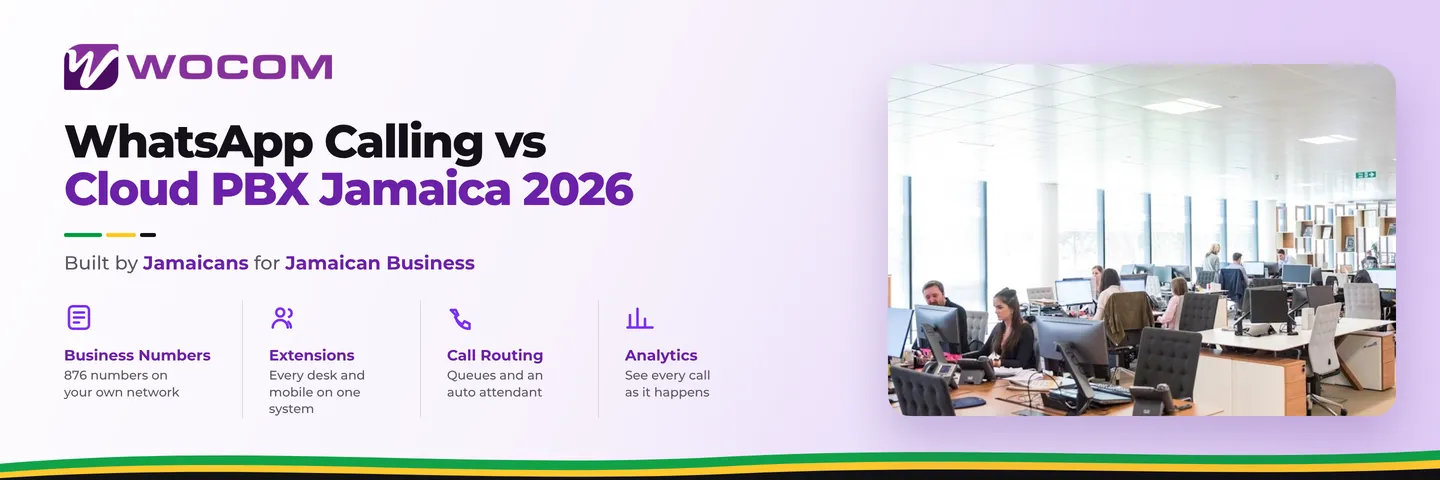
WhatsApp Calling vs Cloud PBX Jamaica 2026: Which Does Your Business Actually Need?
Most Jamaican businesses already use WhatsApp for customer communication. It is fast, it is familiar, and callers in Kingston and Montego Bay expect it. When WhatsApp introduced audio calling, many business owners quietly shelved the idea of a proper phone system. Why pay for a cloud PBX when customers can call you on WhatsApp for free?
The answer depends on how your business actually handles calls, how many people are involved, and what happens when things go wrong.
What WhatsApp Calling Can Do
WhatsApp calling works well for one-on-one conversations between people who already have each other's numbers. If a customer has your number saved, the call connects cleanly with no extra setup required.
- Free audio and video calls over Wi-Fi or mobile data
- End-to-end encrypted by default
- No separate app needed — it runs on WhatsApp Business, which most small Jamaican businesses already have installed
- Customers call on the same number they use to message you, with no learning curve
For a sole trader or a very small operation, this covers most situations day to day. The question is what it cannot cover — and what that costs you as the business grows.
Where WhatsApp Calling Falls Short
The moment your business has more than one person answering calls, or more than a handful of inbound calls per day, WhatsApp calling begins creating invisible problems that compound quietly until a customer notices them before you do.
No call routing. When a caller rings your WhatsApp number, it goes to one phone. If that person is busy, away from their desk, or simply unavailable, the call is missed. There is no ring group, no auto-attendant, and no fallback queue to hold the caller while someone becomes available.
No call recording. WhatsApp does not support call recording in any form. If a customer disputes what was agreed on a call, or a sale falls through and you want to understand why, there is nothing to review.
When a complaint escalates or a deal goes wrong, the first question is always: what was said on that call? If your calls are on WhatsApp, that question has no answer.
No extensions or departments. A cloud PBX lets a caller press 1 for sales, 2 for support, or 3 for billing. WhatsApp has no concept of departments or extensions. Every call lands on the same number and the same device, regardless of what the caller actually needs.
No analytics. A cloud PBX dashboard shows total call volume, missed calls, average answer time, and peak call hours by day of week. WhatsApp provides none of that. You cannot manage what you cannot measure, and you cannot improve what you are not tracking.
No IVR or AI receptionist. WOCOM's Alex AI receptionist answers every call on a dedicated business number, qualifies the caller, captures their name and reason for calling, and either routes them to the right person or takes a full message. None of that logic is possible on WhatsApp calling.
No CRM integration. Call records from a cloud PBX feed directly into your CRM system. WhatsApp call history is a log sitting on someone's personal phone, inaccessible to the rest of the team and invisible to your business systems.
The Professional Signal Your Phone System Sends
Every call your business handles sends a signal to the caller before a single word is spoken. When someone dials a WhatsApp number, they know immediately that they are reaching someone's personal phone. When they reach a cloud PBX with a professional greeting, an auto-attendant, and a named team member, they know they are reaching an organised business.
For companies in Jamaica that need to project credibility — a Kingston accounting firm, a Montego Bay hotel, a logistics operator, a growing distribution company — that first signal influences whether a caller decides to trust you before the conversation even begins.
Cloud PBX systems also present a landline-style 876 or 658 number rather than a mobile number. In Jamaica's business culture, a direct-dial 876 number carries real weight with institutional clients, government agencies, and corporate procurement teams in a way that a mobile-only contact does not.
When WhatsApp Calling Is Enough
This is not an argument that every Jamaican business needs a cloud PBX immediately. WhatsApp calling is genuinely sufficient when most of the following apply to your operation right now:
- You are a sole operator and every call goes directly to you personally
- Inbound call volume is fewer than ten calls per day
- You have no current need to track, record, or analyse calls
- You are not adding staff who will also need to handle customer calls
- All your active customers already have your WhatsApp number and use it
- None of your clients or partners expect a landline-style number
If that describes your business today, WhatsApp calling is your most practical option right now. The upgrade case builds the moment any of those conditions stops being true.
Signs It Is Time to Move to Cloud PBX
The right time to make the move is just before the cracks become visible to customers — not after complaints start arriving. These are the most common triggers Jamaican businesses experience when they contact WOCOM to make the switch:
- A second team member starts taking customer calls and there is no clean way to route between you
- You are running ads and need to know how many calls each campaign is actually generating
- A customer has mentioned that the line was busy or that no one picked up
- You need a landline-style 876 number to list on your website, Google Business Profile, or business cards
- You want to listen back to calls for quality assurance or staff training
- Call volume is growing to the point where one person handling everything creates a bottleneck
- You need reliable after-hours coverage without being personally on call every evening and weekend
WOCOM's Cloud PBX packages give businesses a professional number, a configurable auto-attendant, call routing to any device including staff mobiles, and a real-time call dashboard. The WOCOM Business prepaid plan removes the contract requirement entirely for businesses not yet ready to commit to a monthly subscription.
A Practical Middle Ground: AI Receptionist on a Dedicated Business Number
Some businesses sit between these two positions: too large for WhatsApp-only, but not yet ready for a full multi-seat cloud PBX deployment. WOCOM's Alex AI receptionist is a practical middle step that removes the gap.
Alex answers every call on a dedicated 876 or 658 number, handles common enquiries from your knowledge base, captures caller names and reasons for calling, qualifies sales enquiries, and routes calls to your mobile when you are available. It runs on the same infrastructure as a full cloud deployment, without requiring seat licences or hardware investment upfront.
The key difference from WhatsApp: every interaction is logged, every message is captured to a dashboard you can review, and you have a full record of every call regardless of whether it was answered by a person or handled by the AI. That record alone is worth more than the cost savings of staying on WhatsApp as your business grows.
Get the Right Recommendation for Where Your Business Is Today
The businesses that struggle most with upgrading to a cloud PBX are the ones that waited until customer complaints made it unavoidable. The businesses that handle the transition best moved while there was still time to do it properly — before the peak season, before the ad campaign, before the new hire.
WOCOM can review your current call handling, team structure, and growth plans, and tell you honestly whether a full Cloud PBX, a prepaid business number, or an AI receptionist fits where you are right now. There is no one-size-fits-all answer, and there is no pressure to take more than you need.
Contact WOCOM at wocomja.com or send a message via WhatsApp to start the conversation. If the answer today is that WhatsApp calling is still enough for your stage, we will tell you that too — and we will tell you exactly what to watch for so you know when the right time to upgrade has arrived.
Continue exploring
Ready to upgrade your communications?
Talk to our team about the right solution for your business.
Book a Demo Contact SalesEverett Kildare is WOCOM's voice and infrastructure specialist, with more than 25 years of experience designing and running carrier-grade voice, SIP and virtualization infrastructure. Holding a BSc in Information Technology, he has built, secured and migrated phone systems for businesses of every size. Everett writes WOCOM's technical coverage of SIP trunking, cloud PBX, contact centres, business continuity and migration.