Voice Broadcasting Jamaica: Automated Outbound Calls for Reminders, Alerts and Announcements
What Is Voice Broadcasting?
Voice broadcasting is automated outbound calling at scale. Instead of a staff member dialling each contact individually, a system dials a list of numbers simultaneously, plays a pre-recorded message, and logs who answered, who was busy, and who did not pick up. When a recipient presses a key — say, "1 to confirm" — the system records that response or transfers them to a live agent.
The technology is not new, but modern SIP trunking has made it accessible and affordable for businesses of any size. What once required expensive hardware and dedicated ISDN circuits now runs through the same cloud infrastructure that powers everyday business calls. For a Jamaica business with a modest contact list and a consistent need to reach customers, voice broadcasting is one of the most cost-effective communication tools available.
Why Jamaica Businesses Are Using It
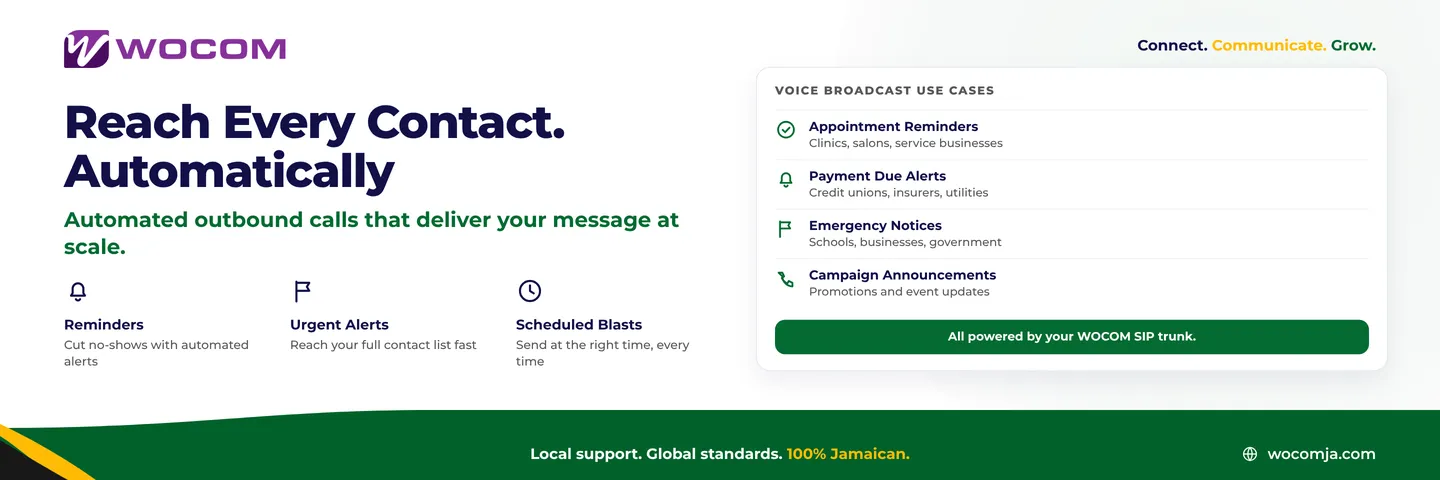
Across Kingston, Montego Bay, and towns in between, businesses are finding voice broadcasting cuts the manual work of staying in touch with customers. The most common applications are:
- Appointment reminders — Medical clinics, beauty salons, mechanics, and legal offices send automated reminders 24 hours before a booking. No-show rates fall immediately because customers who cannot make the appointment call back to reschedule rather than simply not arriving.
- Payment and account alerts — Credit unions, insurance firms, and utilities send payment-due notices before an account falls behind. A polite automated call a few days before the due date beats a collection call weeks after it passes.
- Emergency and operational notices — Schools notify parents of closures or schedule changes. Property managers alert tenants about water interruptions or maintenance access. Businesses communicate sudden hour changes during public holidays or severe weather events.
- Event announcements — Training centres, churches, community organisations, and retailers send promotional messages to opted-in subscriber lists ahead of sales events, seminars, or openings.
- Delivery and service status — Courier companies and repair shops notify customers that their order is ready or their technician is en route — reducing walk-ins and repeat inbound enquiry calls.
How Voice Broadcasting Works Technically
At its core, voice broadcasting requires three components: a SIP trunk with sufficient outbound channel capacity, a dialler application, and a contact list. The typical flow looks like this:
- You upload your contact list — names and phone numbers — and record or generate your message using text-to-speech.
- The dialler schedules and launches outbound calls across multiple channels simultaneously. With a WOCOM SIP trunk, the number of parallel calls is limited only by your channel count, so a list of a hundred contacts can be reached in minutes rather than hours.
- When a call is answered, the system plays the message. It can detect voicemail versus a live answer and play different recordings accordingly — leaving a full message for voicemail and asking for a keypress confirmation from live respondents.
- Response data is collected in real time: answered, pressed 1, pressed 2, went to voicemail, busy, no answer. You receive a delivery report when the campaign concludes.
Integrations with CRM systems and scheduling platforms are common, so a confirmed appointment automatically updates the booking record without manual follow-up. For businesses already using cloud software to manage customers, adding voice broadcasting is often a matter of connecting two systems rather than building from scratch.
Making Your Campaign Work — Practical Tips
A technically successful blast that irritates recipients is not a success. These practices keep voice broadcasting effective and welcome:
- Keep messages short. Callers decide within the first five seconds whether to listen or hang up. Lead with who you are and why you are calling. Thirty seconds is usually enough; sixty seconds is the absolute maximum before drop-off becomes severe.
- Call during business hours. In Jamaica, the window of 9 AM to 6 PM Monday to Friday, and 10 AM to 2 PM on Saturday, is generally acceptable. Early-morning or late-evening calls produce complaints even when the message is legitimate.
- Personalise where possible. Systems that insert the recipient's first name or account reference — "Good afternoon, Michael, this is a reminder from…" — produce measurably higher engagement than generic messages. Modern text-to-speech systems handle this naturally.
- Provide a clear action. Every message should tell the recipient exactly what to do: press 1 to confirm, call back on a specific number, or visit a location. A message with no call to action is a missed opportunity.
- Give an easy opt-out. Even for legitimate campaigns, respecting opt-out requests protects your number's reputation and prevents recipients from blocking your caller ID with their carrier.
Compliance and Data Protection in Jamaica
Jamaica's Data Protection Act, 2020, governs how businesses collect, store, and use personal information — including phone numbers. Voice broadcasting to customers you have an existing relationship with sits in a different position to cold outbound dialling. Key principles to follow:
- Have a lawful basis. An existing service relationship, an explicit opt-in, or a legitimate interest such as notifying a customer about their own account all provide grounds for contact. Using a purchased list of strangers without consent does not.
- Respect expressed preferences. If a customer has told you they do not want phone contact, honour it. Continuing to call them is both a compliance risk and a customer experience failure.
- Record your basis. Keep records of when and how consent was collected. If a customer challenges the contact, you need to demonstrate why you held their number and what lawful basis you relied on.
- Do not repurpose the list. Numbers collected for one purpose — a service relationship — should not be used for a different campaign without fresh consent or a fresh assessment of legitimate interest.
None of this is onerous for businesses that already keep proper customer records. The same CRM data that enables personalised service naturally supports compliant voice broadcasts.
SIP Trunk Capacity: What You Need to Run a Campaign
The practical limit on how fast you reach your list is the number of outbound SIP channels your trunk supports. A trunk with five concurrent channels can place five calls simultaneously. If each call takes forty seconds on average — thirty-second message plus connection and disconnect time — that trunk dials roughly 450 contacts per hour. A ten-channel trunk doubles that throughput.
For small campaigns of a few hundred contacts, the outbound capacity on a standard WOCOM SIP trunk is typically sufficient. Larger campaigns — a school district notifying every parent, a credit union reaching its full membership — may warrant a temporary channel burst or a dedicated campaign trunk. WOCOM can provision additional capacity on request and release it once the campaign ends, so you are not paying for peak capacity year-round.
The key point is that your existing SIP trunk infrastructure is the foundation. You are not buying a separate platform — you are adding a campaign capability to what you already have in place.
Get Started with Voice Broadcasting in Jamaica
Voice broadcasting is one of those capabilities that looks complex until you have seen it set up once. For most Jamaica businesses, the first campaign — an appointment reminder or a payment notice — is running within a day of deciding to use it. The dialler software handles the scheduling and delivery; your job is to record a clear, helpful message and upload a clean contact list.
WOCOM's SIP trunking platform provides the outbound calling infrastructure, a Jamaican caller ID that recipients recognise, and the channel capacity to scale campaigns up or down as your needs change. Whether you are a clinic looking to cut appointment no-shows or an organisation that needs to reach hundreds of contacts in a hurry, the foundation is the same reliable SIP connection your business calls already use.
Ready to reach your customers automatically? Contact WOCOM to discuss how voice broadcasting fits your business — whether you need a straightforward appointment reminder setup or a large-scale outbound notification system for your entire customer base.
Continue exploring
Ready to upgrade your communications?
Talk to our team about the right solution for your business.
Book a Demo Contact SalesEverett Kildare is WOCOM's voice and infrastructure specialist, with more than 25 years of experience designing and running carrier-grade voice, SIP and virtualization infrastructure. Holding a BSc in Information Technology, he has built, secured and migrated phone systems for businesses of every size. Everett writes WOCOM's technical coverage of SIP trunking, cloud PBX, contact centres, business continuity and migration.