Inbound Upselling for Jamaica Contact Centres: Turning Service Calls Into Revenue Moments
The Revenue Sitting Inside Every Service Call
Across Jamaica contact centres — insurance desks in New Kingston, utility billing queues in Portmore, telecoms support lines in Montego Bay — the same scene plays out hundreds of times a day. An agent resolves a query, confirms the account change, or walks a customer through a technical issue. The caller is satisfied. The agent says "thank you for calling." The call ends.
What did not happen: the agent did not notice that the customer's plan has not been upgraded in three years, or that the complaint they just resolved would be prevented entirely by a higher tier. The upsell window — the brief moment of maximum customer openness that follows a successful resolution — closed without anyone walking through it.
This is not a failure of effort. It is a failure of training design. Most Jamaica contact centres train agents to handle calls, not to maximise them. The result is a revenue gap that shows up in every monthly report without anyone knowing exactly where it came from.
Why Inbound Calls Outperform Outbound for Upselling
Outbound sales campaigns in Jamaica run into predictable resistance. The customer did not ask to be contacted, and the first thirty seconds are spent earning the right to keep the conversation going. Inbound is structurally different.
A customer who calls you has already demonstrated intent. They identified a need, waited through the queue, and engaged with an agent. By the time the issue is resolved, trust is at its peak for that entire relationship moment. That is the precise window to offer something genuinely useful — not to push a product, but to connect a solution to a pattern the agent actually heard in the call.
"The best upsell never feels like a sale. It feels like the agent paid attention."
Inbound conversion rates for well-executed upsell programmes consistently outperform outbound campaigns in contact centres that measure both. The difference is consent: the customer chose to be on this call.
The Resolve-First Rule — Non-Negotiable
Before any upsell training lands in a Jamaica contact centre, one principle must be established as non-negotiable: the issue is resolved completely before any offer is made. Not mostly resolved. Not "I'll get someone to follow up on that, and also — have you heard about our new plan?" Completely resolved, with the customer confirming it.
Customers can sense when a company cares more about the upsell than the problem. That perception, once formed, ends the conversation regardless of what the agent says next. Agents who follow the resolve-first rule consistently achieve higher acceptance rates precisely because the caller trusts what comes after a genuine resolution.
The cue to transition is behavioural, not scripted: the customer's tone shifts from tense or focused to relaxed. That shift — audible on any recording — is the signal that the bridge is appropriate.
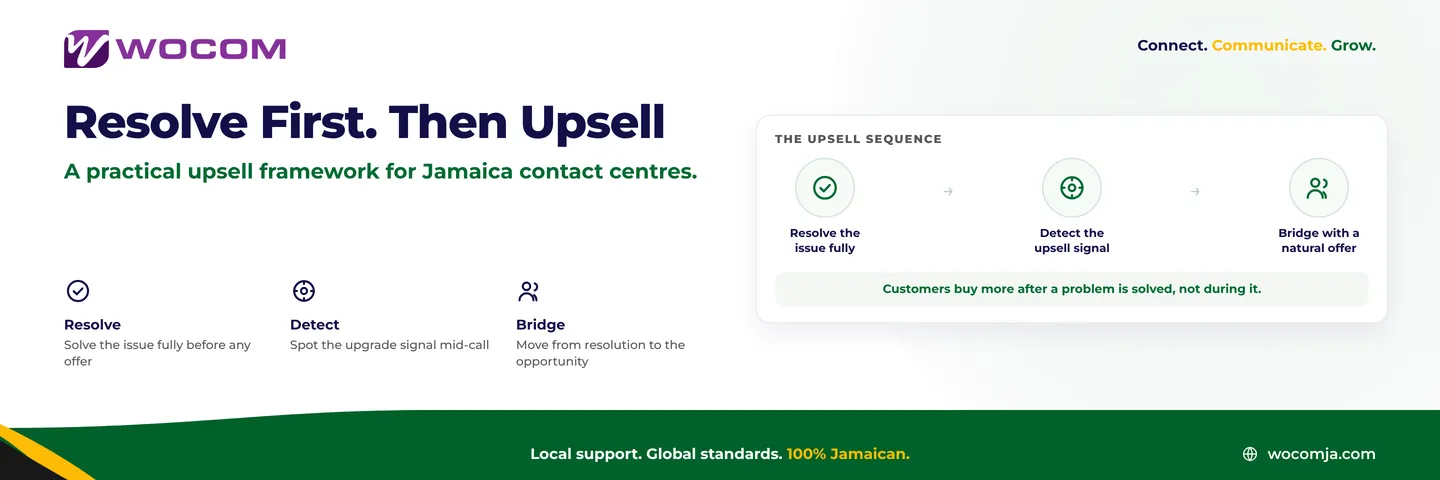
A Three-Step Framework Jamaica Agents Can Apply Today
This framework is simple enough to print and laminate beside every monitor. It works across financial services, telecoms, utilities, and any other inbound contact centre operation in Jamaica where service calls carry upsell potential.
- Step 1 — Detect the signal. While working through the issue, listen for patterns that imply a gap: a plan that no longer fits usage, a recurring complaint that an upgrade would prevent, a feature the customer asked about but does not currently hold. Do not act yet. Note it mentally and keep resolving.
- Step 2 — Resolve completely. Confirm the issue is closed. Ask "Does that fully sort it for you?" or "Is there anything else on that before I let you go?" Wait for a genuine confirmation — not just silence. Do not rush past this step to get to the offer.
- Step 3 — Bridge with permission. Use a transition that connects what just happened to what you noticed. Not "would you like to hear about our new plans?" — that sounds scripted and generic. Instead: "While I had your account open, I noticed something that might actually help with what you just described — do you have another minute?" The caller said yes to this call. Asking for one more minute is low-friction. Most say yes.
In Kingston call centres where Jamaican callers expect warmth and directness in equal measure, this framework works because it mirrors natural conversation: help first, then share what you know.
Scripts That Work With Jamaican Callers
Rigid word-for-word scripts fail in Jamaica contact centres because the audience expects a real conversation. The following are bridge frameworks your agents adapt, not repeat verbatim.
The usage-gap bridge: "I noticed your current package has a cap that the account is hitting most months. There's a tier that gives you more room for a small difference — want me to pull up the comparison while I have you?"
The prevention bridge: "The issue you had today actually comes up from time to time on the standard plan. There is a configuration on the next tier that prevents it. Worth a quick look while I'm in here?"
The feature-reveal bridge: "The feature you were asking about does exist, but it's not switched on for your account. I can activate the basic version now, or if you want the full version it comes standard on the business plan — your choice."
Each bridge references something specific from the call, frames the offer as helpful rather than commercial, and ends with a yes/no question that carries no pressure. The caller is in control.
What to Measure and How to Coach It
Contact centre supervisors in Jamaica often skip upsell coaching because it feels like a different discipline from quality monitoring. It is not — the same tools that track handle time and resolution scores can track upsell performance. Three metrics matter most:
- Upsell attempt rate — the percentage of eligible calls (resolved, with a signal detected) where the agent made a bridge attempt. This is the coaching metric. An agent with a lower conversion rate who attempts on most eligible calls is more trainable than one who converts well but rarely tries.
- Conversion rate by agent — which agents convert most, and what their bridge sounds like. Pull those recordings and use them in team sessions.
- Post-upsell satisfaction scores — if your team runs after-call surveys, track whether upsell calls score lower than non-upsell calls. They should not, when the resolve-first rule is followed. If they do, the bridge is being placed too early.
A five-minute daily team huddle reviewing one upsell win and one missed signal is more effective than a monthly training day. Keep it short, specific, and grounded in actual call recordings.
How Your Phone Platform Supports the Programme
A well-configured contact centre platform does more than route calls. WOCOM's AI call scoring flags upsell signals in real time — a customer whose usage is capped, a complaint that has recurred, a question about a service the account does not currently hold. Supervisors do not need to listen to every call to catch these moments; the system surfaces them automatically.
Call tagging lets your team mark upsell attempts in the reporting layer, so attempt rate sits alongside resolution rate in the same dashboard view. Call recording enables the coaching moment: pulling a thirty-second bridge from a successful call and playing it in the team session is worth more than ten minutes of description. Agent desktop integration — where account data surfaces at the point of answer — means an agent can detect the signal before the customer finishes describing their issue. Preparation converts detection into reflex.
Start Small, Prove It, Then Scale
The mistake most Jamaica contact centre managers make when launching an upsell programme is going too broad too quickly. One team, one signal, one week — that is the starting point. Review the recordings at the end of the week, refine the bridge, add a second signal the following week.
This approach builds agent confidence through early wins, gives supervisors clean coaching data, and avoids the resistance that comes from feeling overwhelmed by a new directive layered onto an existing workload.
WOCOM's contact centre platform includes the call recording, AI scoring, and reporting tools to run this programme from day one. If you want to see how AI signal detection works on a live inbound call — or to discuss how your current contact centre setup could support a structured upsell programme — reach out to the WOCOM team at wocomja.com/contact. The tools are already there. The framework above gives your agents the language to use them.
Continue exploring
Ready to upgrade your communications?
Talk to our team about the right solution for your business.
Book a Demo Contact SalesEverett Kildare is WOCOM's voice and infrastructure specialist, with more than 25 years of experience designing and running carrier-grade voice, SIP and virtualization infrastructure. Holding a BSc in Information Technology, he has built, secured and migrated phone systems for businesses of every size. Everett writes WOCOM's technical coverage of SIP trunking, cloud PBX, contact centres, business continuity and migration.