Telecom Resilience Score Jamaica: How Resilient Is Your Business Phone System?
Why Most Jamaican Businesses Don't Know Their Weak Points Until It's Too Late
A Category 1 storm parks offshore Kingston for 48 hours. A JPS transformer blows on a Monday morning in New Kingston. A contractor severs a fibre run in Montego Bay's industrial corridor. Any of these can happen on any given week in Jamaica — and when they do, the businesses that hold on commercially are the ones that kept taking calls.
The problem is that most businesses assume their phone system is resilient until the moment it isn't. An on-premise PBX in the server room, a single SIP trunk, a UPS with 20 minutes of runtime — that is not a resilient communications setup. That is a setup with the illusion of resilience.
The Telecom Resilience Score framework below gives you a structured way to measure your current setup across five independent dimensions. Score yourself honestly, identify the gaps, and you will have a clear action list before the next disruption forces the issue.
The Five Dimensions of Telecom Resilience
Resilience is not binary. It degrades along five separate failure paths, and a perfect score on four dimensions with a zero on one can still mean a complete call blackout.
- Hardware Independence: Does your phone system depend on physical equipment in your office? An on-premise PBX box, a local server, or a voice gateway are all single points of failure. Cloud-hosted platforms score highest here because there is nothing local to lose, damage, or flood.
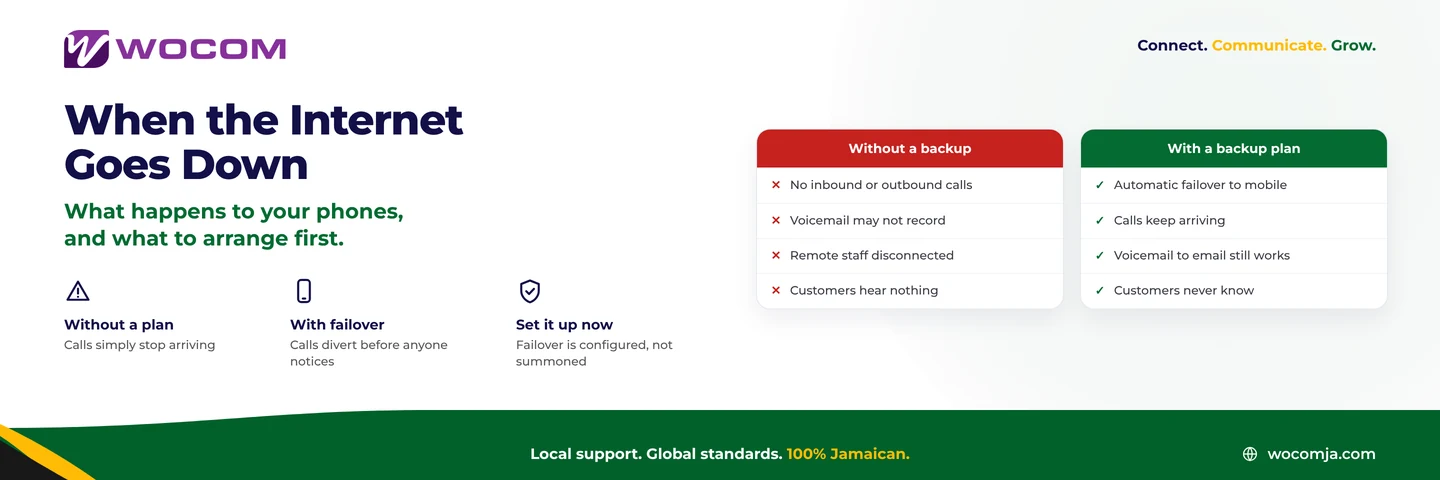
- Carrier Redundancy: If your primary internet provider goes down, what happens to inbound calls? A business with one ISP and one SIP trunk is one fibre cut away from zero inbound capacity. A resilient setup has a second carrier path — whether a second fibre provider, LTE, or Starlink — with automatic failover between them.
- Power Continuity: Jamaica's grid is, charitably speaking, unpredictable. A UPS that lasts 20 minutes does not help during a four-hour outage. Resilient setups route calls to the cloud and to mobile before local power dies, not after — so the office going dark is irrelevant to callers.
- Call Routing Intelligence: Does your system automatically redirect calls when a component fails, or does it require someone to log in and reconfigure it? Auto-failover to a mobile number, a ring group, or a backup trunk scores maximum points. Any process that requires a human to initiate the switch scores zero.
- Staff Accessibility: Your phone infrastructure can be perfectly healthy while staff cannot answer — because they are remote, evacuated, or dealing with a local emergency. A resilient setup lets any authorised team member handle business calls from a laptop or mobile, from any location, without special equipment.
How to Score Your Current Setup
Rate yourself on each dimension from 0 to 4. A perfect score is 20. Score yourself on what is actually configured and tested — not what you believe is possible or what the vendor told you was included.
- 16–20 — Resilient. You have documented failover procedures and have tested them under real or simulated conditions. Minor gaps exist but they are not existential.
- 10–15 — Exposed. You can survive most routine disruptions but a major event will cost you hours of inbound calls. Focus improvement effort on your two lowest-scoring dimensions.
- 6–9 — Fragile. One or two simultaneous failures will take your communications offline for an extended period. You are likely carrying more business risk than your leadership is aware of.
- 0–5 — Vulnerable. Your setup has no real failover architecture. A serious disruption will cut your communications entirely until physical repairs are made or manual rerouting is configured from scratch.
Be honest. "We have a UPS" scores 1, not 4. "Calls automatically route to mobile within five seconds of a power loss and staff can answer from their phones anywhere" scores 4. The framework is only useful if you do not round yourself up.
The Most Common Failure Patterns in Jamaica
After reviewing communications setups across businesses in Kingston, Portmore, Spanish Town, and Montego Bay, these are the failure patterns that appear most often — and they are almost always invisible until something goes wrong.
Single ISP, single trunk. This is the default for most SMEs. The primary provider has an outage, and every inbound call immediately hits a busy signal or voicemail. The fix is a secondary carrier path with automatic trunk failover — a configuration change, not a hardware replacement.
On-premise hardware in flood or storm-risk locations. Businesses in parts of Kingston, Portmore, and coastal commercial zones have physical infrastructure at genuine risk during hurricane season. A cloud-hosted platform means your PBX survives even if your office does not.
Voicemail as the only after-hours fallback. If your business is unreachable after 5pm and the system drops to voicemail, you are not resilient — you are absent. An AI receptionist or a properly configured schedule-based routing rule is the difference between capturing leads and losing them permanently.
Staff mobility not accounted for. Any operation that requires staff to be at a physical desk phone carries a resilience risk the moment disruption forces remote work. Cloud softphones and mobile apps are not just convenience tools — they are continuity infrastructure.
How WOCOM Clients Typically Improve Their Scores
The highest-impact improvements are usually not expensive. They are architectural.
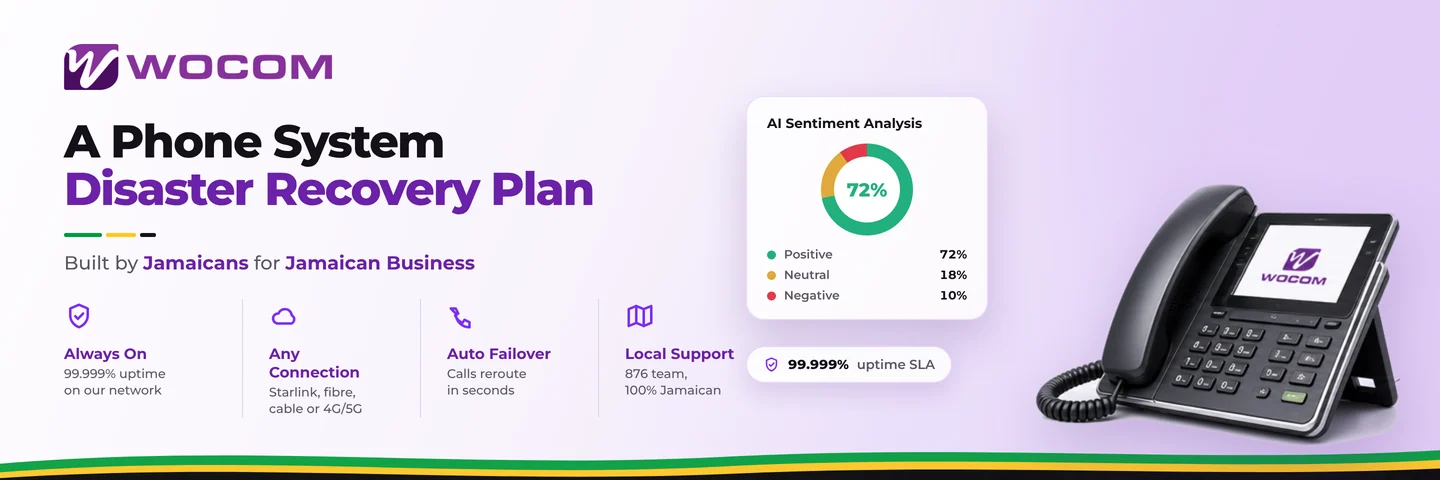
Moving from an on-premise PBX to WOCOM Cloud PBX eliminates the hardware dimension entirely. There is no box to replace after a flood, no server to lose in a power surge, and no local configuration to rebuild from scratch. Calls are hosted on carrier-grade infrastructure with built-in redundancy.
Adding a second SIP trunk on a separate carrier — or routing an existing trunk to a Starlink or LTE backup — adds carrier resilience without touching the primary setup. WOCOM's trunking platform supports primary and failover carriers natively, and the switch between them is automatic and transparent to the caller.
Enabling WOCOM's AI receptionist on every inbound line means that even during a staffing disruption, callers are still greeted, their details are captured, and urgent messages are escalated by SMS. The AI does not need the office to be occupied to be useful.
Finally, testing matters. A failover configuration that has never been triggered is a configuration that cannot be trusted. WOCOM clients on managed plans can request a scheduled failover drill — a brief, controlled test that confirms the architecture behaves as designed before a real disruption forces the question.
Take Action Before the Next Disruption
Business continuity planning is not a project for next quarter. Hurricane season runs through November. Power disruptions happen year-round across every parish. The next outage does not need a date on the calendar.
If you scored below 15, WOCOM can walk through your specific setup, identify where the critical gaps are, and show you what it would take to close them — in many cases without replacing your entire phone system. The highest-risk gaps often close with configuration changes and carrier additions, not capital expenditure.
Book a resilience review with a WOCOM specialist. Call 876-300-7949, email info@wocomja.com, or visit wocomja.com to request your assessment. It costs nothing and takes less than an hour — before the next disruption makes it urgent.
Continue exploring
Ready to upgrade your communications?
Talk to our team about the right solution for your business.
Book a Demo Contact SalesEverett Kildare is WOCOM's voice and infrastructure specialist, with more than 25 years of experience designing and running carrier-grade voice, SIP and virtualization infrastructure. Holding a BSc in Information Technology, he has built, secured and migrated phone systems for businesses of every size. Everett writes WOCOM's technical coverage of SIP trunking, cloud PBX, contact centres, business continuity and migration.