The Smarter Way to Do Business in Jamaica: What the Numbers Say About How We Work Now
“Work smarter” is the emptiest advice in business until somebody attaches numbers to it. So this piece does that. Below is what the published data actually says about how Jamaican businesses operate in 2026 — who they are, where their customers come from, and which parts of the infrastructure they can rely on — and what a sensible operator does with that information.
Every figure here comes from a public source: the Jamaica Information Service, the World Bank, DataReportal’s Digital 2025 report and the Office of Utilities Regulation. They are listed at the end.
First, who the market is
Strategy written for a large company rarely survives contact with a Jamaican business, because the Jamaican business is usually small, owner-led and running without a spare person to absorb a bad process.
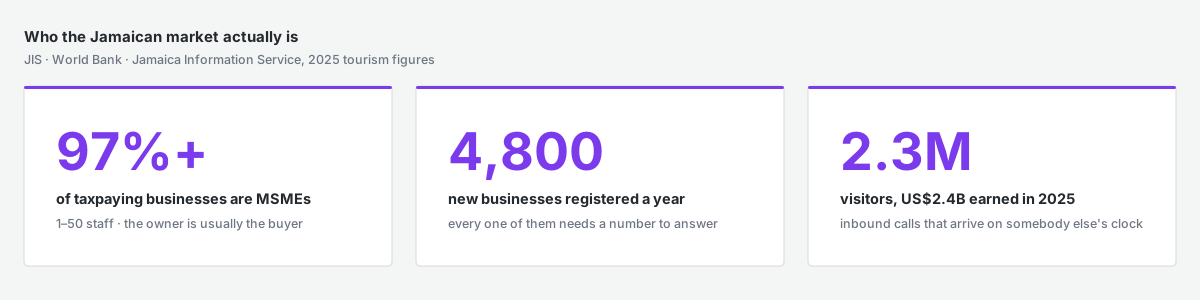
The buyer is almost always an owner-manager, and the customer is often arriving from overseas.
Three things follow from that. The person choosing your systems is the same person serving customers, so anything that needs constant administration will be quietly abandoned. There is no night shift, so demand arriving after five o’clock either gets captured automatically or gets lost. And with roughly 4,800 new businesses registering a year, your competition is being created continuously — often by somebody with no legacy systems to defend.
The country is online. It is just not on a wire.
This is the single most useful piece of market data for anybody choosing business systems in Jamaica, and it is routinely misread.
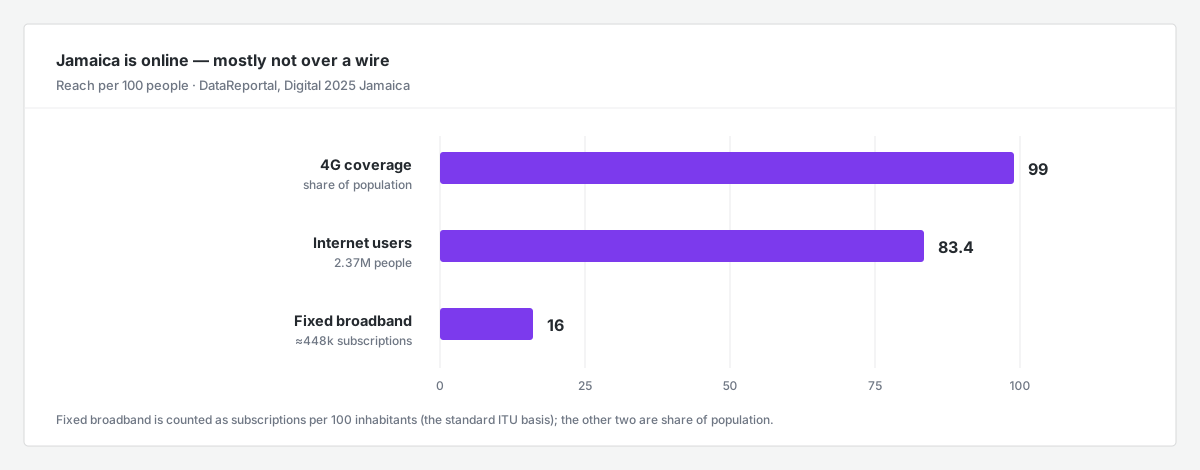
Near-universal mobile coverage, thin fixed-line coverage — the shape of the whole market in one chart.
Read the top two bars and cloud software is obviously viable: 83.4% of the population is online and 4G reaches 99% of it. Read the third bar and you learn the harder lesson — the wire into the building is the weakest link in the chain, not the internet itself.
The smarter posture is therefore not “move everything to the cloud”. It is move everything to the cloud and assume the office link will fail. In practice that means a phone system whose extensions also run on a mobile app, and routing rules that send calls to mobile numbers automatically when a site goes dark, rather than a system that is perfect until the day the fibre is cut. We wrote the checklist version of this in the network readiness check to run before you move to VoIP.
Where the calls are coming from
Two sectors dominate inbound call volume in Jamaica, and they pull in different directions.
The first is tourism. In 2025, 2.3 million visitors spent US$2.4 billion here. Those calls arrive on the visitor’s clock, not yours — evenings, weekends, and from time zones where the working day starts when yours has ended. A hotel, villa, tour operator or transport company that only answers between nine and five is not choosing to lose bookings; it simply never sees them.
The second is global services — the BPO and ICT sector — which buys more voice capacity per employee than any other part of the economy.
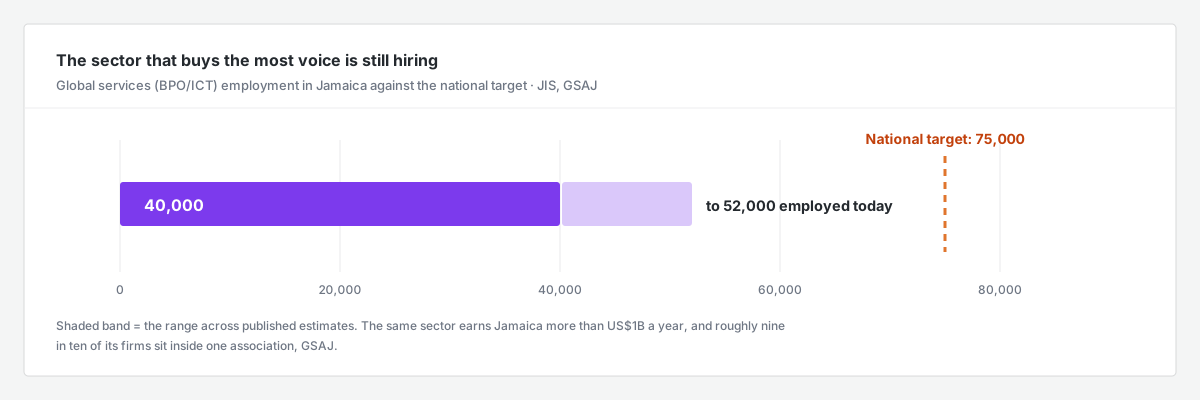
A sector with a stated national target roughly 50% above where it sits today.
Whichever side of it you are on — operating a contact centre, or competing with one for the same staff — the implication is the same. Customer expectations in this market are being set by operations that answer immediately, route accurately and record everything. That is now the baseline, not the premium tier.
What “smarter” actually means, in order of return
Given the above, the interventions that pay back fastest for a Jamaican business are unglamorous and mostly about the phone:
- Answer everything, including after hours. The cheapest revenue in any business is the call it already earned and did not pick up. An AI receptionist answering at 9pm on a Sunday is not a novelty in a tourism economy — it is when a meaningful share of the enquiries arrive.
- Route by intent, not by hoping. A caller who reaches the right department first time does not call three times. Queues, dial-by-name and simple menus are old technology that most small businesses still do not use.
- Make the office phone follow the person. With 4G at 99% coverage, the mobile app version of the desk extension works nationwide — and it is also your continuity plan.
- Record and read back. Recording is only useful if you can find the call afterwards; that is the difference between a compliance archive and an actual management tool, covered in call recording is easy, finding the right recording is the hard part.
- Consolidate the bill. Numbers, trunks, handsets, video and support from one provider in one currency removes a whole category of monthly administration.
The switching risk is smaller than most owners think
The most common reason a business stays on a system it has outgrown is fear of losing its number. That fear is out of date.
Number portability in Jamaica is a regulated right, not a favour granted by your current provider. Under the rules administered by the Office of Utilities Regulation, mobile numbers port in roughly 24 hours and landline numbers within about five business days, and the process is required to happen with minimal interruption to service. Your business number is yours; the provider carrying it is a decision you are allowed to revisit.
Two operators account for roughly 95% of internet users here, which means most businesses have never actually run a comparison. Being big is not the same as being the right fit for a twelve-person firm.
The test to run on your own business this week
None of this requires a consultant. Four checks, an hour of your time:
- Call your own business at 7pm. Whatever happens next is what happens to every after-hours customer you have.
- Count last month’s missed calls. If your phone system cannot tell you the number, that is itself the finding.
- Unplug the office internet for two minutes. If the phones die with it, you do not have a phone system, you have a phone service that depends on one cable.
- Add up every communications invoice. Numbers, lines, mobile, conferencing, support. Owners are routinely surprised by the total, because it never appears on one page.
Frequently Asked Questions
Is cloud telephony reliable enough in Jamaica?
For the great majority of businesses, yes: 83.4% of the population is online and 4G reaches 99% of it. The weak point is the fixed link into a specific building, which is why a properly designed system includes mobile apps and automatic failover to mobile numbers.
What is the fastest communications improvement for a small business?
Capturing calls that currently go unanswered — after hours, during lunch, and when everyone is already on the phone. It requires no new staff and no change to how the business operates during the day.
Will I lose my business number if I switch providers?
No. Number portability is a regulated right in Jamaica: mobile numbers move in about 24 hours and landline numbers in roughly five business days, with the rules requiring minimal service interruption.
Why does the tourism figure matter if I am not in tourism?
Because 2.3 million visitors reset what customers expect from every business they deal with while they are here — and because tourism demand arrives outside normal working hours, which is where most missed calls happen in any sector.
Do small Jamaican businesses really need call recording and analytics?
Not all of them. But any business where a disputed conversation, a compliance obligation or a training problem costs real money gets more from recording than it expects — provided the recordings can actually be searched.
Where do these figures come from?
The Jamaica Information Service (MSME share, global services employment, 2025 tourism), the World Bank via Trading Economics (new business registrations), DataReportal’s Digital 2025 Jamaica report (internet and 4G reach) and the Office of Utilities Regulation (number portability rules). Links are below.
Sources
- DataReportal — Digital 2025: Jamaica (internet users, 4G coverage, fixed broadband)
- Jamaica Information Service — MSMEs: government support and business registration
- Jamaica Information Service — Global services sector employment growth
- Jamaica Information Service — US$2.4B earned from 2.3 million visitor arrivals, 2025
- World Bank via Trading Economics — New businesses registered
- Office of Utilities Regulation — Number portability FAQs
Where WOCOM fits
Everything described here is ordinary practice for a business phone system that was designed for this market: extensions that also live on a mobile, automatic failover when a site loses its link, an AI receptionist for the hours nobody is at the desk, and one bill in Jamaican dollars. See what is included with WOCOM Cloud PBX, compare the plans and pricing, or talk to our team in Jamaica about which parts are worth doing first.
Continue exploring
Ready to upgrade your communications?
Talk to our team about the right solution for your business.
Book a Demo Contact SalesMichelle Goss is a data and AI analyst at WOCOM, where she studies how Jamaican businesses use voice, messaging and AI to win and keep customers. With a BSc in Data Science & Analytics, she turns call data, customer trends and AI receptionist performance into practical guidance owners can act on. Michelle writes WOCOM's coverage of AI call handling, call analytics, customer growth and industry trends.