SIP Trunk ROI Jamaica: How to Calculate What You Save by Replacing Legacy Lines
Why Most Jamaica Businesses Don't Know What Their Phone Lines Actually Cost
Voice infrastructure costs are easy to ignore. A monthly invoice arrives, finance pays it, and no one examines the line items. For many businesses across Kingston, Montego Bay, and the parishes in between, this invisibility has meant overpaying for legacy phone services for years — sometimes long after better alternatives became available.
SIP trunking replaces physical telephone lines with voice delivered over your existing internet connection. The cost model is fundamentally different: you pay for the concurrent call capacity you actually need, you own the configuration, and you can change it without booking a service visit. But before making any switch, you need to answer one question honestly: what is your current setup actually costing you?
Step 1: Audit What Your Legacy Lines Are Costing
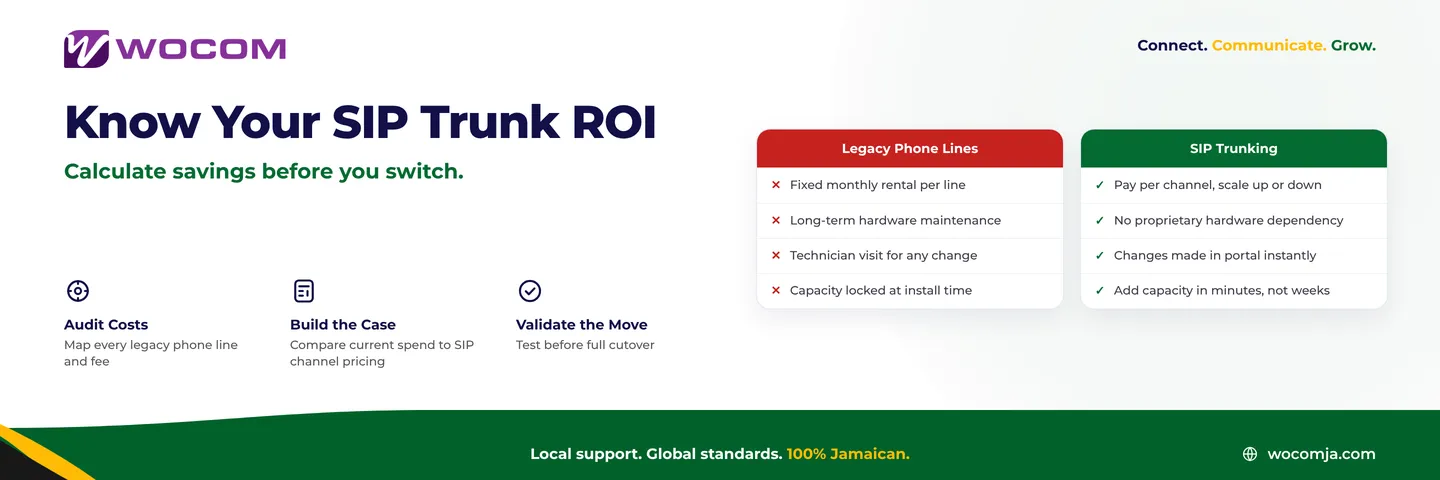
Pull your last three monthly phone invoices and identify every recurring charge. Most businesses in Jamaica are paying for some combination of the following:
- Monthly line rental — a fixed fee for each analogue or ISDN circuit, whether you use it or not
- Equipment maintenance — service contracts or ad-hoc call-out fees for physical PBX hardware
- Per-minute charges on international calls — often priced at retail when wholesale rates on SIP are significantly lower
- Long-distance national calling — calls between parishes can still carry separate rate structures on legacy tariffs
- Equipment rental — some legacy contracts include gateways or handsets you are no longer actively using
Once you have a total, you have your baseline. Do not skip this step. Businesses regularly discover they are paying for three or four lines that handle a fraction of their actual call volume — lines that could be replaced by a single SIP channel at a fraction of the cost.
Step 2: Understand What SIP Trunking Replaces
A SIP trunk replaces the physical connection between your phone system and the public telephone network. Instead of copper lines or ISDN circuits running into your building, calls travel over your internet connection using the Session Initiation Protocol.
This matters for your ROI calculation because it eliminates several cost categories entirely:
- Fixed monthly rental on physical lines disappears
- Per-minute rates on local and national calls drop — SIP carriers price these at wholesale, not legacy retail rates
- Geographic restrictions go away; a Kingston number can ring at a branch in Mandeville without any special routing arrangement
- Carrier-side hardware costs vanish — there is no ISDN termination equipment to maintain on your premises
What does not disappear: your IP PBX or cloud PBX system, your internet connection, and your handsets. SIP trunks connect to your existing phone system — they are not a complete replacement of it, which keeps migration costs predictable.
Step 3: Build Your Simple ROI Comparison
The comparison has three columns: what you pay now, what you would pay on SIP, and the difference. Here is how to populate each one.
Current state costs (monthly): Add your line rentals, your average per-minute charges over the last three months, and any equipment or maintenance fees that are line-specific. That sum is your monthly voice spend baseline.
SIP equivalent costs (monthly): Estimate the number of calls your business typically handles simultaneously at peak. If you have four lines but rarely have more than two calls running at once, you need two SIP channels — not four. SIP channel pricing is sold per concurrent call, per month. Add your estimated per-minute usage at SIP rates, which will be lower than your current tariff for most Jamaica businesses.
The difference: Subtract. The question is whether that monthly saving justifies the one-time migration effort.
A practical breakeven test: If your monthly saving covers the setup and migration cost within six to eight months, the ROI case is strong. If breakeven stretches past twelve months, scrutinise your legacy contract for exit penalties — those change the calculation significantly.
Step 4: Account for What You Gain, Not Just What You Save
A pure cost comparison understates the case for SIP because it ignores capabilities you gain that legacy lines simply cannot provide.
With SIP trunking, you can add and remove channels in minutes — no waiting for a technician, no new hardware, no service call. During a busy period in Ocho Rios or at the start of the school year in Kingston, you can add two channels on Monday and remove them at month-end. Legacy lines do not offer this kind of elasticity.
Failover routing is another factor worth pricing. A properly configured SIP trunk can redirect calls to a mobile number or a secondary site automatically if your office connection drops. Adding equivalent resilience to a legacy line setup typically requires a separate contract and additional hardware. With SIP, it is a configuration option.
Finally, SIP trunks integrate cleanly with modern cloud PBX platforms and AI receptionist tools. If your business has any plans to add intelligent call handling or contact centre functionality, SIP is the connectivity layer those systems assume. Staying on legacy lines creates a compatibility barrier that eventually forces a migration under less controlled conditions.
What the Migration Actually Involves
The one-time cost of migrating to SIP typically covers: any IP-to-analogue gateway hardware if your existing PBX is not SIP-native, configuration of your PBX to register against the new SIP provider, porting your existing business numbers (usually completed within a few working days in Jamaica), and structured testing before you cut over completely.
Running both your legacy lines and new SIP trunks in parallel for a short period — a practice covered in detail in our guide on SIP trunk parallel running — adds a few weeks of overlap cost but eliminates the risk of committing before the new setup is verified. For businesses where voice availability is critical, that overlap is worth every dollar.
The migration cost is one-time. The savings run monthly from the moment you exit the legacy contract. That ratio makes the decision clear for most businesses that go through the exercise honestly.
Run the Numbers Before You Decide
SIP trunking is not automatically the right answer for every Jamaica business. If your legacy setup costs very little and you have no plans to grow, modernise, or add features, the ROI calculation may be marginal. But for businesses with four or more lines, meaningful per-minute call volumes, or any intention to upgrade their communications infrastructure in the next two years, the cost comparison almost always favours SIP.
The businesses that get this wrong skip the audit. They assume savings without calculating them, then get surprised by contract exit fees or miscalculate how many concurrent channels they need. Starting with real numbers from real invoices makes the decision straightforward.
WOCOM can walk you through a no-obligation review of your current voice spend and a side-by-side comparison against SIP trunk pricing. If the numbers work in your favour, migration can begin within days. If they do not, we will tell you that too.
Contact WOCOM today to request your free SIP trunk cost comparison. Bring your last phone invoice and we will have a clear figure for you before the conversation is over.
Continue exploring
Ready to upgrade your communications?
Talk to our team about the right solution for your business.
Book a Demo Contact SalesEverett Kildare is WOCOM's voice and infrastructure specialist, with more than 25 years of experience designing and running carrier-grade voice, SIP and virtualization infrastructure. Holding a BSc in Information Technology, he has built, secured and migrated phone systems for businesses of every size. Everett writes WOCOM's technical coverage of SIP trunking, cloud PBX, contact centres, business continuity and migration.