SIP Trunk Parallel Running Jamaica: Test Your New Provider Without Cutting Over Cold
Why "Cut Over Cold" Is Still the Biggest Migration Risk
Every week, businesses across Kingston, Montego Bay, and the wider Jamaica market switch SIP trunk providers on a Monday morning — and spend the rest of the week firefighting. Extensions fail to register. Inbound calls land on the wrong number. International routes drop mid-call. The engineer who configured everything is unreachable by 9 a.m.
The root cause is almost always the same: the team ran a single test call from IT's desk, declared it working, and committed the primary number range without validating behaviour under real production load. What they needed was parallel running — a technique that lets you test a new SIP trunk in your actual environment, with real callers, while your existing service stays fully operational.
What Parallel Running Actually Means
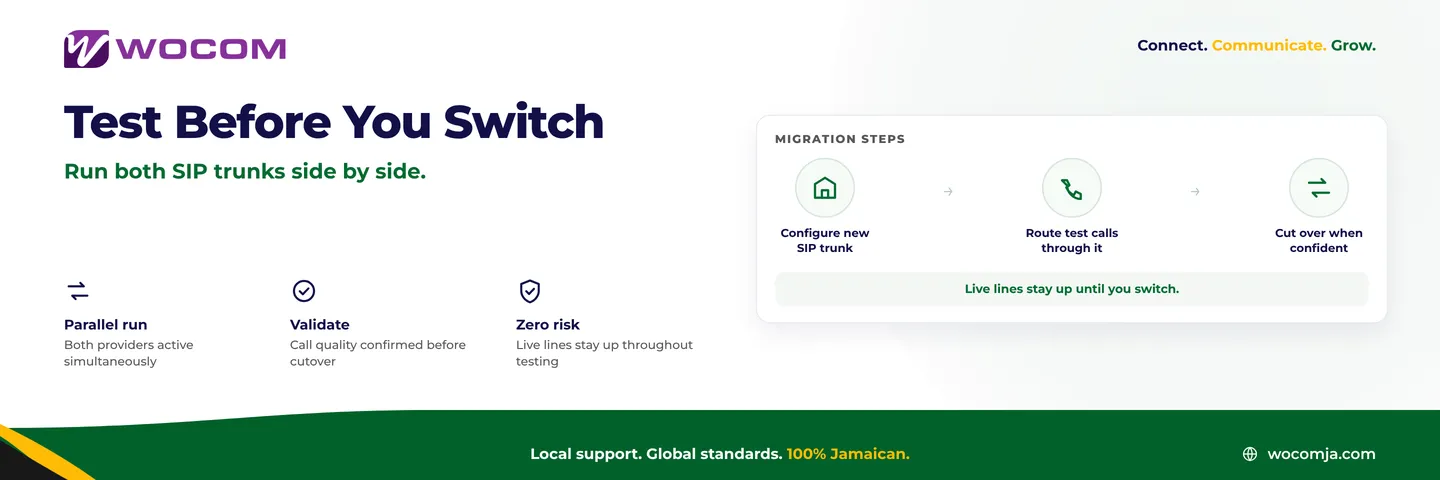
Parallel running means commissioning your new SIP trunk without decommissioning the old one. Both trunks are registered on your PBX simultaneously. You route a specific subset of traffic — test calls from internal users, or a temporary inbound DID — through the new provider, while your main business numbers continue to route through the existing trunk.
Nothing changes for callers on your primary numbers. Your business keeps answering. Meanwhile, your team is placing real outbound calls and receiving real inbound calls through the new provider, measuring quality, latency, and routing behaviour under conditions that cannot be replicated in a lab.
The cutover — moving your main number range to the new provider — only happens after you have enough evidence to be confident. And even then, leaving the old trunk registered as a hot standby for another 48 hours costs almost nothing.
How to Set Up a Parallel Run
The configuration differs slightly depending on your PBX platform — Asterisk, FreePBX, 3CX, or a hosted Cloud PBX — but the approach is consistent.
- Provision the new trunk credentials alongside the existing one. Register the new SIP trunk as a secondary trunk group. Do not modify, disable, or overwrite your current trunk at this stage.
- Assign a test inbound DID. Request a temporary number from your new provider, or port a low-traffic number across early. Route this number exclusively through the new trunk so inbound test calls are isolated from your live traffic.
- Create a secondary outbound dial plan. Configure a short prefix or feature code — for example, dialling 2 before a number — that forces outbound calls through the new trunk. Staff can use this prefix to test outbound quality without affecting normal operations.
- Capture CDR data per trunk. Ensure your call detail records tag which trunk handled each call, so you can compare drop rates, duration patterns, and quality issues side by side, not in aggregate.
- Run for at least five full business days. A single afternoon of test calls is not sufficient. You need to capture Monday–Friday call patterns, peak-hour behaviour, and any variation across Jamaican mobile networks (calls terminating on Digicel can behave differently from calls terminating on Flow depending on how your provider routes to each).
What to Test During the Parallel Period
Parallel running is not a gut-feel check — it is a structured validation. These are the areas that catch the most problems before cutover.
Perceptual call quality. Listen critically for delay, echo, clipping, and noise artefacts on both outbound and inbound legs. Issues that only appear under call load — not on a quiet test call from IT — are exactly what this period is designed to surface.
Post-dial delay. Measure the time between dialling the last digit and the far end ringing. A new provider routing through a different media gateway can introduce noticeable delay, particularly for calls to Jamaican mobile numbers. If your team notices it, your customers will too.
DTMF reliability. Call your own IVR and press every menu option. Tone-based DTMF behaves differently across providers depending on whether the codec is compressing in-band audio. A keypress that is silently dropped in your IVR menu is invisible in testing but costs real customers in production.
Caller ID presentation. Verify that inbound caller ID arrives in the format your systems expect — 10-digit, 7-digit, or E.164. In Jamaica, number format inconsistencies between providers can break CRM screen-pop integrations or cause AI receptionist name lookups to fail silently.
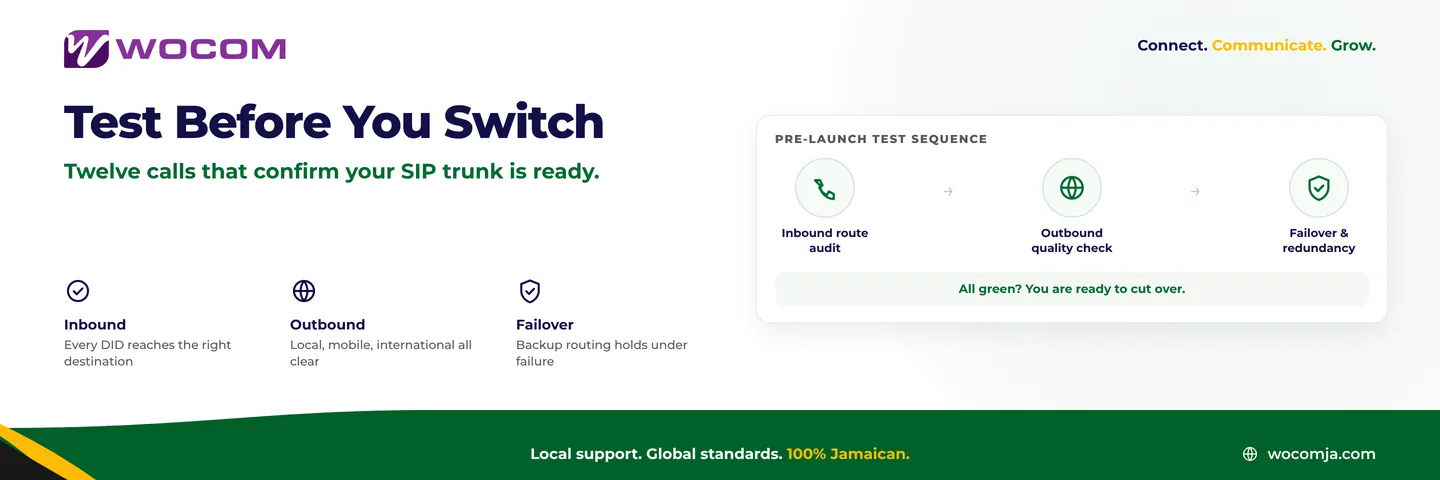
Failover timing. Simulate a trunk failure and confirm that your PBX rolls over to the existing trunk fast enough that callers do not hear a gap or receive a fast busy signal.
When You Are Ready to Cut Over
A completed parallel run is not "no one complained." Before you move your primary number range, work through a concrete sign-off checklist:
- Five or more business days of test calls with no quality complaints from internal users
- Inbound caller ID presenting correctly and matching your CRM or AI configuration
- DTMF confirmed working through your complete IVR menu tree
- CDR data showing no unexplained short-duration calls or mid-call drops
- Failover tested and rollover timing confirmed acceptable
- New provider support contact and escalation path documented in writing
If you can check all six, you are not guessing. You are making a decision grounded in evidence from your own environment.
Schedule the cutover itself — the moment your main DID range moves — for a low-traffic window. Early Tuesday morning, after any weekend call load and before the peak weekday volume, is a common choice for Jamaican businesses. Have someone available to watch the first two hours of live traffic before declaring the migration complete.
Keep the Old Trunk as a Hot Standby
One of SIP trunking's practical advantages over legacy telephone circuits is that decommissioning is immediate and requires no engineer visit. Because of this, it costs almost nothing to leave your old trunk registered and configured as a failover destination for 48 to 72 hours after cutover, rather than decommissioning it the same morning.
If something unexpected surfaces in the first few days on the new provider — a routing path that behaves differently with real traffic volume, a DTMF issue on a specific IVR branch you did not test — your PBX can roll back before a single caller notices. Once you have a full business week of clean traffic on the new trunk, decommission the old one.
How WOCOM Handles Migration for Jamaica Businesses
When businesses migrate their SIP trunking to WOCOM, the provisioning team configures the new trunk in parallel with whatever service is currently in place. You receive test credentials and a temporary inbound DID on the same week as sign-up. Your existing service is never modified until you confirm the new trunk is performing to your standard.
For businesses also deploying WOCOM Cloud PBX or the WOCOM AI receptionist, the parallel period serves double duty: call quality is validated while routing, knowledge bases, and staff portal access are configured at the same time. Go-live is not also a learning day — your team has already seen the system working before a single primary number is moved.
WOCOM is a licensed telephone provider and network operator in Jamaica. When you call our support line, you reach the team that manages the network — not a helpdesk that must escalate to a reseller above them.
Start Your Migration the Right Way
If you are evaluating SIP trunk providers in Jamaica for 2026, do not accept a proposal that skips the parallel run. Any provider confident in their service quality will support it without hesitation.
Contact WOCOM to have a test trunk provisioned this week. Our business team will walk you through the parallel run checklist, help you configure the secondary dial plan on your PBX, and stay available through cutover day. Reach us at wocomenterprise.com/contact or speak with our business team directly to get started.
Continue exploring
Ready to upgrade your communications?
Talk to our team about the right solution for your business.
Book a Demo Contact SalesEverett Kildare is WOCOM's voice and infrastructure specialist, with more than 25 years of experience designing and running carrier-grade voice, SIP and virtualization infrastructure. Holding a BSc in Information Technology, he has built, secured and migrated phone systems for businesses of every size. Everett writes WOCOM's technical coverage of SIP trunking, cloud PBX, contact centres, business continuity and migration.