SIP Trunk Load Balancing Jamaica: Distribute Call Traffic Across Carriers for Maximum Uptime
What Is SIP Trunk Load Balancing?
A SIP trunk is the digital connection between your phone system and the public telephone network. Most businesses buy one trunk from one provider and route all calls through it. Load balancing changes that model: instead of one path, your PBX maintains two or more SIP trunks — often from different carriers — and distributes call traffic across them according to rules you define.
The result is a phone system that keeps working even when any single carrier has an outage, a congestion event, or a routing problem. For businesses in Kingston, Montego Bay, or anywhere in Jamaica that depend on the phone as a primary customer channel, that resilience is not a luxury — it is a continuity requirement.
Why Single-Carrier SIP Trunks Leave Jamaica Businesses Exposed
A single SIP trunk creates a single point of failure. When that trunk goes down — whether due to a carrier-side outage, a network routing fault, or congestion at your internet service provider — every inbound and outbound call fails simultaneously. Your staff have no warning. Callers hear a fast busy tone or dead silence. The business effectively disappears from the phone network.
Caribbean carriers, including those operating in Jamaica, experience periodic outages. International routing paths can degrade independently of local connectivity. A trunk that worked perfectly at 9 AM may start dropping calls by noon because of an upstream routing fault you have no visibility into. Without a secondary trunk to absorb traffic, there is nothing to fall back on.
The other risk is capacity. A single trunk with a fixed channel count saturates during peak periods — a marketing campaign, a sale announcement, or a storm that drives customers to call at once. Load balancing across trunks with different channel counts gives you an effective burst ceiling well above what any single trunk can carry.
Routing Strategies: Round-Robin, Priority-Based, and Least-Cost
Not all load balancing uses the same logic. The right strategy depends on your business priorities.
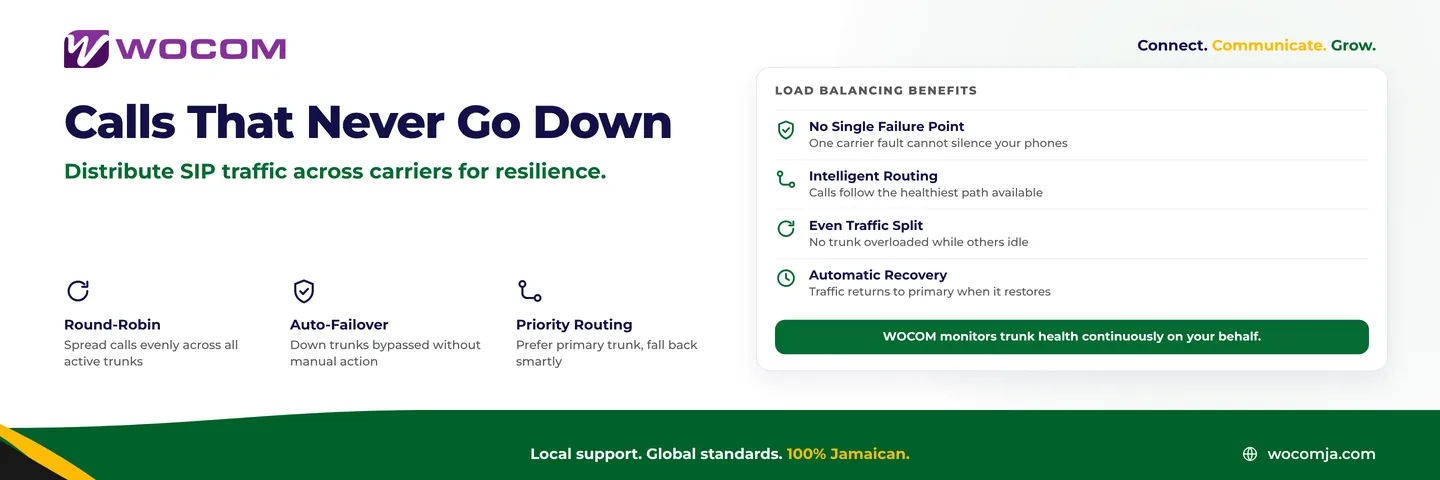
- Round-robin routing distributes each new call to the next available trunk in sequence. This keeps all trunks equally busy and works best when your carriers are similar in quality and cost.
- Priority-based (active/standby) routing sends all traffic to your primary trunk first and shifts to the secondary only when the primary is unavailable or congested. This is the most common setup for businesses that want a reliable primary carrier but need a safety net behind it.
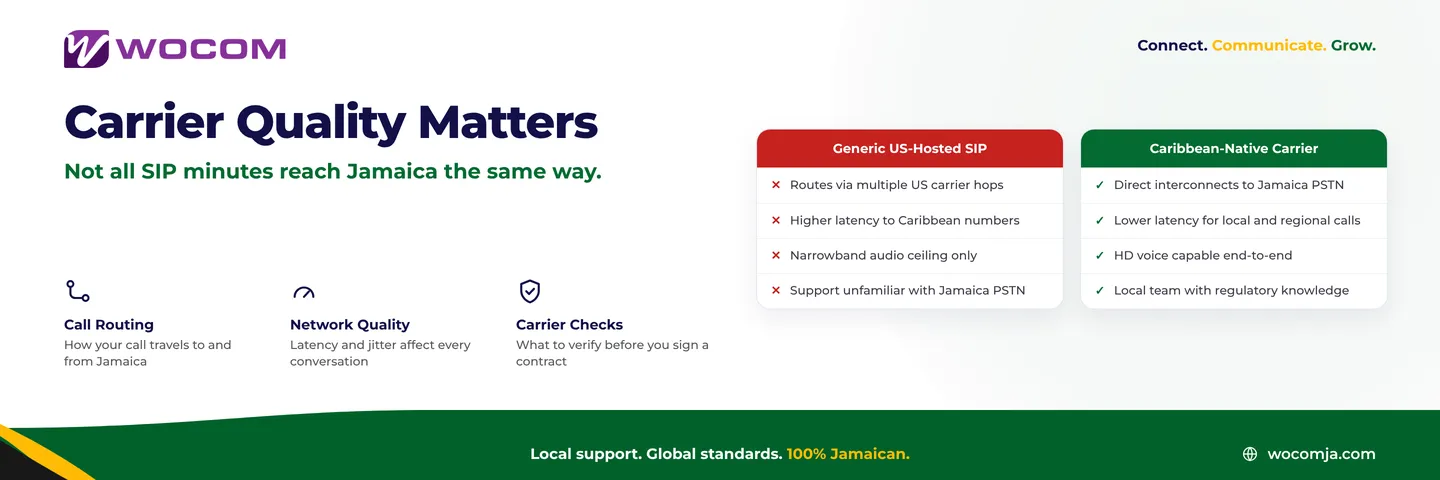
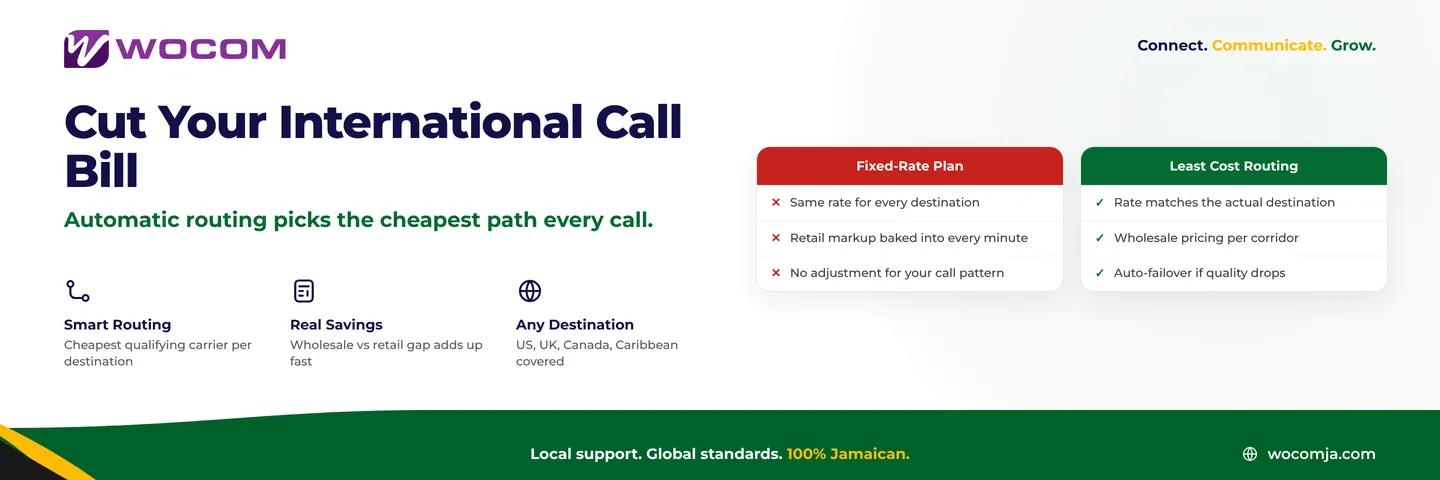
- Least-cost routing (LCR) selects the trunk based on the destination number and the per-minute rate each carrier offers for that route. It is especially useful for businesses with high volumes of international or long-distance calls, where rate differences between carriers accumulate quickly.
- Latency-based routing sends calls through the trunk with the best measured path quality to the destination. This matters when you are connecting to customers across the Caribbean, North America, and the UK — as many Jamaican businesses do regularly.
Many businesses combine strategies — primary/standby failover for reliability, with least-cost rules applied within the active trunk selection for cost efficiency. These are not mutually exclusive.
Automatic Failover: The Core Protection You Are Paying For
Load balancing infrastructure is only as good as its failure detection. When a trunk becomes unavailable, your PBX needs to detect the fault and reroute traffic without human intervention. This requires active health monitoring — typically SIP OPTIONS pings sent to each trunk endpoint at short intervals. When a trunk stops responding, it is removed from the routing pool. When it recovers, traffic returns to it automatically.
The key questions to ask any SIP trunk provider about failover are:
- How quickly does your platform detect a trunk failure — seconds or minutes?
- Can inbound calls to my number reroute to a secondary trunk if my primary endpoint becomes unreachable?
- Does failover apply to inbound calls as well as outbound?
- Can I test failover without disrupting live traffic?
Inbound failover is particularly important and often overlooked. If a caller dials your number and your primary trunk endpoint is down, the carrier needs an alternate destination to try. Without a configured failover destination — a second trunk, a mobile number, or an IVR hosted off-premises — the call simply fails. The caller hears a tone that suggests you do not exist.
How Load Balancing Fits Into Your Existing Setup
If you run Asterisk, FreePBX, 3CX, or a similar open-standards PBX, you can configure multiple SIP trunk accounts and define outbound route priorities and failover sequences in the dial plan. Most enterprise-grade systems expose these controls in trunk management. What they cannot do on their own is monitor carrier-side health or reconfigure inbound routing at the carrier level — that requires coordination with your SIP trunk provider.
A cloud PBX or hosted SIP trunk service can manage much of this transparently. When the platform spans multiple carrier interconnects, load balancing and failover happen in the network before a call ever reaches your PBX. Your phones receive calls normally regardless of which underlying path carried them. This architecture removes the dial-plan burden from your team and places the resilience logic in the carrier infrastructure where it belongs.
Before adding a second trunk or switching to a load-balanced service, confirm the following with your provider:
- Number ownership: Your inbound DIDs must be configurable to route through a secondary trunk. If a provider owns the number and locks it to their infrastructure, you cannot use another carrier as an inbound failover for that number.
- Codec compatibility: Both trunks must support the same audio codecs your PBX uses, or you will face quality differences between the primary and failover path.
- DTMF handling: Confirm both trunks use the same DTMF relay method — RFC 2833 is standard — to prevent IVR failures on the secondary path.
- Authentication method: Verify your PBX and both providers handle SIP authentication consistently, whether by IP whitelist or username/password registration.
Build a Resilient Call Path with WOCOM
WOCOM provides SIP trunks over its own licensed carrier infrastructure in Jamaica, with routing that spans multiple international interconnects. Whether you need a managed active/standby failover pair, a least-cost configuration for high-volume outbound calling, or a fully load-balanced inbound setup that keeps your lines ringing through any single-carrier fault, WOCOM's team can design and configure the right architecture for your call volume and business continuity requirements.
Your current trunk setup almost certainly has a single point of failure that you have not had to think about yet. The right time to find it is before an outage, not during one.
Speak with a WOCOM engineer about SIP trunk resilience for your Jamaica business. Visit wocomja.com to get started — or call us directly and experience the platform you would be trusting your calls to.
Continue exploring
Ready to upgrade your communications?
Talk to our team about the right solution for your business.
Book a Demo Contact SalesEverett Kildare is WOCOM's voice and infrastructure specialist, with more than 25 years of experience designing and running carrier-grade voice, SIP and virtualization infrastructure. Holding a BSc in Information Technology, he has built, secured and migrated phone systems for businesses of every size. Everett writes WOCOM's technical coverage of SIP trunking, cloud PBX, contact centres, business continuity and migration.