SIP Trunk Invoice Explained: What Every Line Item Means for Your Jamaica Business
Why Your SIP Trunk Bill Can Look Confusing
When your first SIP trunk invoice arrives, it looks nothing like the flat monthly charge you used to get from a traditional landline provider. Instead of one straightforward figure, you see a list of items — channel fees, DID rentals, per-minute breakdowns, destination rate codes, and occasionally a one-time charge from months ago that you thought was already settled.
This isn't a Jamaica-specific problem. SIP trunk billing is inherently more granular than legacy landline billing because you are paying for distinct resources: call capacity, virtual phone numbers, and actual usage. Once you understand what each component represents, reviewing your invoice takes five minutes and you can catch errors before they roll into the next billing cycle. This guide walks through every major line item, what it means, and what to do if something looks off.
The Three Building Blocks of Any SIP Trunk Invoice
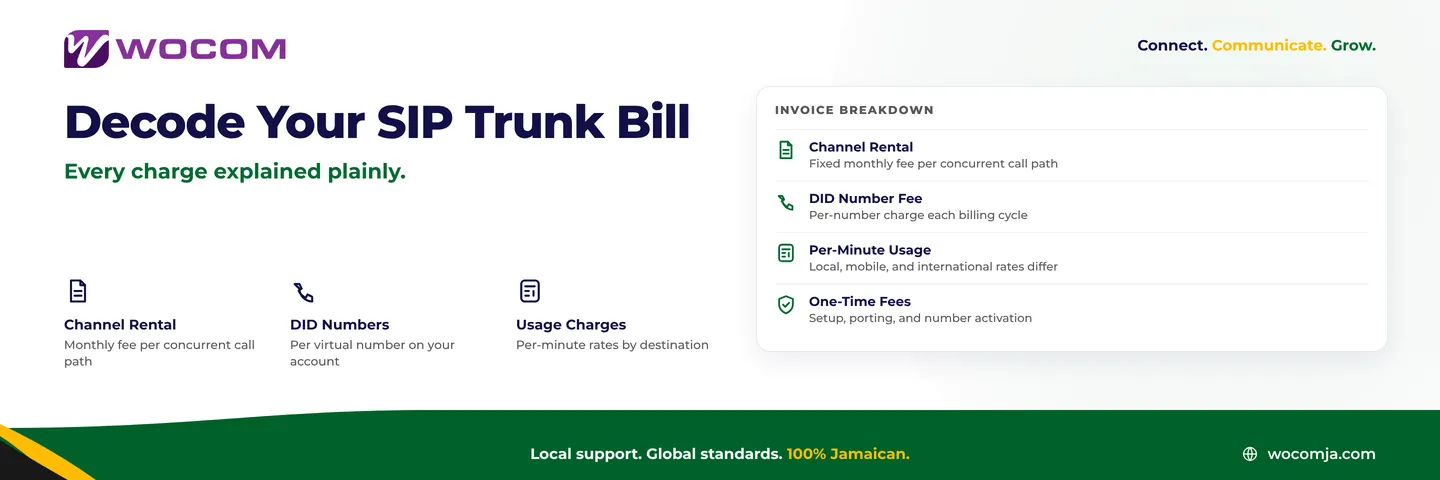
Almost every SIP trunk invoice — whether from WOCOM or any other provider — is built from three core components: channels, DID numbers, and usage charges. Everything else is a variation or addition to these three.
- Channels determine how many calls your business can handle at the same time.
- DID numbers are the virtual phone numbers that callers dial to reach you.
- Usage charges are the per-minute fees for calls that fall outside any included bundle.
When you can identify each of these, the rest of the invoice falls into place. Let's look at each one in detail.
Channel Rental: Your Call Capacity Charge
A channel is a single simultaneous call path. If your business has four channels and five people try to call at exactly the same moment, the fifth caller hears a busy signal. Channel rental is a fixed monthly fee per channel — you pay for capacity whether you use every channel or not, similar to renting parking spaces in a car park.
The right number of channels depends entirely on your call patterns. A Kingston accounting firm that handles client queries one at a time may need only two or three channels. A Montego Bay tourism business fielding inbound booking enquiries during high season could need twelve or more. Your provider can pull a concurrent-call peak report from your call data to tell you whether your current channel count is leaving callers stranded or whether you are over-provisioned.
On your invoice, channel rental appears as a line item per channel or as a named bundle, for example 5-Channel SIP Trunk — Monthly. If your team reports frequent busy signals at peak times, this is the line to review first when deciding whether to expand.
DID Fees: The Cost of Each Virtual Number
A DID — Direct Inward Dialling number — is a real Jamaican phone number, 876 or 658 area code, that routes calls to your phone system. Businesses pay a monthly rental fee per DID to keep each number active and reachable.
You may have several DIDs serving different purposes: a main switchboard number, a direct line for your accounts department, a separate number for a branch in Spanish Town or Ocho Rios, or an 888 toll-free number for customer service. Each one appears as a separate line on your invoice, which is normal.
DID fees in Jamaica are generally modest, but they accumulate if your account has collected numbers you no longer use. A number provisioned for a project that ended, a branch that closed, or a campaign that wrapped up two years ago is still generating a monthly charge until it is decommissioned. Reviewing your DID list once a quarter and releasing numbers you do not need is one of the simplest ways to reduce your bill without any impact on service quality.
Per-Minute Usage: Local, Mobile, and International Rates
Usage charges cover the cost of calls themselves. Most SIP trunk plans in Jamaica carry different per-minute rates depending on where the call is going:
- Local fixed-line calls — calls to 876 or 658 landline numbers — are typically the lowest per-minute rate.
- Mobile calls — calls to Jamaican mobile numbers — often carry a higher per-minute rate because mobile termination costs more than fixed-line termination on the Jamaican network.
- International calls — calls to the United States, United Kingdom, Canada, or any destination outside Jamaica — are billed at destination-specific rates that vary considerably by country.
If your plan includes a bundle — for example, unlimited local landline calls or a block of minutes to North America — usage charges only appear for calls that fall outside the bundle. Reviewing your usage breakdown each month, broken down by destination type, tells you whether your bundle is correctly sized or whether you are consistently paying overages that a different plan would eliminate.
If you see a spike in international usage you cannot account for internally, treat it as a red flag. Toll fraud — where unauthorised calls are made through a compromised phone system — almost always shows up first as unexpected international usage charges. Report it to your provider immediately.
One-Time Fees: Setup, Porting, and Number Activation
Your first invoice is typically the most complex because it includes charges that should not appear again:
- Setup fee — charged once when your SIP trunk is provisioned. This covers the configuration and testing work on your provider's network.
- Number porting fee — if you transferred an existing number from another carrier, the porting process carries a one-time cost that should be clearly labelled as non-recurring.
- Number activation fee — some providers charge a small fee when a new DID is first assigned to your account, separate from the ongoing monthly rental.
These charges should be clearly listed as one-time items on your invoice. If any of them appear on a second or third invoice without explanation, contact your provider before paying — they should not recur unless you have added new services.
Line Items Worth Questioning
Not every charge on a SIP trunk invoice is automatically legitimate. These are worth querying if you encounter them:
- Vague service or admin fees — any charge without a specific description should be explained by your provider before payment. "Miscellaneous services" is not an acceptable invoice line.
- International calls you did not authorise — as noted above, unexpected international usage is a serious anomaly, not a billing quirk.
- Recurring one-time fees — setup or activation charges appearing in multiple billing periods should be challenged immediately.
- DID numbers you do not recognise — if a number appears on your invoice that was never provisioned to your account, escalate it to your provider the same day.
A Five-Minute Monthly Invoice Review
Once you understand the structure, reviewing your SIP trunk bill is a short routine:
- Confirm the channel count matches what you ordered and has not changed without your approval.
- Check that every DID listed is a number you currently use and need.
- Review usage totals by destination — local fixed, local mobile, international — and compare against the previous month.
- Verify that any one-time fees appear only on the invoice where they are expected.
- Flag any line item you cannot immediately identify and request a written explanation before the invoice is due.
Doing this monthly rather than at annual renewal means you catch billing drift early, before small discrepancies become quarters of cumulative overcharges.
Talk to WOCOM About Your Current Invoice
If you are looking at your telecom invoice right now and there is a line item you cannot explain, or you suspect your current channel count or DID portfolio no longer matches what your business actually needs, WOCOM can help you review it. We provide SIP trunking to businesses across Jamaica — from Kingston to Montego Bay to parish-based operations — with transparent billing and a local support team that can walk through every line item with you.
Reach out to WOCOM today to request a usage review or to discuss whether your current SIP trunk package is still the right fit for where your business is now.
Continue exploring
Ready to upgrade your communications?
Talk to our team about the right solution for your business.
Book a Demo Contact SalesEverett Kildare is WOCOM's voice and infrastructure specialist, with more than 25 years of experience designing and running carrier-grade voice, SIP and virtualization infrastructure. Holding a BSc in Information Technology, he has built, secured and migrated phone systems for businesses of every size. Everett writes WOCOM's technical coverage of SIP trunking, cloud PBX, contact centres, business continuity and migration.