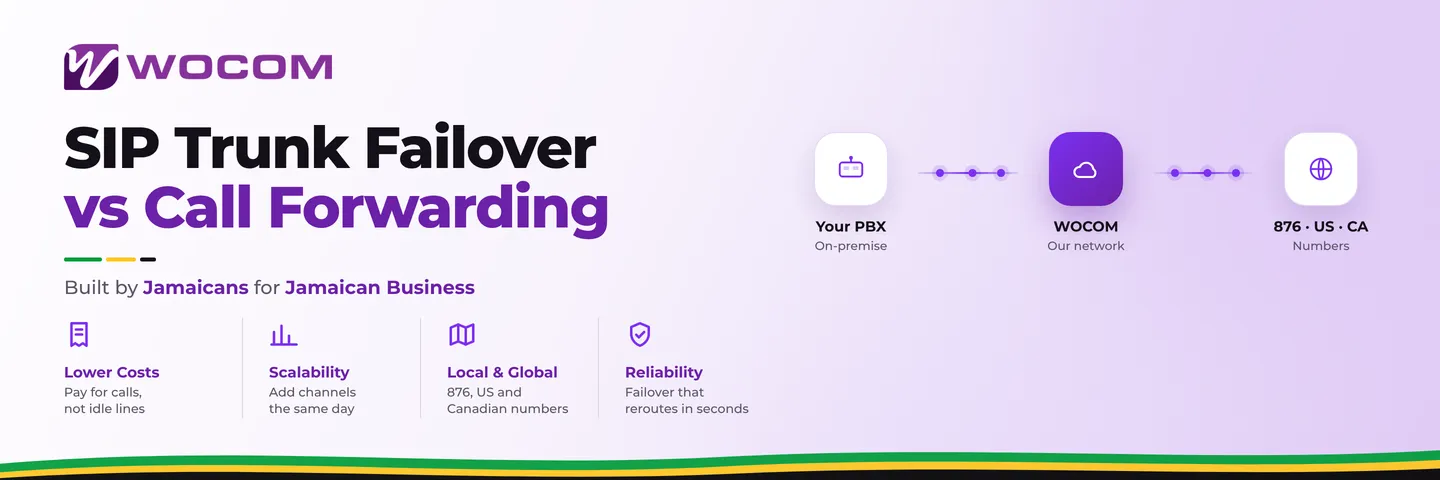
SIP Trunk Failover vs Call Forwarding Jamaica: Two Different Protections Your Business Needs
Why Most Jamaican Businesses Think They Are Protected When They Are Not
Ask a Kingston business owner how their phones are covered if something goes wrong and the answer is usually the same: "We have call forwarding." Ask a Montego Bay contact centre manager and they might say: "Our carrier has failover." Both answers describe real, working protections. Neither answer is complete on its own.
Call forwarding and SIP trunk failover are two different mechanisms, guarding against two different failure types, sitting at two different layers of your phone infrastructure. Understanding which problem each one solves — and which one it cannot solve — is the difference between a business that stays reachable during an incident and one that goes dark for hours while callers hit a network error and move on.
What Call Forwarding Actually Does
Call forwarding is a rule that lives inside your PBX — either an on-premise system or a hosted Cloud PBX. The rule says: if a call arrives and meets a certain condition, send it somewhere else. Common conditions include no answer after a set number of rings, a busy line, a phone set to do-not-disturb, or an unconditional forward that reroutes every call directly to a mobile number.
The critical phrase is "if a call arrives." For a call to arrive at your forwarding rule, it must first travel from the caller, through your SIP trunk provider, and land on your PBX. Your PBX then reads the forwarding rule and acts on it.
Call forwarding protects you when your phones or PBX are the problem — if nobody picks up, if your desk phones lose power, or if your PBX instance becomes temporarily unreachable. It does nothing when the failure is upstream at the carrier level, before the call ever reaches your system.
What SIP Trunk Failover Actually Does
SIP trunk failover operates at a completely different layer. It is a routing instruction held at the carrier level — configured between your SIP provider and a backup path — that says: if the primary route to this customer's PBX becomes unreachable, divert traffic to an alternative destination instead.
Failover at this level activates when the SIP provider's network has an issue, when connectivity between the carrier and your PBX breaks down, or when your PBX stops responding to SIP registration attempts. The carrier detects that calls cannot complete on the primary path and diverts them to a failover destination — which might be a secondary SIP trunk, a mobile number, or a hosted AI receptionist.
SIP trunk failover protects you when the carrier or the network path between carrier and PBX is the problem. It does not protect you from what happens after a call successfully reaches your PBX and your PBX cannot handle it.
The Gap That Leaves You Silent
Here is the scenario that catches Jamaican businesses off guard. Your SIP trunk provider experiences an outage — a routing issue on their network, a configuration error, or a hardware failure in their data centre. Callers in Kingston, Spanish Town, and Portmore dial your business number. Those calls never reach your PBX. They hit the carrier's broken network and return an error to the caller.
Your call forwarding rule is sitting inside your PBX, correctly configured, ready to fire. But it never fires, because the call never arrived. Call forwarding cannot protect you from a carrier failure.
The reverse gap is equally real. Your carrier is working perfectly. But your on-premise PBX loses power during a grid interruption, your cloud PBX subscription lapses, or a misconfiguration causes your PBX to drop its SIP registration. The trunk delivers the call to your PBX address. Nothing answers it. SIP trunk failover has no role to play — the carrier did its job correctly. The PBX is the failure point, and no carrier-level rule can fix that.
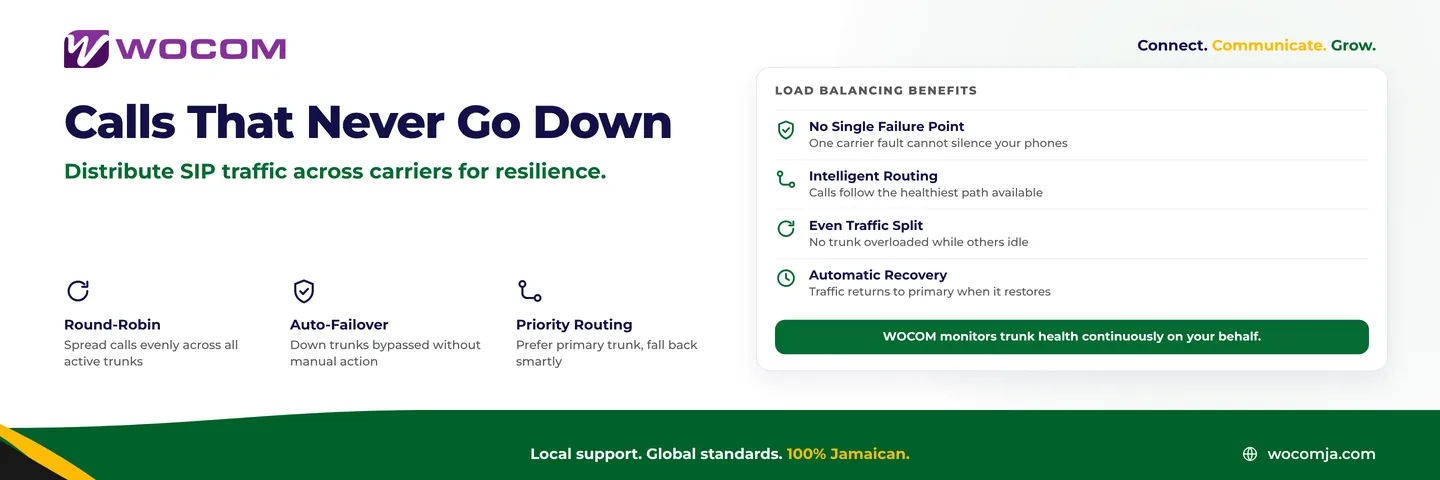
Businesses that have only call forwarding are exposed to carrier outages. Businesses that have only carrier failover are exposed to PBX failures. Both gaps are common, both are silent — callers simply get nothing — and both are preventable.
Building Both Layers of Protection
Closing these gaps means putting independent protection at each layer. Neither one substitutes for the other.
- Carrier-level failover: Your SIP trunk should be provisioned with a secondary routing path that activates automatically. This can be a secondary SIP carrier, a mobile fallback number, or a hosted AI receptionist. The failover fires without any manual intervention the moment the primary path becomes unreachable.
- PBX-level forwarding: Your Cloud PBX should have unconditional or emergency forwarding rules that fire when your PBX cannot respond to inbound calls. For businesses running on-premise equipment in Jamaica, this is especially important given the frequency of power interruptions and internet disruptions during storm season.
- Hosted Cloud PBX over on-premise hardware: When your PBX runs in a data centre rather than a server room in your office, the hardware-failure scenario becomes far less common. Hosted Cloud PBX removes the physical equipment risk and reduces what you need to protect at the device layer.
- AI receptionist as an independent fallback: An AI receptionist running on a separate infrastructure path adds a third layer. Even when your agents are unavailable or your PBX is under stress, the AI can receive calls, take messages, answer common questions, and ensure callers are never greeted with silence or a dead line.
Testing That Both Layers Actually Fire
Configuring both layers is not enough. Neither failover nor forwarding can be assumed to work until it has been tested under realistic conditions. Many Jamaican businesses find that their forwarding rule was set up during an office move two years ago, points to a mobile number that has since changed, or was disabled during a PBX software update and never re-enabled.
A practical test schedule looks like this:
- Monthly: Confirm that call forwarding destinations are still active numbers by making a test call that deliberately triggers the forwarding condition — no answer or a busy line.
- Quarterly: Ask your SIP provider to confirm the failover routing configuration is current and document the destination it points to.
- After any infrastructure change: Any time you switch carriers, update your PBX, or change network settings, test both layers before declaring the change complete.
The right time to discover that your fallback does not work is not at 8:30 on a Monday morning when your phones go silent and your front desk starts receiving walk-in complaints from callers who could not get through.
What to Ask Your Phone Provider
When reviewing your current setup, the two questions that matter most are straightforward. First: if your SIP trunk provider's network fails right now, where does the call go? If the answer is "I'm not sure" or "it just fails," you have a carrier-layer gap. Second: if your PBX becomes unreachable right now, where does the call go? If the answer depends on the PBX being up to execute a forwarding rule, you have a PBX-layer gap.
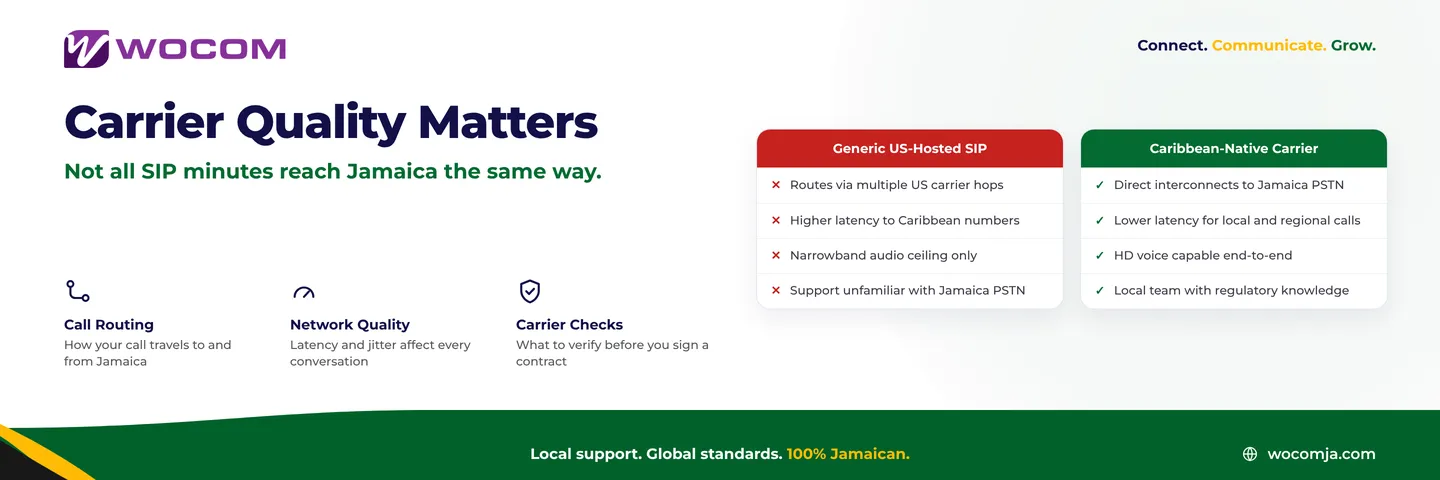
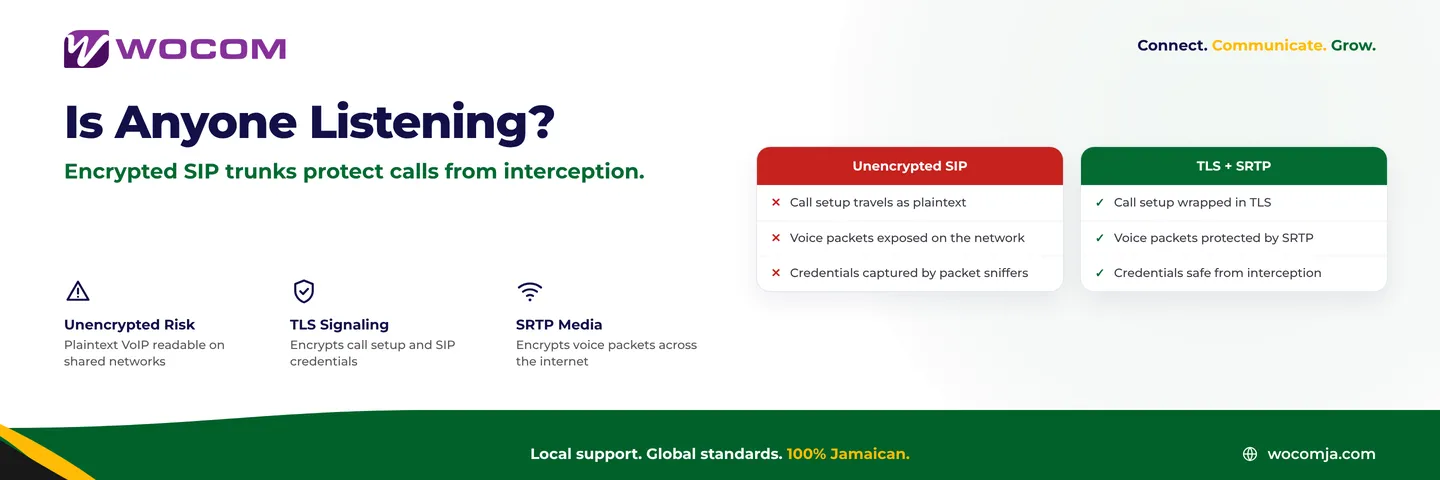
WOCOM's SIP trunking and Cloud PBX infrastructure is designed with both layers in mind. SIP trunks are provisioned with automatic failover routing. The hosted Cloud PBX platform eliminates hardware failure risk on the PBX side. And WOCOM's AI receptionist — Alex — adds an independent third layer that runs regardless of agent availability or PBX registration state. Businesses across Kingston, Portmore, and Montego Bay have moved from a single-layer approach to a fully redundant setup, with the result that callers reach a professional response regardless of what is happening on the technical layer beneath.
If you are not certain whether your current setup covers both failure types, that is a gap worth closing before the next incident reveals it.
Contact WOCOM at wocomja.com to review your SIP trunk failover configuration and Cloud PBX resilience options. The conversation takes far less time than the next missed-call event will cost you.
Continue exploring
Ready to upgrade your communications?
Talk to our team about the right solution for your business.
Book a Demo Contact SalesEverett Kildare is WOCOM's voice and infrastructure specialist, with more than 25 years of experience designing and running carrier-grade voice, SIP and virtualization infrastructure. Holding a BSc in Information Technology, he has built, secured and migrated phone systems for businesses of every size. Everett writes WOCOM's technical coverage of SIP trunking, cloud PBX, contact centres, business continuity and migration.