SIP Trunk Call Quality Jamaica: Why Your Carrier's Network Is the Foundation
What SIP Termination Actually Is
When a customer in New Kingston dials your business number, that call does not travel in one straight line. It passes through a series of carrier handoffs before it reaches your desk phone or softphone app. SIP termination refers to the last-mile carrier — the provider responsible for connecting your VoIP call to or from the traditional public telephone network (PSTN).
Your SIP trunk provider is the company you contract with. The termination carrier is the network doing the actual heavy lifting. These may or may not be the same entity, and for Jamaica businesses, that distinction matters enormously. A reseller sitting on top of a wholesale US carrier has very little control over what happens to your call once it leaves their platform. A provider with direct Caribbean network presence does.
Why Jamaica Routing Is Different From the US or UK
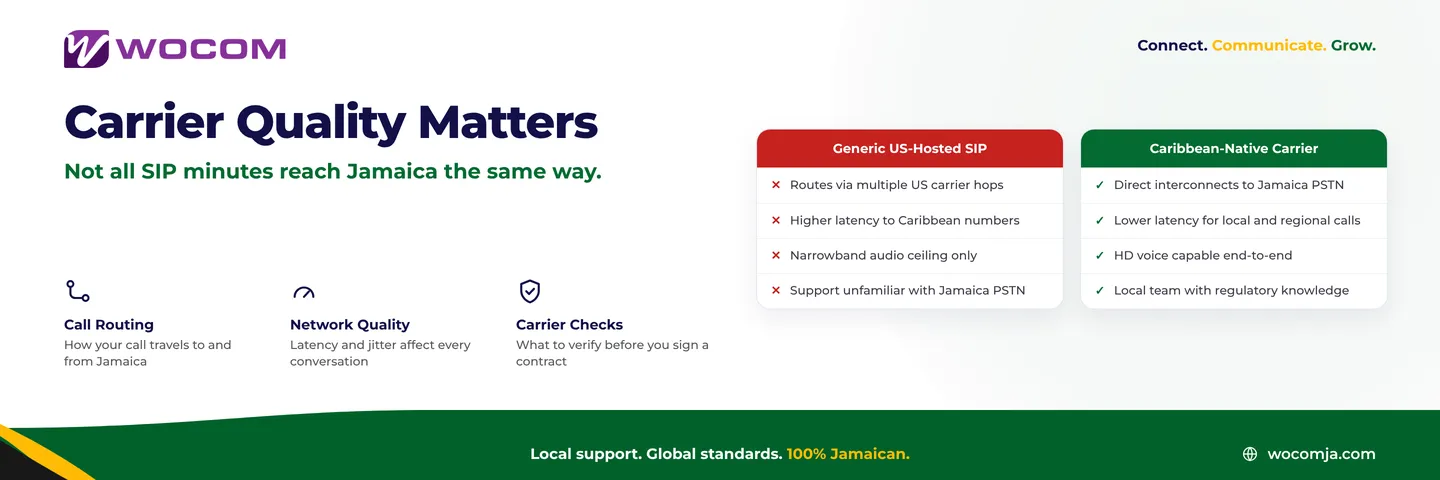
The Caribbean is not a tier-1 internet region. While Kingston and Montego Bay have solid fibre infrastructure, international voice traffic to and from Jamaica often routes through the United States before completing. This introduces hops — transit points where your call data moves between carrier networks.
Every hop adds latency. A call that routes Kingston → US East Coast → US Midwest → back to Jamaica adds measurable round-trip delay. When that delay exceeds 150 milliseconds, callers start noticing. Above 300 ms, conversations feel like a satellite phone call — that awkward pause where both people talk at once because neither can tell the other has finished.
Carriers with direct Caribbean interconnects — peering agreements with Jamaica's licensed telcos and regional CLECs — eliminate unnecessary hops. The call moves directly between networks, and latency stays in a range where the conversation feels completely natural.
What Poor Termination Sounds Like on a Jamaica Business Line
Businesses often blame their internet connection first when call quality degrades. If your connection tests clean and you are still hearing problems, the termination carrier is the more likely culprit. Watch for these patterns:
- One-way audio: You can hear the caller, but they cannot hear you, or vice versa. Can signal routing instability or a codec mismatch at the carrier handoff point.
- Echo and sidetone: Your own voice bounces back with a slight delay, making it hard to concentrate on what the caller is saying.
- Choppy or robotic audio: Packet loss above 2 percent causes this. When the problem lives on a carrier's backbone, it shows up on every call regardless of how clean your local network is.
- Calls that connect but drop within seconds: Usually a codec negotiation failure or carrier incompatibility — both provider-side problems that your team cannot fix locally.
- Inconsistent quality depending on who you call: If calls to mobile numbers sound worse than calls to landlines, or international calls are fine but local ones are choppy, the problem is in how the carrier routes different number ranges within Jamaica.
These symptoms are common enough that many Jamaica businesses simply accept them as "how VoIP sounds." They are not. They are signs of a carrier that does not have proper Caribbean infrastructure.
Narrowband vs HD Voice: The Quality Ceiling Your Carrier Sets
Traditional PSTN calls use the G.711 codec, which caps audio at 3.4 kHz — narrowband. It is what telephone quality has sounded like for decades: serviceable, but thin. HD voice, also called wideband, supports frequencies up to 7 kHz. Speech sounds noticeably clearer and more natural, which matters in noisy environments like a busy showroom floor, a construction site office in Portmore, or a Montego Bay hotel front desk during peak season.
Whether your calls reach HD quality depends on the entire path — your PBX, your SIP provider, the termination carrier, and the network on the receiving end. If any link in that chain does not support wideband codecs, the call falls back to narrowband automatically. A provider that consistently routes through aging carrier infrastructure will never deliver HD quality, regardless of what their product page claims.
What to Ask Before Signing a SIP Trunk Agreement
Before committing to a SIP provider in Jamaica, go beyond the per-minute rate and ask these questions directly:
- Where is your peering for Jamaica PSTN termination? You want to hear "direct Caribbean interconnect" or named regional carrier partnerships — not "we route through our US network."
- What codec do you support for local Jamaica calls? G.711u or G.722 (wideband) are both acceptable. G.729 compresses audio and is a step down in clarity for voice-heavy businesses.
- What SLA covers call completion rate and audio quality? A reputable provider will commit to a minimum call completion percentage and define the process for reporting degraded audio.
- How do you handle number portability to Jamaican DIDs? Real porting experience signals genuine carrier relationships, not just wholesale resale.
- What call quality monitoring can I access? At minimum, a portal showing call records with quality indicators. Better providers offer MOS score reporting or real-time dashboards.
Avoid providers that pivot to price comparisons when you ask about routing architecture. A lower per-minute rate means very little if one in five calls has echo or drops before the caller finishes their first sentence.
What It Means to Have a Licensed Carrier as Your SIP Provider
WOCOM operates as a licensed telecommunications provider in Jamaica — not a reseller sitting above a third-party US carrier. That means every voice minute terminating on a Jamaican number moves through infrastructure WOCOM owns and maintains direct relationships with.
For Jamaica businesses on WOCOM SIP trunks, that translates to:
- Local PSTN interconnects that keep calls on the shortest path to Jamaican numbers, mobile and landline
- HD-capable call paths end-to-end when both sides of the call support wideband codecs
- Quality monitoring that WOCOM controls directly — not dependent on a wholesale carrier's support queue
- A local technical team that understands the Jamaican numbering plan, 876 and 658 ranges, carrier-specific quirks, and regulatory requirements
- Transparent SLA terms written for the Caribbean market, not repackaged from a US carrier agreement
When a business in Kingston, Spanish Town, or Ocho Rios reports a call quality issue, the team that picks up that support call has direct visibility into the network carrying those minutes. That is not the case with every provider marketing SIP trunks to Jamaica businesses today.
Start With the Right Foundation
If your business depends on the phone — and in Jamaica, most businesses do — the carrier underneath your SIP trunk is not a secondary detail. It is the product. Poor call quality costs you in first impressions, dropped leads, and customer frustration that shows up in ways that are hard to attribute back to the phone system.
If you are noticing quality issues your internet provider cannot explain, or if you are reviewing your options before a contract renewal, speak with the WOCOM business team. We can walk through your current routing setup, run a network assessment, and show you exactly what carrier-grade SIP termination looks like for a Jamaica business that cannot afford to sound bad on a call.
Contact WOCOM today to speak with a SIP specialist — visit wocomja.com or call our business line to get started.
Continue exploring
Ready to upgrade your communications?
Talk to our team about the right solution for your business.
Book a Demo Contact SalesEverett Kildare is WOCOM's voice and infrastructure specialist, with more than 25 years of experience designing and running carrier-grade voice, SIP and virtualization infrastructure. Holding a BSc in Information Technology, he has built, secured and migrated phone systems for businesses of every size. Everett writes WOCOM's technical coverage of SIP trunking, cloud PBX, contact centres, business continuity and migration.