Are Your Jamaica Business Calls Encrypted? What SIP Trunk Security Actually Means
The Gap in Most Business Phone Security Plans
Most Jamaica businesses have taken cybersecurity seriously in recent years. Firewalls are configured, Wi-Fi passwords are updated, and staff have been warned about suspicious emails. But ask the same businesses whether their phone calls are encrypted and you will usually get a blank look — or a confident but incorrect "yes, we use VoIP."
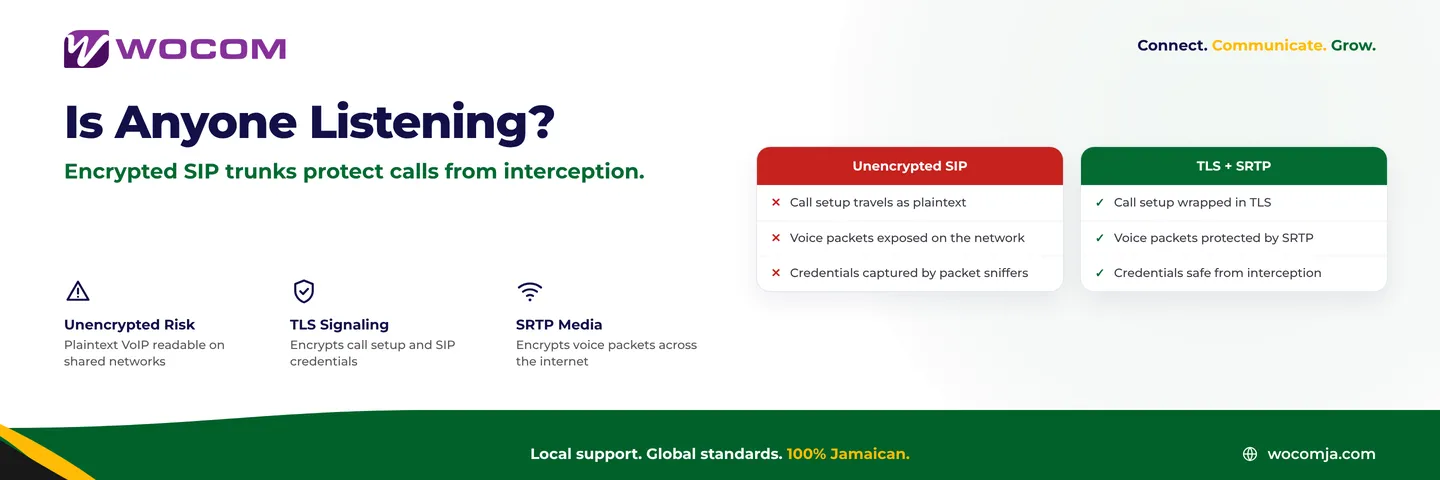
VoIP does not equal encrypted. A SIP trunk or cloud PBX transmits calls as data packets across the public internet. Without encryption, those packets travel as plaintext. Anyone positioned between your office and your phone provider — on a shared network, at a hosting facility, or anywhere along the routing path — can potentially intercept and reassemble them into a clear audio conversation. The software tools to do exactly this are freely available, well-documented, and used routinely by both security researchers and criminals.
How a Business Call Actually Travels
When you make a call using a SIP trunk, two separate data streams are created simultaneously and sent across the internet:
- Signaling (SIP messages): These set up, manage, and end the call. They carry information about who is calling, what audio format to use, the extension numbers involved, and — critically — the authentication credentials your phones use to register with your provider.
- Media (RTP packets): The actual voice audio, broken into small packets and transmitted independently across the network, typically via UDP.
On an unencrypted SIP trunk, both streams travel in plaintext. The signaling channel exposes your extension numbers, usernames, and authentication tokens. The media channel contains the conversation itself. A packet capture tool running on the same network segment — or at a compromised point along the route — can intercept both within minutes and reconstruct them into readable data and playable audio.
This is not a sophisticated attack. It is a well-understood network technique taught in entry-level security courses. The barrier is access to the network path, not technical expertise.
Who Would Want to Listen to Your Business Calls in Jamaica?
The threat landscape is more realistic than most business owners assume. Three scenarios apply directly to the Jamaican business environment:
Toll fraud via credential theft. SIP authentication credentials appear in plaintext in unencrypted SIP signaling. Automated scanners continuously probe internet-facing SIP servers looking for unprotected credentials. Once captured, stolen SIP usernames and passwords are used to generate large volumes of calls to international premium-rate numbers — sometimes accumulating charges of tens of thousands of dollars before the business notices. This is the most common active attack on unprotected SIP infrastructure and it targets businesses in Jamaica as readily as anywhere else.
Competitive intelligence on shared infrastructure. Co-working spaces, business parks, and shared office facilities — increasingly common in Kingston, New Kingston, and along the Portmore corridor — often run multiple businesses on shared network infrastructure. A business on the same VLAN or Wi-Fi segment as your office could, without sophisticated tools, capture SIP packets containing your call metadata and conversation audio. Pricing discussions, contract negotiations, and client acquisition calls are commercially sensitive information.
Compliance exposure for regulated industries. Medical clinics, pharmacies, lawyers, accountants, insurance brokers, and financial services firms handle legally protected information by voice every working day. Jamaica's Data Protection Act creates direct accountability for how personal information is collected, stored, and transmitted — including voice. Unencrypted voice channels carrying patient details, client financial information, or legally privileged conversations represent an identifiable compliance gap that regulators and legal counsel will eventually notice.
The Two Protocols That Close the Gap: TLS and SRTP
Encrypting business SIP calls does not require replacing your phone system. It requires your SIP trunk provider to support two standard protocols, and your phones or PBX to be configured to use them:
Transport Layer Security (TLS) encrypts the SIP signaling channel. It works identically to HTTPS for websites — it wraps SIP messages in an encrypted tunnel before they leave your network. An attacker who captures the signaling packets sees only ciphertext, not your extension numbers or authentication credentials. TLS also authenticates the server your phones connect to, preventing man-in-the-middle attacks where traffic is silently redirected to a rogue SIP server before being forwarded to the real one.
Secure Real-time Transport Protocol (SRTP) encrypts the voice media stream. It applies AES encryption to each audio packet. A complete capture of your call audio is useless to an attacker without the corresponding decryption keys — which are exchanged securely during the TLS-protected call setup phase.
Used together, TLS and SRTP mean that anyone who intercepts your network traffic sees only encrypted noise. No credentials, no call metadata, no conversation content.
Five Questions to Ask Your SIP Trunk Provider
Not all SIP trunk providers in Jamaica or internationally offer TLS and SRTP by default. Some list it as an optional feature requiring separate configuration. Others do not support it at all. Before you sign a new contract or renew an existing one, ask these questions directly:
- Do your SIP trunks support TLS for signaling encryption?
- Is SRTP available for media encryption?
- Is encryption enabled by default, or does it require a separate configuration request?
- What TLS version do you support? (TLS 1.2 is the minimum acceptable standard; TLS 1.3 is preferred.)
- Are the IP phones, softphone apps, or PBX systems you provision compatible with TLS and SRTP?
A provider that cannot answer questions one and two with a clear and direct "yes" is telling you something important about their infrastructure priorities. The follow-up questions distinguish a provider who has built encryption into their platform from one who has bolted it on as an afterthought.
How WOCOM Approaches Call Security
WOCOM's SIP infrastructure operates on a licensed carrier network where security is a foundational requirement, not an optional feature customers must discover and request. Businesses connecting to WOCOM's SIP trunks benefit from encrypted signaling paths and protected credential exchange as part of the core service — not a configuration task left to the customer's IT team to figure out after go-live.
This matters particularly for multi-site businesses routing calls between Kingston headquarters and branch offices in Montego Bay, Ocho Rios, or other parishes, and for businesses with remote staff connecting via softphone apps on laptops or mobile devices. Each connection point is a potential interception point if the provider has not secured the transit path end to end.
For regulated industries — financial services, healthcare, legal practice — WOCOM's carrier-grade security posture aligns with the data protection obligations that apply to voice communications under Jamaican law, reducing the compliance burden on the business itself rather than adding to it.
Your business conversations carry commercially sensitive information every working day. The question is not whether call encryption is worth the complexity — modern cloud phone systems handle it transparently, with no impact on call quality or setup process. The question is whether your current provider has actually implemented it.
What to Do Next
If you do not know whether your current SIP trunk encrypts calls, the safest working assumption is that it does not. Verifying is straightforward: ask your provider directly using the five questions above, or ask your IT team to confirm which SIP transport protocol your phones are configured to use. If the answer is standard UDP SIP with RTP rather than TLS-over-TCP with SRTP, your calls are travelling unprotected across the public internet today.
WOCOM's team works with businesses across Jamaica — from Kingston law firms and financial services companies to medical clinics in Montego Bay and multi-branch retailers across the parishes — to assess current phone infrastructure and identify the fastest path to a secure, licensed-carrier connection.
Contact WOCOM to review your current SIP trunk security posture. The assessment starts with a straightforward conversation about what you are running today and what a fully encrypted, carrier-grade connection would look like for your business. Visit wocomja.com to get in touch with our team.
Continue exploring
Ready to upgrade your communications?
Talk to our team about the right solution for your business.
Book a Demo Contact SalesEverett Kildare is WOCOM's voice and infrastructure specialist, with more than 25 years of experience designing and running carrier-grade voice, SIP and virtualization infrastructure. Holding a BSc in Information Technology, he has built, secured and migrated phone systems for businesses of every size. Everett writes WOCOM's technical coverage of SIP trunking, cloud PBX, contact centres, business continuity and migration.