SIP Trunk Billing Models Jamaica: Pay-Per-Minute vs Per-Channel vs Flat Rate Explained
Why the Billing Model Matters More Than the Rate
Most Jamaican businesses shopping for a SIP trunk ask the same question first: what's the rate per minute? That number matters — but it can mislead you. Two providers with identical per-minute rates can produce monthly bills that differ by 40% or more, because the billing model determines the structure of what you're charged, not just the unit cost.
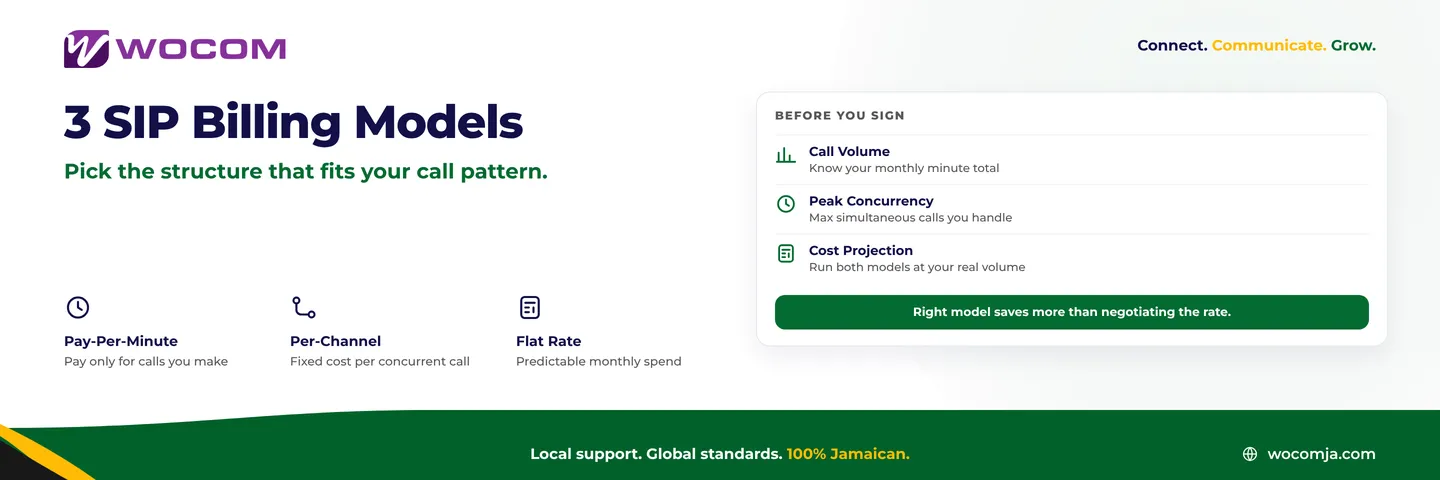
SIP trunking in Jamaica comes in three main structures: pay-per-minute, per-channel (concurrent call) pricing, and flat-rate or bundled plans. Understanding the difference before you sign a contract can mean thousands of dollars saved annually — especially for businesses in Kingston and Montego Bay whose call volumes shift across the week, the month, or the season.
Pay-Per-Minute SIP Trunking
With a pay-per-minute model, you're billed for every minute of call time at a set rate. There's typically no cap on simultaneous calls, and usage is the only variable that drives your bill. A quiet month costs next to nothing; a busy one reflects every call made.
- Best for: Businesses with low or unpredictable call volumes — startups, solo operators, seasonal businesses, and professional service firms that phone clients only occasionally.
- Advantage: No commitment to capacity you don't use. You scale up and down automatically without changing your plan.
- Risk: A promotion, a product launch, or a storm-season surge can produce a spike bill that catches you entirely off guard. There's no ceiling unless you set one manually.
Pay-per-minute suits a Negril resort with low off-season traffic or a boutique accounting firm that ramps up only during tax season. It works poorly for a busy Kingston contact centre running agents eight hours a day, where the unbounded usage model translates directly into an unbounded bill.
Per-Channel (Concurrent Call) Billing
With per-channel billing, you pay a fixed monthly fee for each channel — a single simultaneous call path. Ten channels means ten calls can be active at the same time. Within those channels, calls are typically either unlimited or billed at a very low rate. Your cost is driven by capacity, not minutes.
- Best for: Businesses with steady, predictable call activity — contact centres, property management offices, multi-branch retailers, and medical clinics with constant inbound traffic throughout the day.
- Advantage: Predictable monthly cost. At moderate-to-high usage, the effective per-minute cost of a channel plan is almost always lower than a pay-per-minute rate.
- Risk: You're buying capacity whether or not you fill it. Too many channels and you're paying for air. Too few and callers reach a busy signal during your peak hours.
A practical rule of thumb: measure how many simultaneous calls you handle at your single busiest hour, then add 20–30% as headroom. That's your starting channel count.
A Spanish Town distribution company taking supplier and driver calls all day, or a Montego Bay hotel reservations desk handling a constant stream of room enquiries, is a natural fit for this model. The key question is always: what does your peak concurrency actually look like?
Flat-Rate and Bundled SIP Plans
Some providers offer a single monthly fee bundling a defined minute allowance — or unlimited calling within specified zones — into one line item. It functions like a mobile phone plan applied to your business trunk: one price, predictable, no calculations required.
- Best for: Businesses that want a fixed, budget-able expense without engineering the right channel count or tracking per-minute usage each month.
- Advantage: Simplicity. One bill, one number. Easy to present to finance teams or include in project budgets without variance.
- Risk: Flat-rate plans frequently carry restrictions — fair-use thresholds, geographic calling zones, or rate changes above a minute ceiling. The word "unlimited" rarely means unconditional. Read the service agreement carefully before assuming otherwise.
Flat-rate plans fit businesses that prioritise simplicity over price optimisation — a law firm with two offices and a small switchboard, or a remote-first team that makes moderate outbound calls each day. They're rarely the most cost-efficient option for heavy users, but the administrative simplicity has real value.
Which Model Fits Which Jamaican Business?
A direct mapping, based on typical usage profiles:
- Under 2,000 minutes per month or highly seasonal volume: Pay-per-minute. You pay only for what you use and carry no unused capacity.
- Steady 2,000–20,000 minutes per month with identifiable peak concurrency: Per-channel pricing. The fixed cost per channel almost always wins at this volume. Run the calculation at your actual numbers before assuming.
- Budget-driven, administratively simple, or mixed-use office: Flat-rate bundled plan. The premium over per-channel is often worth the predictability.
- Significant international calling (US, Canada, UK, Caribbean): Evaluate international rates separately, regardless of model. "Unlimited" flat-rate plans almost never include international calling at no cost. This is one of the most common hidden-cost traps in business SIP contracts.
Five Questions to Ask Before Committing to a Plan
Whatever model a provider is offering, get clear answers to these before you sign:
- What is my actual monthly minute total? Pull at least three months of call logs from your existing system. A single month gives you a snapshot; three months shows your pattern.
- What is my peak simultaneous call count? If you run a contact centre or busy reception desk, this is the number that determines whether a per-channel plan works for you. Look at your busiest hour on your busiest day — not averages.
- Are inbound calls billed separately? Some providers charge for inbound calls; others include them at no cost. A business with high inbound volume — a customer service line, a bookings desk — should check this carefully, because it can double the effective rate.
- What happens when I exceed my limit? Soft limits with burst pricing are far better than hard cutoffs. Know what the overflow behaviour is before your next busy period tests it for you.
- Is there a minimum term commitment? Pay-per-minute plans are typically month-to-month. Per-channel and flat-rate plans often require 12-month agreements. If your business is in a growth phase, locking into a fixed channel count for a year carries real risk — negotiate flexibility where you can.
Talk to WOCOM Before You Sign Anything
At WOCOM — Jamaica's own licensed business phone provider — our SIP trunking runs on infrastructure we own and operate, not through a chain of resellers. When we work with businesses in Kingston, Montego Bay, or anywhere across the island, we review actual call history, identify real concurrency needs, and recommend the billing structure that fits — not the one with the highest margin for us.
Whether you need a lightweight pay-as-you-go trunk for a small office or a high-channel carrier-grade trunk feeding a multi-agent contact centre, WOCOM gives you the numbers in plain language so you can make an informed decision.
Ready to see which billing model saves your business the most? Contact the WOCOM team for a no-obligation usage review. We'll run the calculation with you against your real call data and show you exactly where you stand — before you commit to anything.
Continue exploring
Ready to upgrade your communications?
Talk to our team about the right solution for your business.
Book a Demo Contact SalesEverett Kildare is WOCOM's voice and infrastructure specialist, with more than 25 years of experience designing and running carrier-grade voice, SIP and virtualization infrastructure. Holding a BSc in Information Technology, he has built, secured and migrated phone systems for businesses of every size. Everett writes WOCOM's technical coverage of SIP trunking, cloud PBX, contact centres, business continuity and migration.