The Small Business Phone System That Grows With You (Without a PBX on the Wall)
A small business in Jamaica does not need a smaller phone system. It needs the same one every large company runs, priced for its size and without the equipment on the wall. That is the whole idea behind a cloud phone system: the switching happens on WOCOM's own licensed network, and what sits in your office is the handset and the internet connection you already pay for.
The practical difference shows up on the day you hire your fifth person. On a traditional system that is an engineer visit, a card in a cabinet and an invoice. On a cloud system it is an extension added in a browser, live in about a minute.
What a small business phone system actually has to do
Strip away the feature lists and there are four jobs. Every one of them matters more at five people than at five hundred, because there is nobody spare to absorb a failure.
- Answer every call. A missed call at a ten-person firm is not a statistic, it is the week's biggest quote walking to somebody else.
- Reach the right person. Callers should not be asked to ring a different number because the first one only lands on one desk.
- Work away from the desk. Most small businesses are not all in one room all day.
- Tell you what happened. Who called, when, how long, and what got missed.
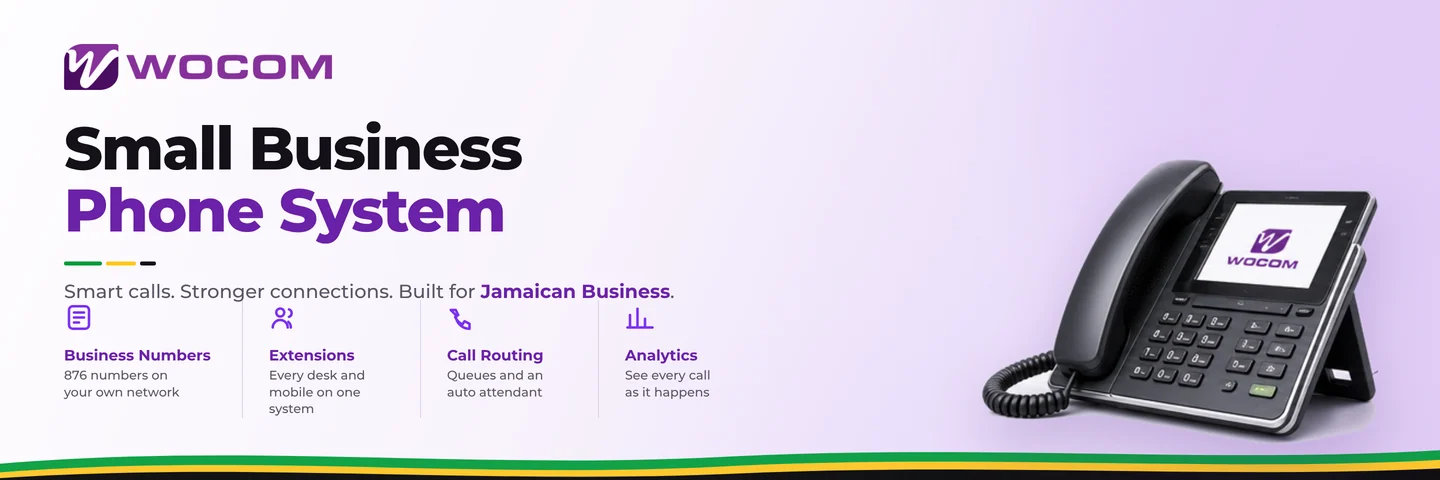
Business numbers, without giving up the one you have
Your number is on your van, your signage and every invoice you have ever sent. Moving to a cloud system does not mean giving it up — a Jamaican 876 number ports across to WOCOM, and you can add more alongside it: a second line for sales, a toll-free number, or a US or Canadian number for customers and family abroad.
What changes is what the number can do once it is on a real network rather than a copper pair. It can ring three places at once. It can ring the office in business hours and a mobile after them. It can go to a menu on a public holiday. The number stays the same; the routing behind it stops being fixed.
Team extensions: the part that saves the most time
Extensions are the unglamorous feature that changes daily life most. Every person gets a short internal number, calls between them are free, and transferring a caller stops being “hold on, let me take a message.”
On WOCOM an extension is not tied to a desk. The same extension rings a desk phone, a laptop and a mobile app, and it follows the person to whichever they are using — the full mechanics are in the guide to phone extensions. For a small team that means the person who works Tuesdays from home is not unreachable on Tuesdays.
Call management that a non-technical person can run
The features that used to require a technician are now a settings page: an auto attendant that answers and offers options, ring groups that try three people before voicemail, business-hours routing, and a queue when everybody is busy. None of it needs a maintenance contract, and none of it needs somebody to come out and change it.
The one piece worth setting up on day one is what happens when nobody answers. A number that rings out is worse than a number that goes to a menu, because the caller has no idea whether you are closed or simply not picking up.
Real-time analytics, which is really just knowing what you missed
Small businesses rarely have call data, and it is usually the first thing that surprises them. How many calls come in before nine. How many were abandoned waiting. Which day is genuinely the busiest — almost never the one people assume.
That reporting is standard on a cloud system rather than an upgrade. It answers a question worth real money: are you losing business at a particular hour, and would one more person answering at that hour pay for themselves?
What it costs, and what it does not
The cost that catches people out on traditional lines is not the calls, it is the line rental — a monthly charge per line whether or not anybody uses it. A cloud system charges per user instead, so a five-person business pays for five people rather than for the four lines somebody sized the office for a decade ago. The 2026 Cloud PBX pricing guide sets out the real figures, and the hidden costs of legacy landlines covers the charges that never appear in the headline price.
Two things are included that are usually sold separately elsewhere: video conferencing for every user, and the WOCOM AI receptionist on the Starter allowance, which answers when your team cannot.
Sounding bigger than you are
There is a presentation argument as well as a practical one. A menu, a hold message and a proper transfer make a six-person firm sound like an established one, which matters when you are quoting against a larger competitor. That is worth doing carefully rather than by default — how Jamaican SMEs project an enterprise phone presence goes through what helps and what sounds like a small company pretending.
Frequently Asked Questions
What is the smallest business a cloud phone system makes sense for?
Two people. Below that the argument is weaker, because a single mobile covers it. From two upward, extensions, transfers and a shared business number start saving real time, and the cost is per user rather than per line.
Can I keep my existing 876 number?
Yes. Numbers port to WOCOM and keep working exactly as they do now. Porting is a paperwork exercise rather than a technical one, and the line keeps running until the switch completes.
Do I need special phones?
No. Desk handsets are available and most businesses take them, but the same extension works from a laptop or the mobile app, so you can start with what you already own and add handsets later.
What happens if the internet goes down?
Calls fail over to mobiles automatically, so the business stays reachable while the connection is restored. Businesses that cannot tolerate any interruption add a second connection — the connection options guide covers Starlink, fibre, cable and 4G/5G failover.
How long does it take to set up?
A small business is usually live the same week. The longest step is number porting, which runs in the background while the system is configured and tested.
Getting started
If your phones are already costing more in line rental than they return in calls, the switch pays for itself before the features do. The Cloud PBX page covers what is included, pricing has the numbers, and the WOCOM team can port your existing 876 number and have a small team running within the week.
Continue exploring
Ready to upgrade your communications?
Talk to our team about the right solution for your business.
Book a Demo Contact SalesEverett Kildare is WOCOM's voice and infrastructure specialist, with more than 25 years of experience designing and running carrier-grade voice, SIP and virtualization infrastructure. Holding a BSc in Information Technology, he has built, secured and migrated phone systems for businesses of every size. Everett writes WOCOM's technical coverage of SIP trunking, cloud PBX, contact centres, business continuity and migration.