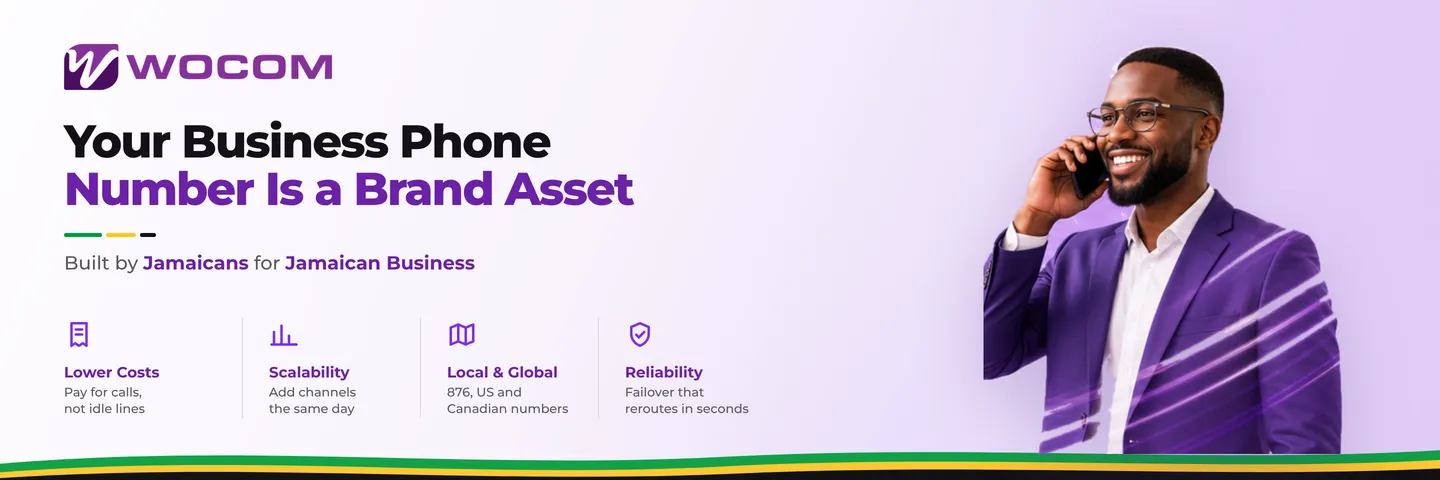
Your Business Phone Number Is a Brand Asset: How to Protect It in Jamaica
Your Phone Number Is Worth More Than You Think
Your business phone number appears on your Google Business Profile, your Facebook page, every flyer distributed in Half Way Tree, the livery on your delivery van, and years of word-of-mouth between customers who pass it along. When a loyal client wants to reach you, they dial that number without looking it up. It is, in practice, a piece of your brand identity — one that took years to establish and cannot simply be replaced overnight.
Yet most Jamaica businesses have never asked a straightforward question: do I actually own this number, or does my provider? The answer determines what happens when you want to change carriers, upgrade your platform, or survive a supplier going out of business.
The Three Ways Jamaica Businesses Lose Control of Their Number
There are three common scenarios where a Jamaica business discovers, too late, that the number they built their reputation around belongs to someone else.
Reseller Lock-In
Many businesses receive their phone line through a broadband provider, cable company, or third-party reseller who holds the actual DID (Direct Inward Dial number) with a licensed carrier. In this arrangement the number belongs to the reseller, not to you. When you decide to leave — because the service has declined, pricing has climbed, or you need more capacity — you discover the number stays behind. The reseller may permit porting for a fee, or may simply refuse. Businesses in Kingston and Montego Bay have faced this situation after years of uninterrupted service to a provider they trusted.
Bundled Service Contracts
Voice-and-broadband bundles are common, and some providers do not clearly disclose at signup that the phone number is provisioned on their infrastructure. Changing your internet service can terminate the number automatically. You find out when the retention team explains, politely, that the number cannot follow you to a new carrier.
Personal Mobile Used as the Business Number
Many small businesses across the parishes launch on a personal mobile and never transition to a dedicated business line. The owner's number ends up on Google, in WhatsApp broadcasts, and on printed signage. Mobile numbers in Jamaica are carrier-locked and cannot be ported to a SIP trunk or cloud PBX without a formal mobile number porting process involving the originating network. If the SIM is lost, the plan changes, or the owner exits the business, there is no quick recovery path and no way to redirect incoming calls without the cooperation of the mobile carrier.
How DID Ownership Actually Works in Jamaica
A DID — Direct Inward Dial number — is a telephone number that routes calls to a destination you configure: a cloud PBX, a SIP endpoint, a ring group, or an AI receptionist. When you take a DID from a licensed carrier, that number is provisioned under your business account. It is yours for as long as the account is active, and your porting rights are contractually protected.
When you take a number from a reseller, the DID sits in the reseller's account with the upstream carrier. If that reseller dissolves, is acquired, or loses their carrier agreement, your number can disappear without notice and without recourse.
The Office of Utilities Regulation (OUR) in Jamaica oversees the allocation of telephone number ranges. Only OUR-licensed providers are authorised to hold those ranges directly. When a reseller assigns you a number, ask them which licensed carrier holds that block and confirm whether a formal porting agreement exists between the reseller and that carrier. If they cannot answer clearly, treat it as a warning.
Four Questions to Ask Before You Sign Any Phone Contract
Before committing to any provider, get clear written answers to these four questions:
- Is the DID registered to my business, or to the provider's account? A reputable provider will commit to this in writing. Your company name and tax registration number should appear on the DID record — not just the provider's billing details.
- Does the contract permit outward porting? This is your right to take the number to a different provider at end of term. Some contracts prohibit it entirely; others impose a fee. Read the clause carefully before you sign, not after you want to leave.
- Is the provider OUR-licensed? The OUR publishes a register of licensed operators. A licensed operator holds number ranges directly and is subject to porting obligations under Jamaican telecommunications regulation. An unlicensed reseller is not.
- What is the notice period and porting timeline? If you must give 30 or 60 days' notice before porting, plan the transition carefully so the number does not lapse in the gap between contracts while you wait for the port to complete.
Porting: Moving Your Number Without a Gap in Service
Number porting is the transfer of your telephone number from one provider to another. In Jamaica, porting between licensed operators is regulated and carries defined completion timeframes. For a business landline DID, the process typically takes five to ten business days once it is initiated correctly by both parties.
To port a number successfully:
- Confirm with your current provider that the number is portable and that your account has no outstanding balance or active dispute blocking the process.
- Request a porting authorisation code from your current provider. This code authorises the receiving carrier to initiate the transfer.
- Provide the code to your new provider. WOCOM can manage the full porting coordination on your behalf, including direct liaison with the losing carrier's number management team.
- Keep your old service active until porting is confirmed complete. Cancelling the old account before the port finalises risks the number being returned to the general pool.
During the porting window, calls to your number continue reaching the original destination. Once the port completes, they route to the new platform with no gap in service — provided the process is handled in the correct order.
Why a Secondary Number Adds Important Protection
Even with your primary number fully secured, maintaining a secondary DID on a separate route adds a meaningful layer of resilience. If your primary SIP trunk experiences a disruption, the secondary number — pointed at a mobile or a backup site — keeps calls arriving. This matters especially across parts of Jamaica where power and internet reliability are variable.
A secondary number also lets you trial new call routing configurations, run a campaign, or test an AI receptionist setup without touching your primary line. The ongoing cost is low; the operational protection is real.
A business number that has appeared on signage in New Kingston for ten years carries the same kind of equity as a domain name or a registered trademark. Treat it accordingly.
How WOCOM Protects Your Number
WOCOM is an OUR-licensed telecommunications provider. Numbers provisioned through WOCOM sit on WOCOM's directly held number range, registered under your business account. Your contract explicitly preserves porting rights. If you ever choose to change platforms, the outward port is managed without obstruction.
If you have an existing number currently held by another provider — one that has been your business's public identity for years — WOCOM can manage the inward port, coordinating directly with the losing carrier so you are not left navigating a process that many providers make deliberately slow and opaque.
WOCOM's cloud PBX and SIP trunking platform lets you add DIDs, configure routing, and monitor usage from a single admin panel accessible from anywhere. For businesses with multiple branches across Kingston, Portmore, Spanish Town, or the western parishes, every site can share a unified number plan with the same level of ownership protection on every line.
Take Stock of What You Actually Own
Before your next contract renewal — whether that is in one month or one year — spend ten minutes asking your current provider in writing: who is the registered holder of my DID? The answer will tell you immediately whether your number is genuinely yours or effectively on loan.
WOCOM's team can review your current arrangement and advise on whether your number is protected, portable, and held by a licensed carrier. We can also walk you through consolidating your numbers onto a secure, licensed platform with zero disruption to your callers during the transition.
Reach out at wocomenterprise.com to speak with our team. Protecting a number you have spent years building should not require a legal dispute with your provider — and with the right carrier from the start, it never does.
Continue exploring
Ready to upgrade your communications?
Talk to our team about the right solution for your business.
Book a Demo Contact SalesEverett Kildare is WOCOM's voice and infrastructure specialist, with more than 25 years of experience designing and running carrier-grade voice, SIP and virtualization infrastructure. Holding a BSc in Information Technology, he has built, secured and migrated phone systems for businesses of every size. Everett writes WOCOM's technical coverage of SIP trunking, cloud PBX, contact centres, business continuity and migration.