Post-Hurricane Season Phone Audit: What Jamaica Businesses Should Check Before Year-End
Hurricane season in Jamaica runs June 1 to November 30. For many Kingston and Montego Bay businesses, this year's season passed without a direct hit — but that does not mean your phone infrastructure went untested. Power fluctuations, internet disruptions from storm systems, and the sudden shift to remote work during tropical weather advisories all place real stress on your business communications. The window between now and year-end is the best opportunity to document what happened and close any gaps before the 2027 season opens.
Most businesses skip this review entirely. They wait until a problem forces their hand — usually midway through the next season, at the worst possible time. A structured post-season audit, done in November while the year is still fresh, protects you for 2027 and feeds directly into year-end budget planning.
Why November Works Better Than December or January
There are three reasons to do this now rather than later. First, this season's events are recent enough to reconstruct accurately. If staff remember periods when the main line went unanswered during a weather advisory, those details are still retrievable from call logs and memory. By January, they will be vague.
Second, this review feeds directly into Q4 budget conversations. If the audit surfaces a gap — an unprotected SIP trunk, a missing backup internet path, a disaster recovery plan that has not been updated since 2024 — you can include the remediation cost in your year-end budget before it is finalised, rather than requesting emergency spend mid-2027.
Third, your provider still has context from the season. If you want to discuss resilience improvements with your telephony or internet provider, November is when their teams have the most relevant knowledge from recent events — before institutional memory fades.
Audit Point 1: Build Your 2026 Outage and Disruption Log
Pull your call logs for the June through October period and look for two patterns: unusual drops in inbound call volume during weather events, and periods where your line went unanswered when staff were present. On a cloud PBX, your provider's call reporting should show volume by day. Look for days where volume dropped significantly compared to the same day the prior week — that is often a connectivity issue rather than genuine low demand. Cross-reference those dates against weather event records for the season.
For each disruption you identify, record the following:
- Date and approximate duration
- Whether calls were silently dropped or correctly redirected to a backup path
- Whether callers could reach your business through an alternate route (mobile, WhatsApp)
- The root cause — internet outage, power failure, SIP trunk issue, or upstream provider problem
This log is not just for internal reference. If you need to pursue an SLA credit from your phone or internet provider for a significant disruption, a documented outage record is the evidence you need.
Audit Point 2: Test Your Failover Right Now
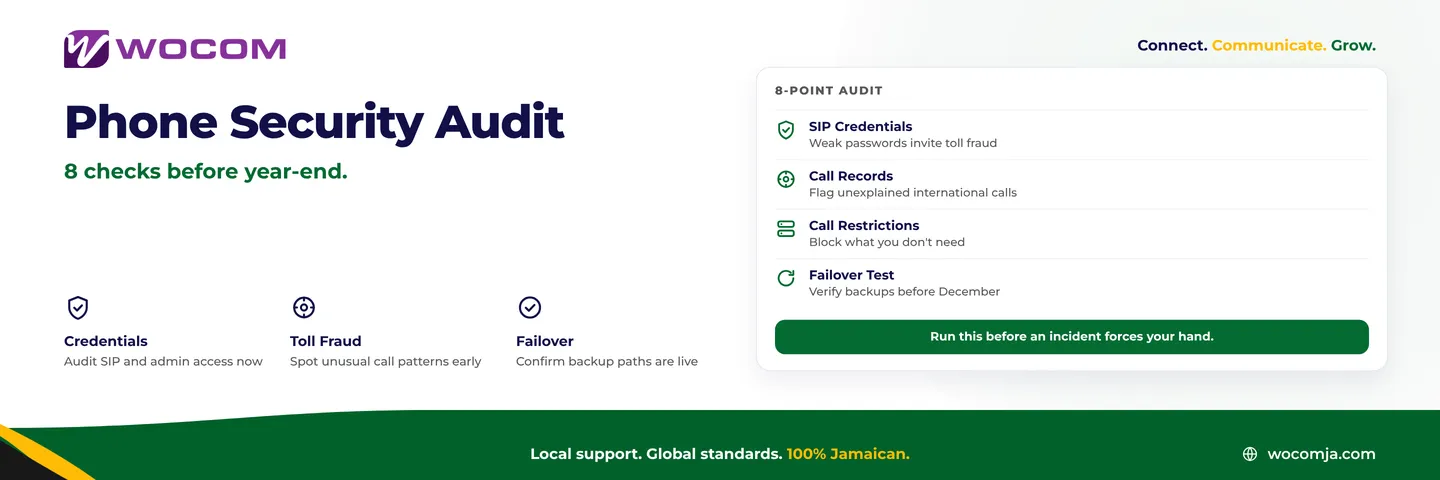
Many Jamaica businesses have backup call routing configured — calls that should redirect to a mobile number or alternate line when the main system is unreachable. The problem is that failover settings are configured once and never tested. Over time they silently break: a mobile number changes, a forwarding rule is overwritten during a system upgrade, or a backup SIP trunk's credentials expire.
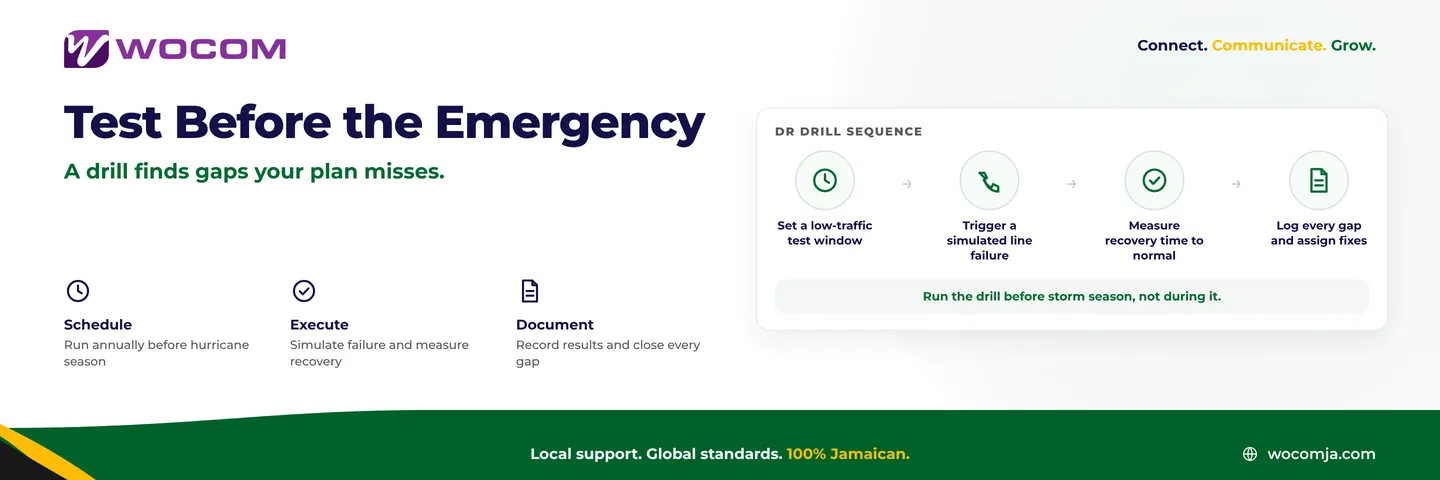
The test is straightforward. Ask a colleague to call your main business number while you temporarily disable your primary internet connection. Watch what happens. Do calls redirect correctly? Does the caller hear a useful message or dead silence? Does the backup route reach an actual person or an unmanned extension?
Testing this in November, at low business risk, is far safer than discovering it is broken during a Category 1 advisory in August 2027.
Audit Point 3: Review Your SIP Trunk Resilience
SIP trunks are the connections that carry your business calls over the internet. Most Jamaica businesses run a single SIP trunk from a single provider over a single internet connection — three single points of failure stacked on top of each other. Review the following with your telephony provider:
- Geographic redundancy: Does your SIP trunk provider have infrastructure in more than one data centre? If their primary point of presence goes offline, can your calls automatically route through an alternate path?
- Internet failover: If your primary internet connection drops, do your SIP credentials work through a secondary connection — LTE, a second fixed line, or Starlink?
- Failure alerting: Is your phone system configured to detect a SIP trunk failure quickly and notify you before callers start getting busy signals?
If you are not certain whether your current setup has any of these protections, this audit is the trigger to find out.
Audit Point 4: Update Your Business Continuity Communication Plan
A business continuity communication plan answers one question: if your main phone system becomes unreachable today, how do your customers and staff reach you? Most plans written before 2025 are already outdated — staff have changed, mobile numbers have changed, and the communication tools referenced may no longer exist.
Your November update should cover these elements:
- Current personal mobile numbers for every person in an escalation role
- The backup number your business will direct customers to if the main line is down
- Clear ownership: who activates the backup plan, and who communicates the disruption to customers?
- How callers will be informed — an updated auto-attendant message, a social media post, or a WhatsApp broadcast
Keep the updated plan somewhere that does not depend on your normal systems. A printed copy, a shared cloud document accessible from personal devices, or an email to all key staff works well. A plan stored only in your office server does not help when the system is down.
Audit Point 5: Brief Your Team on What Changed
The value of this audit is only realised if the people who answer your phones know what to do. A short briefing with your front-desk staff, office manager, and any remote workers who handle calls should cover the backup path to use if the main system is down, what to tell callers who experienced disruptions during the season, and what to log if it happens again.
One specific situation worth preparing for: if a caller mentions they tried to reach your business during a weather event and could not get through, your staff should acknowledge this directly and offer to help. Callers who cannot reach a business during a difficult period often do not complain — they simply find an alternative next time. A prepared team can recover that relationship immediately.
The 2026 Atlantic hurricane season closes November 30. The 2027 season opens June 1. That gives you roughly six months to act on whatever this audit uncovers — and the earlier you start, the less disruption the changes cause to daily operations.
Strengthen Your Jamaica Business Phone Resilience Before Year-End
WOCOM works with businesses in Kingston, Montego Bay, and across the parishes to build phone systems designed for Caribbean conditions: redundant SIP trunks, automatic failover routing, and call continuity that holds during internet outages. If your post-season review has surfaced gaps in your setup, the time to address them is now — before the budget closes and before the next season's calendar begins filling up.
Visit wocomja.com or reach out on WhatsApp to schedule a no-obligation resilience review with the WOCOM team. We will look at your current configuration, identify the single points of failure, and outline what a hardened setup would look like for your business size and industry — at no cost and no commitment required.
Continue exploring
Ready to upgrade your communications?
Talk to our team about the right solution for your business.
Book a Demo Contact SalesEverett Kildare is WOCOM's voice and infrastructure specialist, with more than 25 years of experience designing and running carrier-grade voice, SIP and virtualization infrastructure. Holding a BSc in Information Technology, he has built, secured and migrated phone systems for businesses of every size. Everett writes WOCOM's technical coverage of SIP trunking, cloud PBX, contact centres, business continuity and migration.