Phone First or Digital First? How Smart Jamaican Businesses Are Managing Customer Channels in 2026
Walk into any Kingston business district — from New Kingston's glass towers to the wholesale lanes of Spanish Town Road — and you'll notice the same thing: phones are ringing. Not WhatsApp notifications. Not email alerts. Phone calls.
Yet every few months a new think-piece declares voice communication dead, replaced by digital channels. Jamaican businesses hearing this message are increasingly asking a strategic question: should we put our resources into the phone system, or shift investment toward WhatsApp, chat, and social media messaging?
The honest answer is that it's a false choice — but getting the balance wrong costs real money. Here's what's actually happening in the Jamaican market in 2026, and how the businesses pulling ahead are managing it.
Why This Decision Matters More Than It Used To
Five years ago, most Jamaican businesses had one channel: the phone. Digital enquiries trickled in by email, and WhatsApp was something staff used personally. Today, a typical SME might be managing enquiries through three or four channels simultaneously — and doing it poorly on all of them.
The businesses that are thriving aren't the ones that went all-in on one channel. They're the ones that figured out which channel their specific customers prefer for each type of interaction — and built infrastructure to handle both without dropping the ball.
The stakes are real. A missed call costs more than a missed WhatsApp message. Callers who can't get through are significantly more likely to call a competitor than customers who sent a digital message and didn't hear back immediately. Channel choice affects close rates, not just customer satisfaction scores.
Where Voice Still Dominates in Jamaica
Despite the growth of digital channels, phone calls remain the dominant first-contact method for several specific scenarios that are deeply embedded in Jamaican business culture:
- High-value enquiries. A caller pricing a vehicle, comparing insurance packages, or asking about a commercial lease is almost always going to call first. Voice creates accountability — both parties know the conversation happened and something is expected to follow.
- Urgent situations. When something breaks, runs out, needs immediate attention, or involves a deadline, customers call. Montego Bay resorts, Kingston medical clinics, and parish government offices all see the same pattern: urgency equals a phone call.
- Trust-building in new relationships. For first-time customer interactions — particularly in financial services, legal, and professional sectors — a voice conversation builds confidence faster than any digital exchange. Jamaican customers want to hear a real person before they commit.
- Older decision-makers. The business owner authorising a procurement order in Mandeville or May Pen, the manager approving a service contract in Spanish Town — these decision-makers are reaching for the phone, not drafting a WhatsApp message.
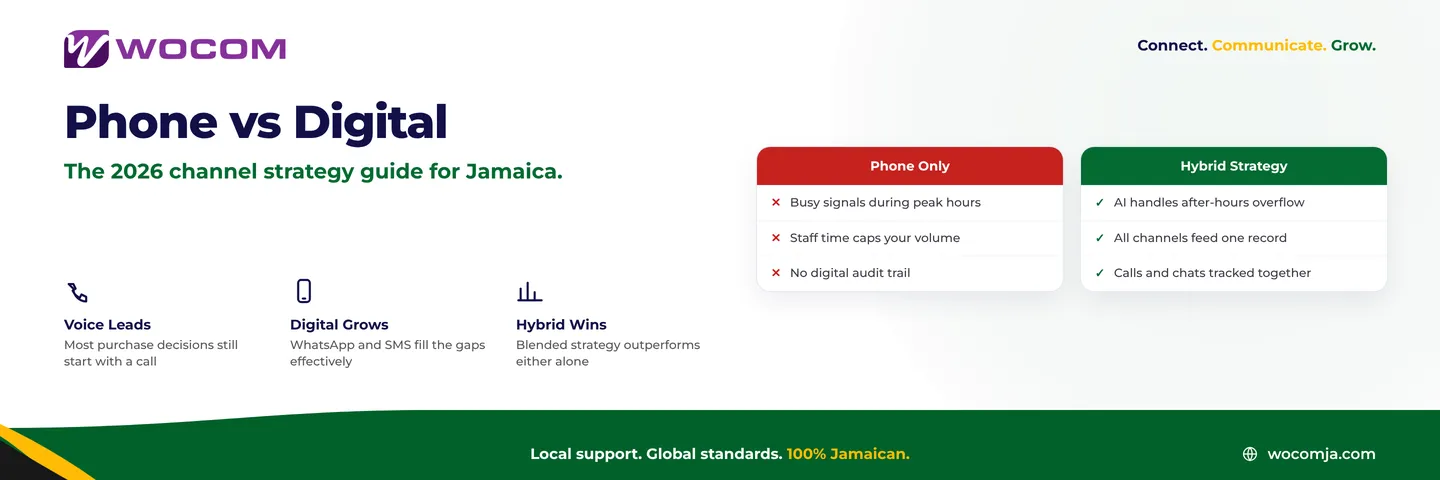
The implication is direct: if your phone system is weak — busy signals during peak hours, unanswered after-hours calls, no queue management — you are losing business in the channel your highest-value customers trust most.
Where Digital Channels Are Genuinely Winning
Digital isn't losing. It's winning in different scenarios:
- Repeat and routine interactions. Customers who already know you are increasingly happy to confirm appointments, check order status, or make simple requests via WhatsApp or SMS. The relationship is established; the formality of a call isn't needed.
- After-hours non-urgent queries. A question sent at 10 PM that the customer doesn't expect answered until morning is perfectly suited to digital. They're not waiting — they're leaving a note for you to act on.
- Documentation-heavy interactions. If the conversation involves sharing photos, PDFs, contracts, or screenshots, digital channels win on friction. A customer reporting a damaged delivery wants to send photos; a voice-only channel makes that unnecessarily complicated.
- Younger demographics and tech-forward industries. E-commerce businesses, Kingston-based startups, and any sector with a significant under-30 customer base are seeing WhatsApp enquiries at volumes that match or exceed inbound calls.
The implication here is equally direct: ignoring digital means losing the high-volume, low-complexity enquiry flow that would otherwise tie up staff time on phone lines. But digital alone will not close your highest-value opportunities.
The Hidden Cost of Getting the Mix Wrong
Businesses that go phone-only hit a hard ceiling: staff time becomes the bottleneck. Every enquiry, no matter how routine, ties up a person. Scaling means hiring — and during peak periods, you're either over-staffed or you're turning customers away with engaged tones.
Businesses that shift too aggressively to digital often discover a subtler problem: their phone infrastructure atrophies. Lines go unmanned. Response times on calls drift. High-value customers who try to call and can't get through leave — not visibly, just quietly.
The most costly version of this is the business that invested heavily in WhatsApp Business, became genuinely responsive on digital, and simultaneously let its phone system degrade. The customers who still call are often the highest-value ones. Losing them is quiet, immediate, and expensive in ways that don't show up clearly in a digital analytics dashboard.
Many businesses discover, on review, that their digital channels are managing existing relationships — while their phone is still winning new ones. The two channels aren't competing; they're doing entirely different jobs.
The businesses that look at their data honestly often find that the large account or the major contract traces back to a phone call, not a WhatsApp exchange. The digital channel kept the relationship warm; the call is what opened it.
Building a Hybrid Strategy That Fits the Jamaican Market
The businesses pulling ahead in 2026 are using a layered approach rather than picking a winner:
- A robust phone system as the foundation. Cloud PBX or SIP trunking ensures calls are never lost — queued, routed, recorded, and reportable. An AI receptionist handles after-hours calls, captures leads, and routes complex queries to the right person the following morning without a single caller being left in silence.
- Digital channels for repeat interactions. WhatsApp Business, SMS, or a website chat widget handles appointment confirmations, order updates, and low-complexity queries — without consuming staff time on every exchange.
- A single log to tie it together. The biggest failure mode in hybrid strategies is siloed channels: your phone system logs calls in one place, your WhatsApp lives on a staff member's personal device, and nobody can see the complete picture of any customer relationship. Integrated platforms — or at minimum, a shared CRM record — prevent this from happening.
- Clear triage rules for staff. Who responds to digital enquiries? Within what timeframe? Which types of digital question should be escalated to a conversation? These decisions, made once and documented, remove daily friction and prevent enquiries from falling through the gap between channels.
The right mix depends entirely on your industry and customer base. A Portmore logistics company may find 80% of its valuable interactions happen by phone. A Kingston e-commerce brand may see the near reverse. The key is measuring both channels deliberately — and making a channel strategy decision, rather than letting it happen by default.
How WOCOM Supports a Balanced Channel Strategy
WOCOM's Cloud PBX and AI receptionist platform is built for exactly this kind of hybrid operation. Your calls are answered professionally around the clock — even when staff are away, during lunch hours, or after the office closes — and every interaction is logged, searchable, and available for review. Our AI receptionist handles routine enquiries, takes messages, and routes callers to the right extension, so your phone channel performs at full strength without requiring additional headcount.
Digital channels run alongside the phone platform without conflict. And when you want to understand how your channels are actually performing, call logs and AI-generated summaries give you the data to make informed decisions about where to invest next.
If you're unsure where your business sits on the phone-versus-digital spectrum — or if you suspect your phone infrastructure is costing you more in missed opportunities than you realise — WOCOM's team can walk through your current setup and show you what a stronger foundation looks like.
Ready to build a channel strategy that works for your customers? Contact WOCOM and let's look at how your business communications are performing today.
Continue exploring
Ready to upgrade your communications?
Talk to our team about the right solution for your business.
Book a Demo Contact SalesMichelle Goss is a data and AI analyst at WOCOM, where she studies how Jamaican businesses use voice, messaging and AI to win and keep customers. With a BSc in Data Science & Analytics, she turns call data, customer trends and AI receptionist performance into practical guidance owners can act on. Michelle writes WOCOM's coverage of AI call handling, call analytics, customer growth and industry trends.