Phone Provider Outage Jamaica: A Resilience Guide for Business Owners
When the Phones Go Silent
Most Jamaica businesses have thought about what happens if the power goes out or the internet drops. Far fewer have a plan for a scenario that hits harder and faster: your phone provider goes down.
It can happen with almost no warning. Your main business number stops ringing. Callers hear a network tone or nothing at all. Your team can still send WhatsApp messages, but inbound customer calls — the ones that generate revenue — simply stop arriving. By the time you confirm it is a provider issue and not something on your end, you have already missed an hour of business.
This guide is for Jamaica businesses that want to stop being surprised and start being prepared.
How Phone Provider Outages Actually Happen
Provider outages are rarely dramatic. They are usually one of the following:
- Network route failure: A carrier upstream from your provider loses a routing path, causing calls to drop or fail to connect at the network level.
- DDoS attacks on VoIP infrastructure: Volumetric attacks can knock SIP platforms offline temporarily, and the disruption can affect every customer on that platform simultaneously.
- Configuration errors after maintenance: Provider patches and hardware upgrades sometimes introduce a bad configuration that disrupts service for hours before anyone catches it.
- SIP registration failures: Your trunks stop registering with the carrier, which silently kills inbound calls with no obvious error showing on your equipment.
- Regional internet disruptions: Undersea cable cuts or major connectivity incidents in Jamaica can affect providers that route international traffic, even if your local internet connection looks healthy.
In most of these cases, there is nothing wrong with your phone hardware, your PBX, or your internet connection. The failure is entirely outside your building — and entirely outside your control unless you have planned for it.
What an Unplanned Outage Actually Costs
The visible cost is the calls you miss during the outage. The less visible cost is the callers who tried once, heard nothing, and moved on to a competitor. For a Kingston business handling 40 inbound calls on a busy morning, even a two-hour outage during peak hours can mean 15 to 20 missed enquiries that never call back.
In high-stakes industries — medical practices, legal firms, financial services, logistics companies in Portmore or Montego Bay — those missed connections directly affect revenue and client confidence. The businesses that handle outages best treat resilience as a design requirement, not an afterthought.
Six Resilience Questions to Ask Your Provider Before You Sign
When evaluating a phone provider — or reviewing the one you already have — these questions separate prepared operators from those that will leave you stranded:
- Do you have a public status page? Providers with genuine transparency publish real-time service status. If they do not, you will only learn about an outage when your callers tell you.
- What is your uptime SLA, and what is the penalty if you miss it? A promise of 99.9% uptime still allows over eight hours of downtime per year. Ask what compensation applies and whether it is meaningful in practice.
- Do you operate carrier redundancy? Your provider should be connected to multiple upstream carriers so that if one route fails, calls automatically re-path through another. Ask whether that failover is automatic or requires a manual intervention from their team.
- Can I configure failover to a mobile number from my portal? In a worst-case scenario, you should be able to redirect your main business number to a mobile at the click of a button — or have it happen automatically when registration drops.
- What is your incident communication process? How quickly does the provider acknowledge an outage, and how do they communicate while it is ongoing? Some providers go silent for hours. Others push updates every 15 minutes.
- Is my phone system hosted in a data centre with redundant power and connectivity? Cloud PBX platforms running from purpose-built infrastructure are significantly more resilient than those dependent on a single server in a single building.
Building Your Own Resilience Layer
Even with a reliable provider, smart businesses build a backup layer of their own. Here is what that looks like in practice:
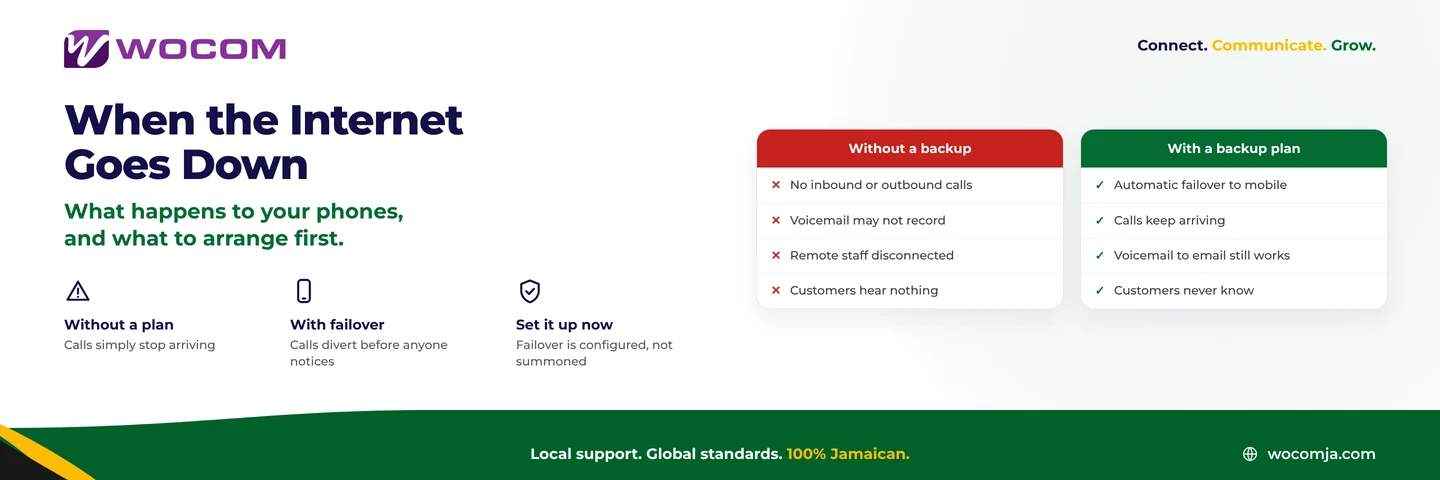
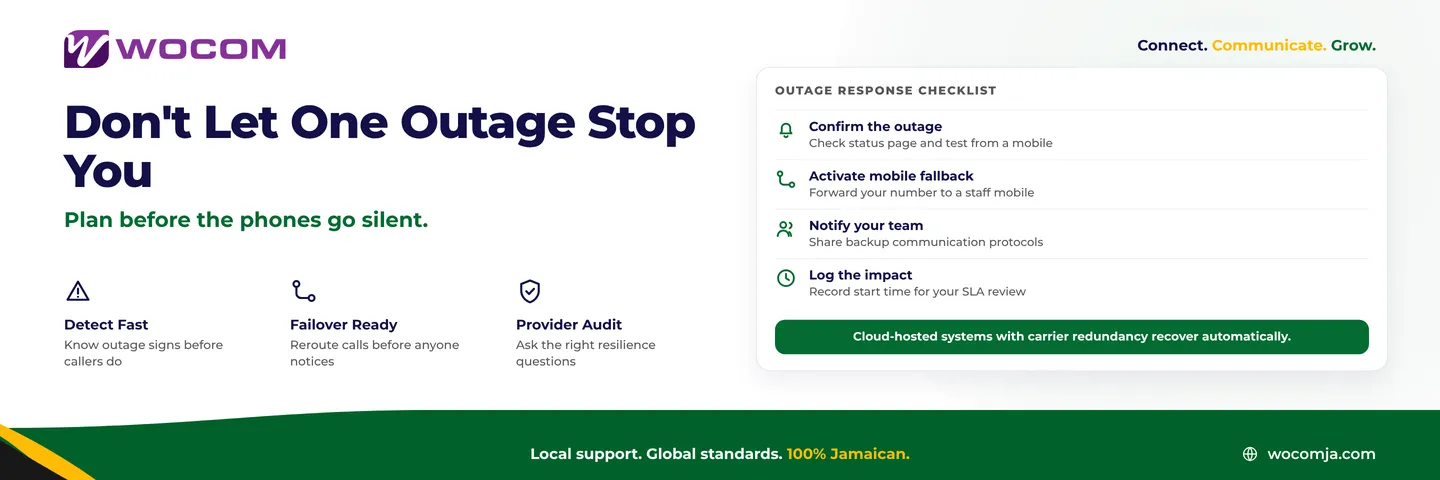
Number-level failover: Your main business number can be configured to forward automatically to a mobile or another number if your SIP trunks stop registering. With a cloud PBX, this redirect takes effect in the portal within seconds and requires no hardware changes on site.
Dual-carrier SIP trunks: Businesses in Kingston or those running contact centres can terminate calls across two independent SIP providers simultaneously. If one fails, the other continues handling calls without any manual intervention.
Staff mobile group: Maintain a shared contact list of staff mobile numbers that can serve as a backup call group during an outage. The team knows to activate this protocol when the primary system is unreachable.
Pre-written outage message: When the phones are down, do not leave customers guessing. Prepare a short social media post and WhatsApp Business message in advance that you can push immediately when an outage is confirmed. Something direct: We are experiencing a temporary phone service issue. Please WhatsApp or email us — we will respond as quickly as possible. Having this ready in advance removes the scramble in the moment it matters most.
What Cloud PBX Gives You That On-Premise Cannot
A traditional on-premise PABX is almost entirely dependent on its physical location, its local internet connection, and its SIP provider. If any one of those fails, the entire phone system stops working.
A cloud-hosted PBX separates your phone system from your building's infrastructure. Extensions can ring on mobile apps, laptops, or remote handsets even if your office internet is down — because call processing happens in a data centre, not on your premises. Staff in Kingston can continue taking calls while the Mandeville branch is offline. Your main business number stays reachable through the cloud even if your on-site connection goes completely dark.
This architectural separation is what makes cloud PBX the smarter continuity choice for Jamaica businesses that cannot afford to be unreachable during a crisis — planned or otherwise.
The Step Most Businesses Skip: Testing
A resilience plan is only useful if it works when you actually need it. Schedule a 15-minute test once per quarter. Simulate an outage: disable your primary SIP trunk in the admin portal and confirm that failover activates correctly. Verify that mobile fallback numbers ring through. Check that your team can locate and follow the backup communication protocols without searching for them.
The businesses that get through outages calmly are the ones that have done this test before. It takes less time than fixing the reputational damage from a real outage nobody prepared for.
The question is not whether your phone provider will ever have an outage. The question is whether your business will feel it.
Ready to Build Resilience Into Your Business Phone System?
WOCOM is Jamaica's licensed business phone provider, operating its own network infrastructure so your calls are handled by the company that owns the path — not a reseller dependent on a third party. Our cloud PBX platform includes configurable failover, carrier-grade SIP trunking with redundant upstream routing, and a real-time admin portal so your team can respond to any disruption in minutes.
If you would like to review your current setup or put a resilience configuration in place before you need it, visit wocomenterprise.com or speak directly with the WOCOM team today. We are here to make sure your business stays reachable — no matter what happens upstream.
Continue exploring
Ready to upgrade your communications?
Talk to our team about the right solution for your business.
Book a Demo Contact SalesEverett Kildare is WOCOM's voice and infrastructure specialist, with more than 25 years of experience designing and running carrier-grade voice, SIP and virtualization infrastructure. Holding a BSc in Information Technology, he has built, secured and migrated phone systems for businesses of every size. Everett writes WOCOM's technical coverage of SIP trunking, cloud PBX, contact centres, business continuity and migration.