Outbound Call Compliance Jamaica 2026: Consent, Recording Disclosure, and Do-Not-Call Rules for Business Callers
Why Outbound Calling Compliance Matters More in 2026
For years, Jamaican businesses treated outbound calling as an unregulated channel: compile a list, pick up the phone, dial. That era is over. Jamaica's Data Protection Act (DPA) 2020 — now fully operational — classifies a customer's phone number as personal data. Any systematic outbound campaign that involves personal data must meet the Act's consent, transparency, and data-handling standards.
The cost of getting it wrong is real: complaints to the Office of the Information Commissioner (OIC), reputational damage, and the kind of reviews that follow a business for years. Carriers and regulators are increasingly equipped to identify and flag high-volume callers who generate opt-out complaints. Building compliance into your outbound workflow now costs far less than managing the fallout later.
Consent: What You Actually Need Before You Dial
The DPA distinguishes between calls to existing customers and calls to prospects — and the rules differ significantly.
- Existing customers: You generally have a legitimate interest basis to contact customers about products or services directly related to what they purchased. A plumbing supplies company in Kingston can call a contractor who ordered last month to announce a promotion on PVC fittings. The existing relationship is the basis.
- Cold prospects: This is the highest-risk category. Purchasing a list of business numbers and calling without any prior relationship or consent is difficult to defend under the DPA. The person must have agreed — through a clearly worded opt-in — to receive commercial calls from your company or a category of companies like yours.
- Referrals: A referral from an existing customer gives you a reasonable basis for one introductory call, but that contact must be told who referred them and given a genuine opportunity to decline further contact.
The safest practice is to document consent at the source: a website form with a phone-call opt-in checkbox, a paper sign-up that includes a tick box, or a recorded verbal consent during a previous call. No documentation means no defensible consent.
Call Recording Disclosure Requirements
The DPA treats a call recording as personal data — it captures the voice and statements of the person on the line. That means you must inform the caller a recording is happening before the substantive conversation begins. Burying the disclosure in the middle of a long IVR message does not meet the transparency standard.
A legally sound disclosure script is brief and direct:
"This call is being recorded for quality and training purposes. If you prefer not to be recorded, please let me know and I will note your preference."
Two points matter here. First, "may be recorded" is weaker than "is being recorded" if your system records every call — accuracy matters. Second, giving the caller a genuine opt-out mechanism, even if it only means the agent makes a note, demonstrates good faith and is consistent with the DPA's accountability principle.
Businesses in regulated sectors — financial services, insurance, credit unions, healthcare — carry the highest obligation and should treat verbal recording disclosure as non-negotiable on every outbound call.
Handling Opt-Outs and Do-Not-Call Requests
Jamaica does not currently operate a centralised national Do-Not-Call registry in the way the United States or Canada does. That does not mean opt-outs can be ignored. Under the DPA, an individual's right to object to the processing of their personal data for marketing purposes is absolute and must be honoured without delay.
In practice, this means:
- Every outbound campaign list must be scrubbed against your internal suppression database before dialling begins.
- Any agent who receives a "do not call me again" from a prospect must log it in your CRM or call system within the same session — not at end of day, not whenever convenient.
- The suppression must persist across campaigns. A contact removed from a May campaign cannot reappear on your October campaign because someone exported a fresh CSV from the database.
- If a customer withdraws consent for marketing calls but remains an active customer for service calls, those two contact streams must be separated in your system and handled independently.
This level of operational discipline requires either a CRM with a proper suppress field, or a contact centre platform where "do not call" is a hard block rather than a soft note that gets forgotten.
A Compliant Outbound Workflow in Five Steps
Compliance is a system, not a one-time audit. Here is a repeatable workflow for Jamaican contact centres and sales teams running outbound campaigns:
- Source audit: Before a list enters your dialler, confirm the legal basis for each segment — existing customer, opted-in prospect, referral, or other documented basis.
- DNC scrub: Run the list against your suppression database. Most CRMs support this as a standard export comparison; your contact centre platform should automate it entirely.
- Script review: Confirm your agent script includes the recording disclosure and a clear, friction-free opt-out statement such as: "If you'd prefer we don't contact you again, just say so and I'll update your record right now."
- Real-time logging: Every opt-out received during a calling session is logged before the agent moves to the next call. This is a process rule, not a suggestion.
- Post-campaign reconciliation: Within 24 hours of a campaign ending, all new suppressions are merged into the master DNC list so they carry forward to every future campaign automatically.
How Your Phone System Supports Compliance
Compliance is significantly easier when your calling infrastructure is built for it. A cloud contact centre platform gives your team the tools to stay clean without adding manual overhead:
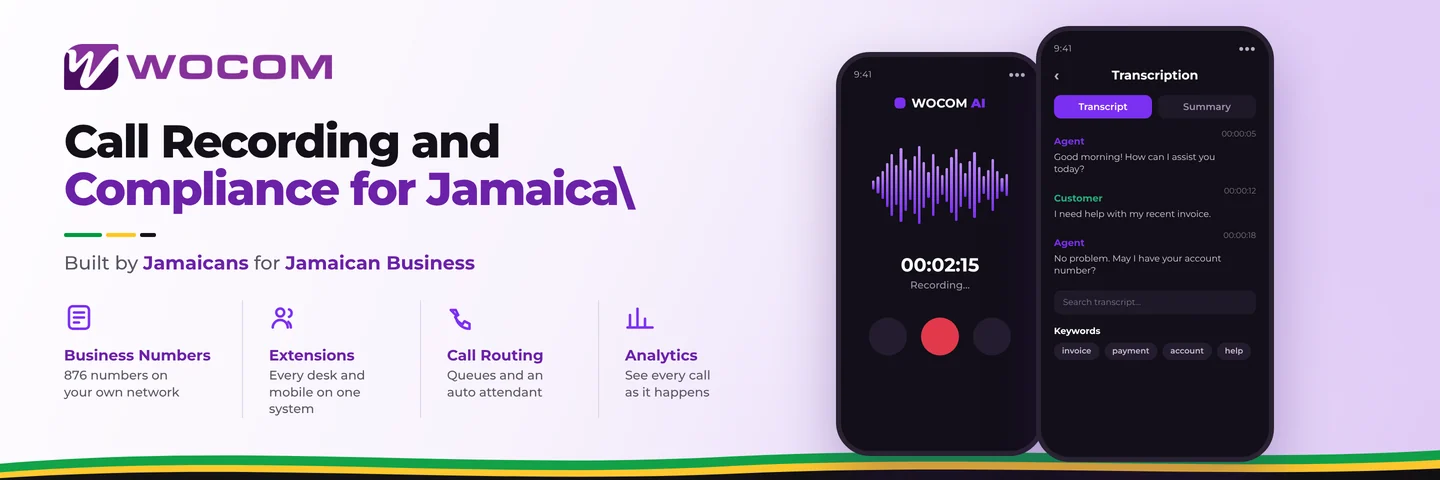
- Automatic call recording with timestamped disclosure — every recording is labelled with the exact time the disclosure was played, creating an auditable trail you can produce on request.
- Agent disposition codes — agents mark "do not contact" dispositions in real time; the CRM integration suppresses the record immediately rather than waiting for a manual export.
- Campaign list validation — list uploads can be checked against your suppression file before any dial begins, eliminating the human-error risk of a fresh CSV overwriting an opt-out.
- Searchable call recordings — if the OIC ever requests evidence of a disclosed recording, you can retrieve it by phone number, date range, and agent within minutes.
Businesses in Kingston, Montego Bay, and across Jamaica that run regular outbound campaigns — collections follow-ups, sales calls, appointment reminders, satisfaction surveys — all benefit from having these controls built into their phone infrastructure from the start rather than patched in after a complaint.
Compliance as a Competitive Advantage
Customers notice when businesses treat them respectfully. A clean disclosure at the top of a call, a prompt and no-questions-asked opt-out process, and a team that never calls back after a do-not-call request signal that your business operates to a professional standard. In a market where many competitors still run outbound campaigns from a shared spreadsheet with no suppression file, operational compliance becomes a genuine differentiator — not just a legal obligation.
If your business runs outbound campaigns and you want to review your current setup — recording configurations, disposition workflows, campaign list controls, or CRM integrations — contact WOCOM today. Our specialists will walk through your current workflow and show you exactly how our cloud contact centre platform makes compliant outbound calling the default, not the exception.
Continue exploring
Ready to upgrade your communications?
Talk to our team about the right solution for your business.
Book a Demo Contact SalesMichelle Goss is a data and AI analyst at WOCOM, where she studies how Jamaican businesses use voice, messaging and AI to win and keep customers. With a BSc in Data Science & Analytics, she turns call data, customer trends and AI receptionist performance into practical guidance owners can act on. Michelle writes WOCOM's coverage of AI call handling, call analytics, customer growth and industry trends.