Month-to-Month vs Long-Term Business Phone Contract Jamaica: The Real Cost of Flexibility
Why Your Business Phone Contract Length Matters More Than You Think
Most Jamaica business owners sign a phone contract the same way they sign a delivery receipt: quickly, because the service is needed now and the details can wait. The result is years of overpaying, or worse, being locked into terms that no longer fit a business that has grown, moved, or changed direction entirely.
The choice between a month-to-month arrangement and a committed term — typically 12 to 24 months — is not a minor administrative detail. It affects your monthly outgoings, your leverage with the provider, your budget predictability, and critically, what happens when your circumstances change. Getting this decision right starts with understanding what each option actually delivers, not just what the headline rate says.
What Month-to-Month Contracts Actually Cost
Flexibility has a price. Providers who offer month-to-month arrangements build that freedom into the monthly rate. The exact premium varies by provider and service type, but the principle is consistent: a business on a rolling short-term arrangement pays more per line, per SIP channel, or per user seat than an equivalent customer on a 12- or 24-month commitment.
That premium is not always visible on a pricing page. You may see a single headline figure without realising that the lower rate on a comparison sheet requires a signed 12-month agreement. When evaluating proposals, always ask for both rates side by side and work out the annual difference — it is often significant.
Month-to-month contracts also carry a risk that committed terms do not: the provider can adjust pricing with relatively short notice, often 30 days. A service that looks affordable today can become expensive by next quarter if rates move. Long-term agreements protect you from mid-term increases; rolling arrangements do not.
Month-to-month tends to suit:
- Startups in year one who do not yet know their call volume or headcount
- Businesses mid-transition — relocating, restructuring, or changing their operating model
- Seasonal operations in tourism or retail that need more lines during peak months and fewer off-season
What Long-Term Contracts Actually Deliver
A committed term — 12 or 24 months — gives you more than a lower monthly rate. It locks in your price for the duration, which makes budgeting straightforward. For a Kingston accounting firm, a Montego Bay medical clinic, or any business that needs to forecast quarterly costs, price certainty has real value independent of the saving itself.
Long-term customers often receive better terms in other respects too: priority support, included onboarding assistance, bundled features that are paid add-ons for month-to-month customers. Providers invest more in customers they know will stay because the economics justify it. That investment shows up in how quickly your calls get answered when something goes wrong.
Long-term contracts tend to suit:
- Established businesses with stable or predictable call patterns
- Organisations where budget forecasting requires fixed-cost communications
- Multi-location businesses that need consistent terms and pricing across all sites
The Hidden Exits: Reading Early Termination Clauses
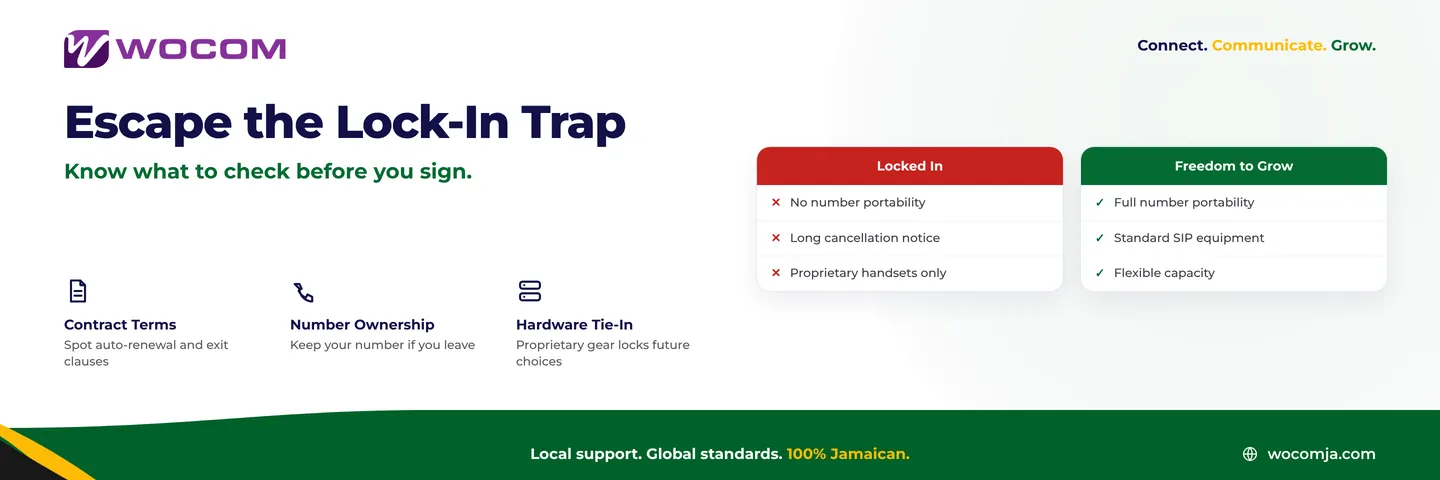
The most consequential section of any business phone contract is the one you hope never to use: the early termination clause. This clause determines what you owe if circumstances change and you need to leave before the term ends.
Common structures include a remaining balance (you pay the full value of the months left on the contract), a percentage penalty of the remaining contract value, or a simple notice period with no financial penalty. Ask for the calculation method in writing before signing — a vague description of "applicable fees" is not acceptable.
Month-to-month contracts are not entirely without exit complexity either. Porting your business number to a new provider takes time. In Jamaica, the process involves the losing carrier and can take several business days. There is often a required notice period before the final service date. "Cancel anytime" rarely means "cancel today," and if your number is your primary business contact, an unplanned gap in service can be damaging.
Before signing any contract, confirm two things in writing: the precise cost and process to terminate early, and what happens to your number if you leave. The second question matters as much as the first.
Also look for a termination for cause provision. If the provider consistently fails to meet the service levels promised in the agreement, this clause should allow you to exit without the standard penalty. A contract without this protection leaves you with no leverage if quality deteriorates.
Matching the Decision to Your Business Stage
The right contract length is not the same for every business. It should reflect where your business is right now, not where you hope to be.
Year-one startup: Choose month-to-month for the first 12 months. Your call volume is unknown, your team size may shift, and your premises may change. Once you have a year of data, you will know exactly what you need and can commit with confidence rather than guesswork.
Stable, established business: If your call volume and headcount have been consistent for two or more years, a long-term contract is almost always the better financial choice. Lock in the rate, stop paying the flexibility premium, and redirect that saving elsewhere in the business.
Rapidly growing business: Consider a hybrid approach. Commit on a base capacity you are certain you will use, and arrange overflow on flexible terms. This gives you cost efficiency on the core while leaving room to scale without renegotiating the entire agreement.
Seasonal business: Businesses in tourism, events, or peak-season retail benefit from contracts that include scaling or suspension provisions. If a provider cannot accommodate predictable seasonal changes in volume, month-to-month may be the only workable option — but price it honestly against a committed rate before deciding.
Six Questions to Ask Before You Sign
No matter which contract length you are leaning toward, these questions protect you before the agreement is final:
- How is the early termination fee calculated? Ask for a worked example with actual numbers.
- Can I upgrade my plan or add lines mid-contract without penalty? Growth should not cost you extra to accommodate.
- What happens to my numbers if I leave? Confirm porting rights and timelines in writing.
- Is the contract price fixed, or can it be adjusted during the term? Some agreements permit "reasonable" rate adjustments — define what that means before signing.
- What service level is guaranteed, and what is the remedy if it is not met? Bill credits alone are not always sufficient; understand the compensation structure.
- Does this contract auto-renew, and what is the opt-out window? Many businesses get caught by automatic renewals they did not notice.
Make the Right Call for Your Business
The contract you sign today sets the terms of your business communications for the next year or longer. A month-to-month arrangement gives you room to adapt; a long-term commitment gives you a lower rate, a locked price, and often better service. Neither is inherently better — the right choice depends on your current stage, your call patterns, and how much confidence you have in the provider you are choosing.
WOCOM provides Cloud PBX, SIP trunking, and AI receptionist services to Jamaica businesses of all sizes, with contract options designed to fit different growth stages and risk appetites. If you are not sure which structure suits your situation, our team can walk you through the numbers and help you model the real cost difference before you commit. Contact WOCOM today — no commitment required just to compare.
Continue exploring
Ready to upgrade your communications?
Talk to our team about the right solution for your business.
Book a Demo Contact SalesMichelle Goss is a data and AI analyst at WOCOM, where she studies how Jamaican businesses use voice, messaging and AI to win and keep customers. With a BSc in Data Science & Analytics, she turns call data, customer trends and AI receptionist performance into practical guidance owners can act on. Michelle writes WOCOM's coverage of AI call handling, call analytics, customer growth and industry trends.