Least Cost Routing Jamaica: How SIP Trunks Automatically Cut Your International Call Bill
What Is Least Cost Routing?
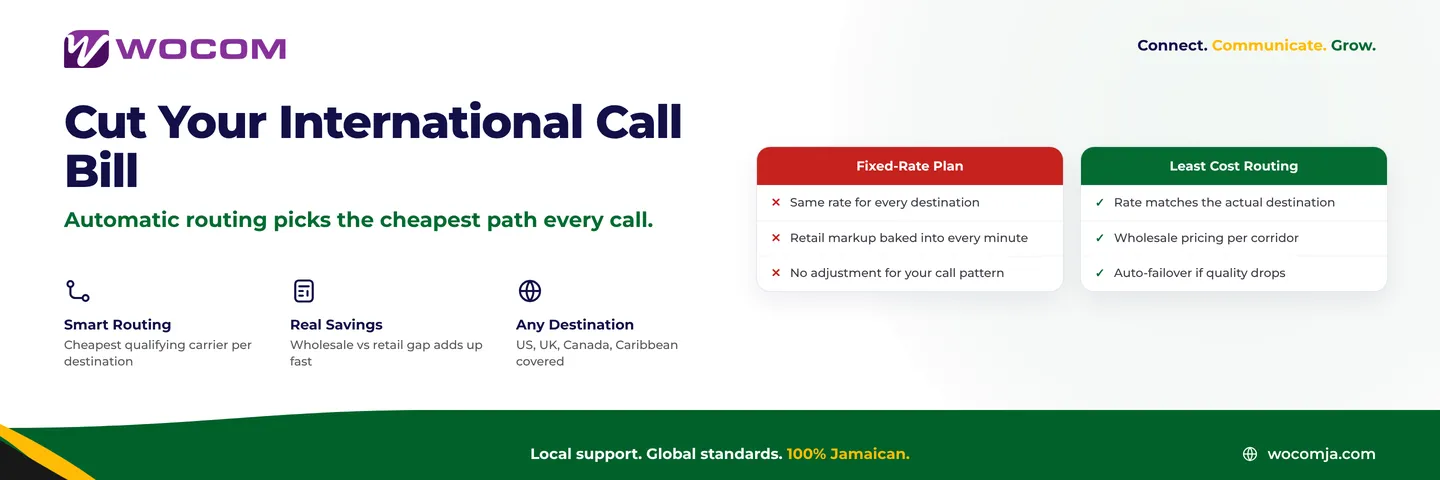
Least cost routing (LCR) is an automated call-routing method built into SIP trunking platforms. When your employee dials an international number, the system checks a live table of carrier rates, selects the route with the lowest per-minute cost to that destination, and sends the call. The entire process takes milliseconds—before the first ring reaches the far end.
For a Jamaican business that regularly calls the United States, the United Kingdom, or other Caribbean islands, LCR is not a luxury. It is the mechanism that prevents you from paying retail rates on calls that could travel a wholesale route at a fraction of the price. If you have never heard the term, there is a reasonable chance your current provider is benefiting from that silence.
How LCR Works Inside a SIP Trunk
A traditional landline has no such intelligence. Your call goes out one wire to one carrier and you pay that carrier's rate, full stop. A SIP trunk sits on a platform that holds relationships with multiple upstream carriers. Each carrier submits a rate deck: the price they charge per minute to reach each country, area code, or even specific mobile prefix.
When a call is placed, the LCR engine works through these steps:
- Strips the dialled number to its international prefix—+1 for US and Canada, +44 for the UK, +1-876 or +1-658 for Jamaica local.
- Queries the rate table for that prefix across all available carriers.
- Ranks routes by cost, then filters by a minimum quality threshold.
- Routes the call down the cheapest route that clears the quality floor.
That quality safeguard is critical. A carrier that costs half a cent less per minute but drops eight percent of calls is not a saving—it is a daily operational problem. Mature LCR systems track per-carrier quality scores in real time and will bypass a cheap carrier that is underperforming, even mid-day if conditions change.
Why This Matters for Jamaican Businesses Specifically
Jamaica's calling geography creates an unusually strong case for LCR. Three factors stand out:
- US and Canada calls dominate. The Jamaican diaspora is large and commercially active. Businesses in Kingston, Montego Bay, and across the parishes call Miami, New York, Toronto, and Houston constantly. NANP (+1) wholesale termination can be as low as 0.5–1 cent USD per minute. Many retail fixed-line plans charge 8–15 cents for the same call.
- Caribbean-to-Caribbean calls vary wildly. Calling Trinidad, Barbados, or Guyana from a Jamaican number is not treated as a "region" call by most carriers—each destination has its own termination cost, and some are surprisingly expensive on retail plans. LCR picks the correct route automatically rather than forcing you to manage it.
- Mobile versus landline prefixes carry different rates. When calling the UK, 07xxx mobile numbers cost significantly more to terminate than 020/01xxx landlines. LCR splits routes by prefix and applies the correct rate automatically, so you are not subsidising mobile termination when you dial a UK office number.
A Kingston-based trading company making 200 minutes of US calls per day and 50 minutes to the UK could easily be spending USD $30–$60 more than necessary every single day on a retail fixed-rate plan. Over a month, that is real money—and it compounds annually.
LCR vs. Flat-Rate International Bundles
Some providers sell unlimited or flat-rate international bundles. These look clean on paper but carry a structural problem: the rate is priced to average across all destinations. If your calling pattern is concentrated in low-cost corridors—like Jamaica to the US—you will overpay for every minute, funding the bundle's profitability on high-cost destinations you never call.
LCR pays the actual wholesale cost for each prefix. For high-volume corridors, that cost is very competitive. For lower-volume or genuinely expensive destinations, the per-minute charge reflects reality rather than an average that works against you.
The exception: if your international call volume is low and you value billing simplicity above all else, a flat-rate bundle removes volatility. The right answer depends on your volume and destination mix—which is exactly why auditing your current usage data before signing any contract is worth the hour it takes.
How to Audit Your Current International Call Spend
You cannot evaluate LCR savings without knowing what you spend today. Run this four-step audit:
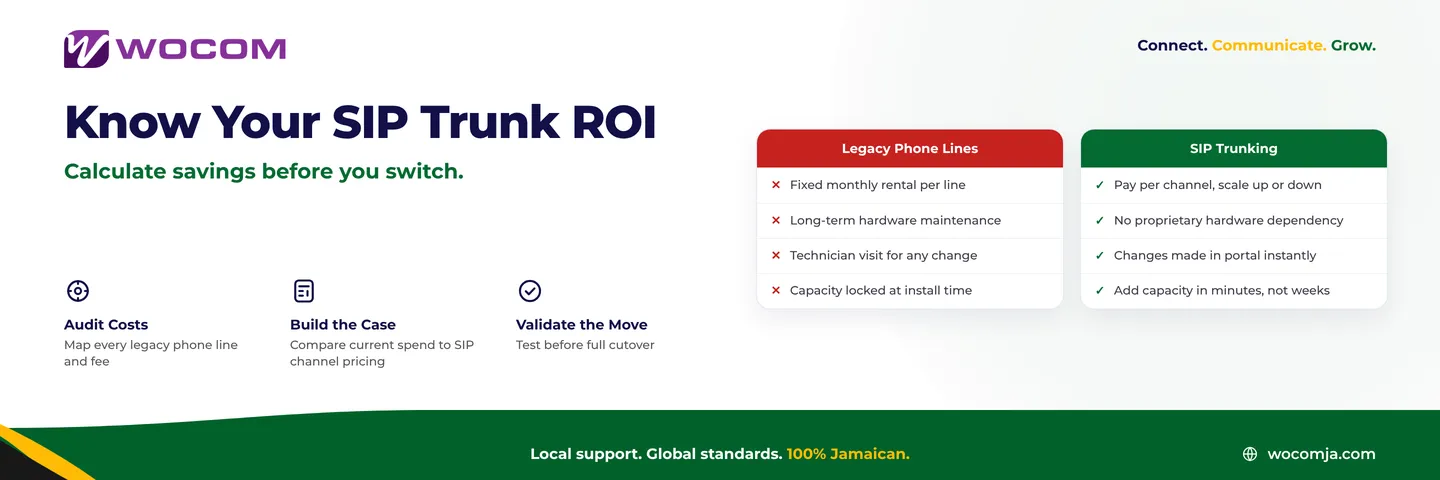
- Pull three months of call detail records (CDRs) from your current provider's admin panel or billing portal. Most platforms export these as a CSV file.
- Group calls by destination prefix. Separate US landline from US mobile, UK landline from UK mobile, and each Caribbean country. Total the minutes per group.
- Multiply minutes by the rate you currently pay for each destination. This shows your actual spend per corridor, not just your overall bill.
- Request a rate deck from a SIP provider and compare wholesale rates for your top five destinations by minutes.
The gap between your current per-minute cost and wholesale LCR rates is your saving opportunity. For businesses with significant international volume—importers, exporters, BPO operations, professional services firms with overseas clients—this exercise regularly surfaces substantial annual savings that have been quietly flowing to the incumbent carrier.
What to Demand From a Provider on Call Quality
The legitimate concern about LCR is that chasing the cheapest route degrades call quality. This risk is real on poorly built platforms. When evaluating a SIP trunk provider in Jamaica, ask three direct questions:
- How many upstream carriers do you use for US termination? A single carrier means no LCR benefit and no failover. Three or more is a reasonable baseline.
- What quality monitoring runs per route? MOS scoring, post-dial delay measurement, and answer-seizure ratio tracking are standard on mature platforms. If the answer is vague, that is your answer.
- How quickly do you pull a failing route? Automatic failover under 30 seconds prevents a bad carrier from affecting more than a handful of calls during an incident.
A provider that cannot answer these questions specifically does not have a mature LCR engine—they have marketing language around the concept.
How WOCOM's SIP Trunking Handles This for Jamaican Businesses
WOCOM operates as a licensed telephone provider in Jamaica, which means the company holds direct carrier relationships rather than reselling through intermediaries. Each layer of reseller adds margin that makes genuinely competitive LCR harder to deliver. Direct carrier agreements are the foundation of a platform where the routing engine is actually pulling from real wholesale rates—not from a single upstream partner's retail sheet.
For businesses using WOCOM SIP trunking, routing logic is applied automatically. You dial, the platform handles carrier selection, and quality monitoring runs continuously in the background. If your volume warrants a dedicated rate review for a specific high-use corridor, that conversation can happen at the account level rather than being locked into a published rate card.
Start With Your Bill, Not a Sales Call
The most useful first step is not a call to a provider—it is pulling your CDRs and knowing your numbers. Once you know your top destinations by minutes and your current per-minute rates, you can have an informed conversation about what a properly structured SIP trunk would cost instead.
If you want WOCOM to run that comparison for your specific calling pattern, reach out through wocomja.com. Bring your CDR export if you have it, or the team can help you identify what to pull from your current system. The comparison will show you exactly where your international call budget is going and where it does not need to.
Continue exploring
Ready to upgrade your communications?
Talk to our team about the right solution for your business.
Book a Demo Contact SalesEverett Kildare is WOCOM's voice and infrastructure specialist, with more than 25 years of experience designing and running carrier-grade voice, SIP and virtualization infrastructure. Holding a BSc in Information Technology, he has built, secured and migrated phone systems for businesses of every size. Everett writes WOCOM's technical coverage of SIP trunking, cloud PBX, contact centres, business continuity and migration.