How Business Calls Are Routed From One Location to Another
What Routing Actually Means
Routing is the set of rules that decides what happens between a caller dialling your number and a phone ringing somewhere. On a traditional system those rules were mostly physical — the number was wired to a phone, and that was the routing. On a cloud system they are entirely logical, which means they can be as simple or as sophisticated as your business needs.
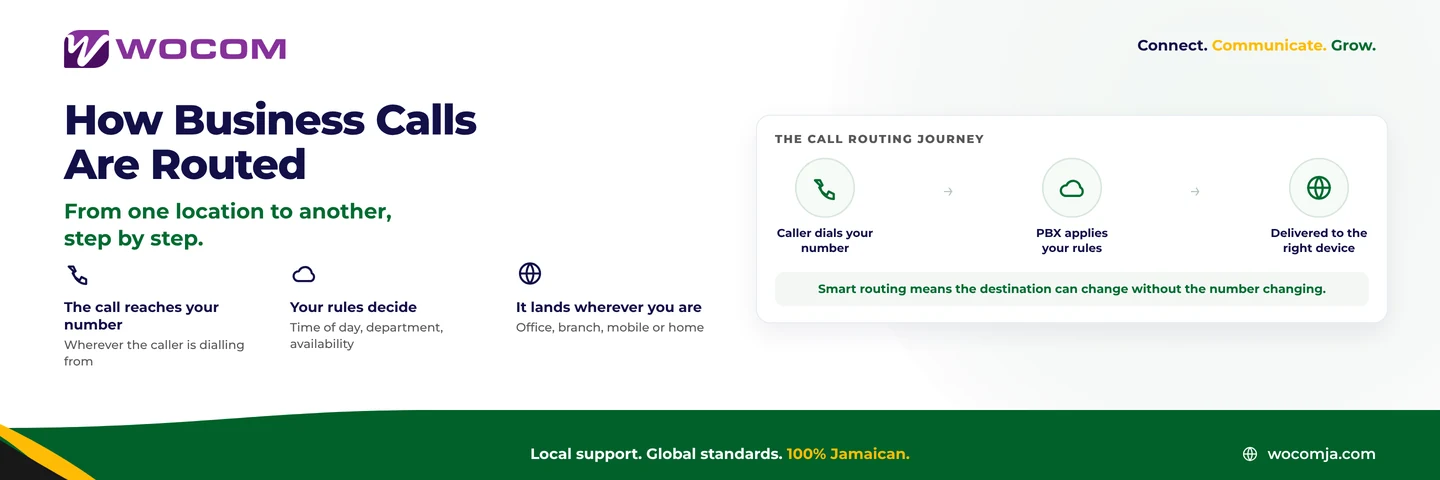
Here is the journey a call takes, and the decision points along it.
Step One: The Call Reaches Your Number
Someone dials your 876 number. The network delivers that call to whoever holds the number — your provider — and your provider passes it to your phone system over your SIP trunk.
At this point nothing has been decided except that the call is for you. The caller’s own location is irrelevant: a call from Mandeville, from Miami or from a mobile in the next building all arrive at the same place in the same way.
Step Two: Your System Applies the Rules
This is where all the interesting work happens, and the rules are applied in order.
Which number was dialled? If you run several numbers, the first decision is which one this call came in on. A call to your accounts number is treated differently from a call to your main number from the first instant. This is direct inward dialling.
What time is it? Business hours, after hours, lunch, a public holiday. Time-of-day rules are the highest-value routing most businesses are not using — and holidays are the case that catches people out, which is why they deserve their own configuration.
Who is available? The system knows which extensions are free, ringing, on a call or set to do-not-disturb. Routing to a phone that is engaged is a wasted leg.
What did the caller say or press? Either a menu selection, or — with an AI receptionist answering — what the caller actually asked for in their own words.
How should the group ring? Simultaneously, in sequence, or in rotation. Each produces a different experience for the caller and a different workload distribution for the team. The ring strategy guide covers the choice.
Step Three: The Call Is Delivered
The destination is whatever your rules selected: a desk phone in the office, a mobile app in the field, a softphone at home, a queue, another branch, a voicemail box, or the AI receptionist.
The important part is that the destination has nothing to do with geography. The call arrived as data; where it is delivered is a setting. A call to a Kingston number can ring a phone in Black River, and neither the caller nor the network knows or cares. This is the whole basis of phone systems for remote teams.
On a cloud system the number is fixed and the destination is a decision. On a traditional system it was the other way round, and that is the whole difference.
Routing Between Locations
For businesses with more than one site, a few patterns cover almost everything.
Local first, head office as backstop. A call to the Montego Bay number rings Montego Bay for fifteen seconds, then overflows to Kingston rather than going to voicemail. The customer is answered by somebody, and the data shows you how often the backstop is being used.
Follow the sun, or follow the roster. Different destination by time of day, so a single number is covered by whichever site is staffed.
Skills before location. For a technical query, the right person matters more than the right building — see skills-based routing.
Internal calls stay internal. Between sites on the same system, staff dial extensions. The call never touches the public network and costs nothing, however far apart the two offices are.
Where Routing Usually Goes Wrong
- Legs that ring too long. Twenty-five seconds on an empty desk before rolling over is a missed call with extra steps. Twelve to fifteen seconds per leg is plenty.
- No final destination. Every route must end somewhere definite — a queue, a voicemail box, an AI receptionist. A route that ends in ringing is a route that ends in a lost customer.
- Holiday rules nobody updated. The single most common Monday-morning complaint after a public holiday.
- Menus written for the org chart. Customers do not know which department owns their problem. Route on what they want, not on how you are organised.
- Rules nobody has read in two years. Businesses change shape; routing rules do not change themselves.
Reviewing Your Own Routing
Two questions answer most of it. First, call your own main number from a mobile, at 9am and again at 7pm, and see what happens — most owners are surprised at least once. Second, look at your reports for calls that rang for more than twenty seconds without being answered, because each of those is a rule not doing its job.
WOCOM will map your call flow and rebuild the rules with you — it is part of the service, not a chargeable project. Call 876-906-7240 in Jamaica or 877-906-7240 from the US, email support@wocomja.com, or use the contact page.
Continue exploring
Ready to upgrade your communications?
Talk to our team about the right solution for your business.
Book a Demo Contact SalesEverett Kildare is WOCOM's voice and infrastructure specialist, with more than 25 years of experience designing and running carrier-grade voice, SIP and virtualization infrastructure. Holding a BSc in Information Technology, he has built, secured and migrated phone systems for businesses of every size. Everett writes WOCOM's technical coverage of SIP trunking, cloud PBX, contact centres, business continuity and migration.